

TL;DR:
- Traditional project estimates often lead to significant overruns due to optimism bias and vague scope.
- Man-hour estimation provides a detailed, task-level approach that improves accuracy and stakeholder transparency.
- Regular review and collaboration are essential for reliable estimates and effective project management.
Ballpark guesses have long been the default approach for software and app project planning, and the results speak for themselves in the worst possible way. 80% of software projects exceed their initial estimates by 50% or more, creating budget overruns, missed deadlines, and fractured stakeholder trust. Man-hour estimation offers a structured, task-level alternative that replaces gut-feel with verifiable, defensible numbers. This article breaks down why traditional estimates fail, how man-hour estimation works, and how product managers and development teams can apply it to achieve far more predictable outcomes on web and mobile app projects.
Table of Contents
- Why project estimates fail: The root causes
- What is man-hour estimation? Core concepts explained
- Why use man-hour estimates? Benefits for project accuracy
- How to use man-hour estimates effectively in your projects
- The real reason man-hour estimates matter
- Start estimating smarter with the right tools
- Frequently asked questions
Key Takeaways
| Point | Details |
|---|---|
| Estimation still fails often | Most software projects run over time and budget due to poor estimation methods. |
| Man-hour estimates add accuracy | Breaking work into specific man-hours can make projects 10% more accurate than top-down guesses. |
| Industry methods reinforce value | Leading frameworks like PERT and COCOMO rely on man-hour estimates to manage uncertainty. |
| Practical steps work | Applying man-hour estimates with team input and regular reviews leads to better project outcomes. |
Why project estimates fail: The root causes
Project estimation failures are not random. They follow predictable patterns rooted in process gaps and cognitive shortcuts that most teams repeat from one project to the next. Understanding those patterns is the first step toward eliminating them.
The most cited reason is optimism bias: the tendency for teams to assume best-case scenarios when assigning time to tasks. A developer estimates a feature will take three days because that is how long it took under ideal conditions, ignoring integration complexity, code review cycles, and dependencies. This single bias, multiplied across dozens of tasks, inflates timelines significantly before the project even starts.
Top-down estimation compounds the problem. A project manager or executive assigns a total budget or deadline based on similar past projects or strategic constraints, then expects the team to reverse-engineer a plan that fits. This approach inverts the process: instead of estimating based on actual work, teams negotiate numbers to match a predetermined answer.
Undefined scope is another major culprit. When requirements are vague or incomplete, common pitfalls in project estimates emerge almost immediately. Teams estimate what they understand, leave gaps for what they do not, and discover the missing pieces mid-delivery. Scope creep follows, and estimates that were once close become irrelevant.
Communication gaps between stakeholders, designers, and engineers further degrade accuracy. A product manager describes a feature in business terms; a developer interprets it differently. Without a shared, granular breakdown of tasks, those misalignments go undetected until they surface as delays.
The downstream impact is significant:
- Budget overruns that erode margins and damage client relationships
- Delayed launches that reduce competitive advantage
- Team burnout from sustained pressure to deliver under unrealistic timelines
- Stakeholder frustration that undermines future project approvals
"An estimate without a structured breakdown is not a forecast. It is a wish."
Addressing software estimation mistakes at the process level, rather than treating each overrun as a one-off failure, is what separates teams that deliver predictably from those that consistently scramble. Man-hour estimation provides that process-level fix.
What is man-hour estimation? Core concepts explained
Man-hour estimation is a bottom-up approach to calculating how long a project will take by breaking work into discrete tasks and assigning a specific number of labor hours to each. The total project estimate emerges from the sum of those task-level hours, adjusted for team size, parallel workstreams, and risk buffers.
The mechanics are straightforward. A project is decomposed into a work breakdown structure (WBS), where each component, from backend API development to UI design and QA testing, is listed as a separate line item. Each task receives an hour estimate from the person best qualified to assess it. Those estimates aggregate into a project total.
Here is a simplified example for a mobile app project:
| Task | Assigned role | Estimated hours |
|---|---|---|
| UI/UX design (5 screens) | Designer | 40 |
| Backend API setup | Senior developer | 60 |
| User authentication module | Developer | 24 |
| Push notifications integration | Developer | 16 |
| QA and testing | QA engineer | 32 |
| Project management | PM | 20 |
| Total | 192 hours |
This level of granularity gives you a defensible, reviewable estimate rather than a single number with no supporting logic.
Man-hour estimation is also the foundation for several established effort estimation for app projects methodologies. PERT (Program Evaluation and Review Technique) uses three-point man-hour estimates: optimistic, most likely, and pessimistic, to calculate a weighted average. COCOMO (Constructive Cost Model) derives effort in person-months from software sizing explained metrics. Function point analysis maps functional requirements to effort hours based on historical productivity data. All three are used in methodologies like PERT, COCOMO, and function point analysis.
Contrast this with story points in Agile, which measure relative complexity rather than calendar time, or with analogy-based estimation, which infers effort from past projects without task-level decomposition. Both have their place, but neither provides the granular cost visibility that product managers and budget owners need when committing to a fixed scope or timeline.
Pro Tip: Always involve the person who will actually do the work when assigning man-hour estimates to a task. Estimates created in isolation by project managers consistently run lower than reality because they omit execution-level complexity that only practitioners can see.
Why use man-hour estimates? Benefits for project accuracy
Man-hour estimation's core advantage is precision derived from specificity. When every task has an assigned hour count, project managers can identify which workstreams carry the most risk, where bottlenecks will occur, and how budget will be consumed across phases.

Budget clarity is perhaps the most immediate benefit. Multiplying task hours by hourly rates produces a cost estimate at the task level, not just the project level. This lets stakeholders see exactly what they are paying for and where trade-offs can be made if budgets tighten.
Scheduling accuracy follows naturally. With hours assigned per task, you can sequence work realistically, account for dependencies, and generate timelines grounded in actual workload rather than optimistic assumptions.
The statistical case is compelling: bottom-up man-hour estimation is 10% more accurate than top-down methods. That differential compounds significantly on larger projects.
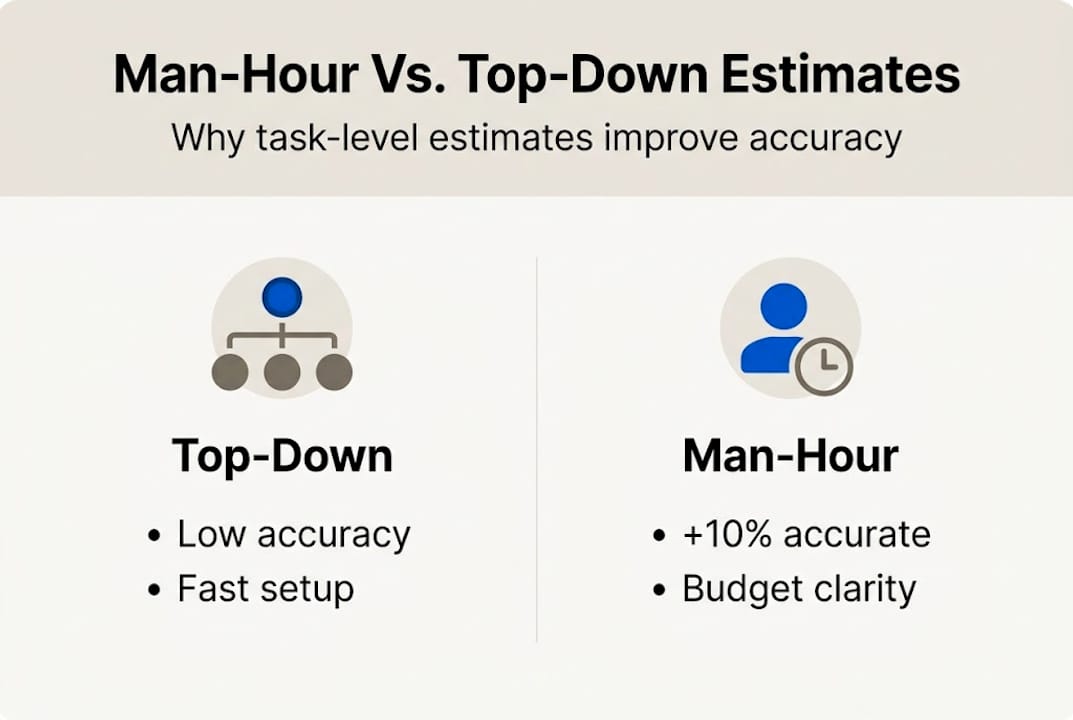
| Estimation method | Accuracy level | Budget visibility | Stakeholder transparency |
|---|---|---|---|
| Top-down | Low | Limited | Low |
| Analogy-based | Medium | Moderate | Moderate |
| Story points (Agile) | Medium | Limited | Moderate |
| Man-hour (bottom-up) | High | Granular | High |
Beyond accuracy, man-hour estimates support team estimation practices that build cross-functional alignment. When developers, designers, and QA engineers contribute their own estimates, they take ownership of those numbers. That ownership translates into accountability during execution.
For handling uncertainty, multi-point man-hour methods shine. PERT-based three-point estimation produces a probability-weighted forecast that accounts for best and worst cases, giving stakeholders a range rather than a single point that may prove unrealistic. Linking these forecasts to a development cost calculator allows teams to model scenarios quickly.
Key benefits at a glance:
- Granular cost breakdowns by task, phase, and role
- Clear identification of high-risk, high-effort workstreams
- Improved team accountability through participatory estimation
- Stronger stakeholder trust when budgets are traceable to specific deliverables
- Flexibility to reforecast quickly when scope or requirements shift
How to use man-hour estimates effectively in your projects
Applying man-hour estimation well requires more than creating a spreadsheet with hours. The process needs to be structured, collaborative, and iterative to deliver reliable results.
Follow these steps to build accurate man-hour estimates for your next project:
- Define scope before estimating. Incomplete requirements produce incomplete estimates. Before assigning a single hour, ensure the feature list, acceptance criteria, and technical constraints are documented and agreed upon.
- Build a work breakdown structure. Decompose the project into the smallest independently estimable tasks. The more granular the WBS, the more accurate the aggregate estimate.
- Involve the execution team. Assign hours with input from the developers, designers, and testers who will do the work. Estimation workshops are a proven technique for facilitating this collaboratively.
- Apply risk buffers by task category. High-certainty tasks (standard UI components, known integrations) warrant smaller buffers. Novel or externally dependent tasks warrant 20 to 30% contingency.
- Validate against historical data. If your team has completed similar projects, compare task estimates against actuals. Historical benchmarks are the most reliable calibration tool available.
- Review and revise regularly. Reviewing project estimates at sprint or phase boundaries allows you to incorporate new information before it becomes a surprise.
Pro Tip: Avoid freezing estimates after project kickoff. Treat your man-hour estimates as a living document updated at defined checkpoints. A 15-minute estimate review at the start of each sprint costs almost nothing and can prevent multi-day schedule slippage.
Common mistakes that undermine man-hour accuracy include treating the initial estimate as final, failing to account for scope changes mid-project, and excluding non-development tasks like code review, deployment, and stakeholder communication from the WBS. All three inflate actuals above estimates and erode credibility with clients and executives.
Bottom-up man-hour methods remain 10% more accurate than top-down, but only when the process is disciplined. Methodology alone does not guarantee accuracy. Execution of the process does.
The real reason man-hour estimates matter
Most teams frame estimation as a necessary administrative burden: something done to satisfy a client contract or a project management tool. That framing explains why estimates are often rushed, delegated to one person, and forgotten after kickoff.
The more accurate framing is that estimation is a communication and learning exercise. When a team works through a detailed WBS together, they surface assumptions, expose knowledge gaps, and align on what the project actually requires. That conversation is more valuable than the spreadsheet it produces.
Man-hour estimates also create adaptability. When scope changes mid-project (and it will), a task-level estimate gives you a clear baseline to re-forecast from. Without it, scope changes become arguments. With it, they become calculations. Teams with granular estimates can absorb change without losing control of budget or timeline because they know exactly what was planned and what has shifted.
This perspective on accurate app budgets reframes estimation not as a constraint but as the foundation for informed decision-making throughout the project lifecycle.
Start estimating smarter with the right tools
Understanding man-hour estimation at a conceptual level is one thing. Applying it to a real project with multiple roles, phases, and cost variables is another challenge entirely. The good news is that structured tools make the process significantly faster and more reliable.
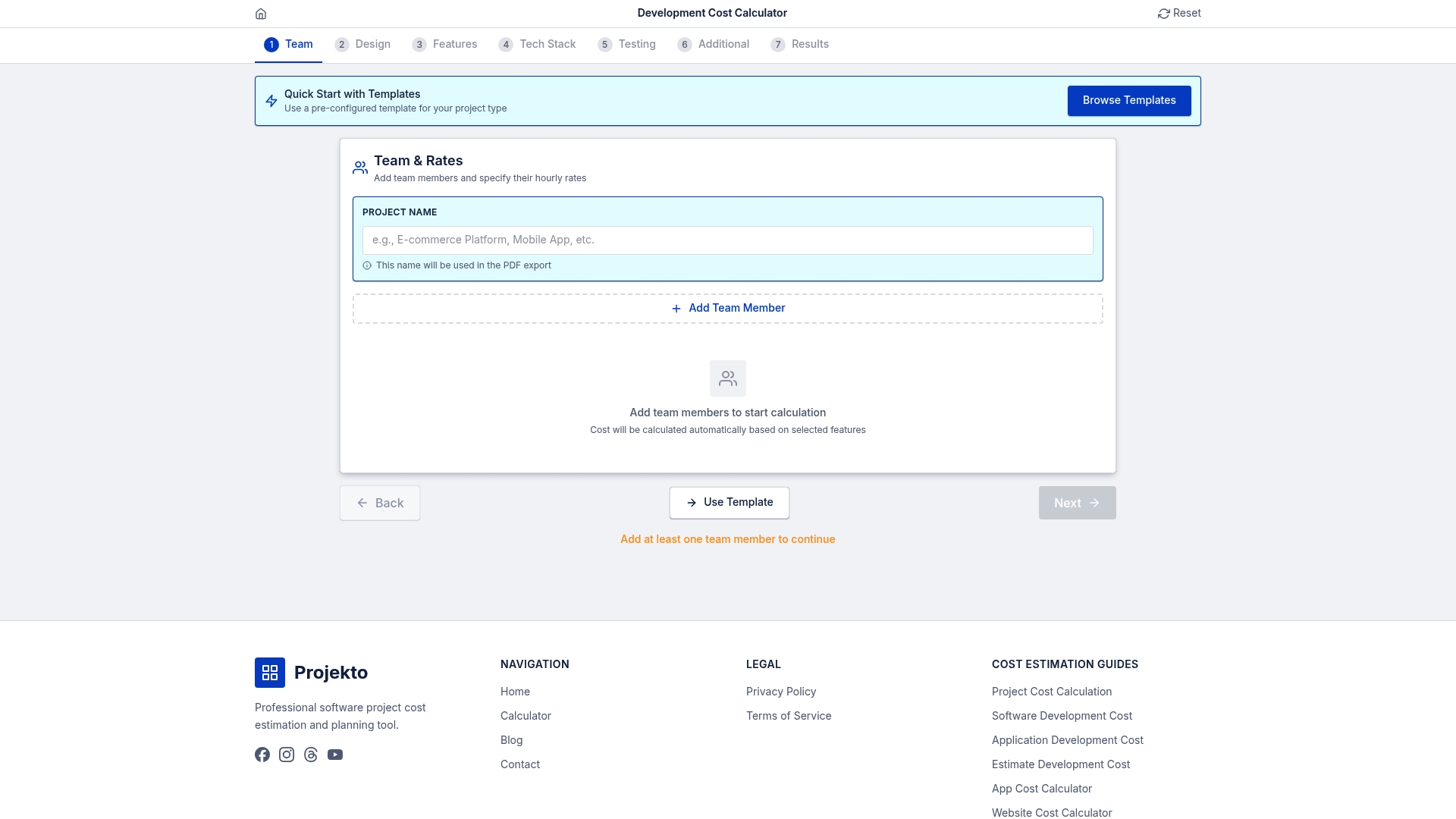
Projeto's development cost calculator lets you input project scope, team composition, and task breakdown to generate accurate time and budget estimates in minutes. Rather than building man-hour models from scratch in a spreadsheet, you get a purpose-built environment that handles the aggregation, risk-buffering, and cost modeling for you. If you are ready to move from guesswork to structured forecasting, explore how to estimate software development cost with a tool built specifically for web and mobile app projects.
Frequently asked questions
How do man-hour estimates compare to story points in Agile?
Man-hour estimates deliver time-based cost accuracy, while story points measure relative complexity. Agile story points become accurate within 20% after approximately three sprints, making man-hours the stronger choice when fixed-cost or fixed-timeline commitments are required upfront.
What makes man-hour estimation more accurate than top-down estimation?
Task-level decomposition eliminates the single-point guessing that makes top-down methods unreliable. Bottom-up estimation is 10% more accurate than top-down by grounding each number in specific, reviewable work.
Can man-hour estimates handle project uncertainty?
Yes. Methods like PERT and parametric models use optimistic, most likely, and pessimistic hour inputs to generate probability-weighted forecasts, giving stakeholders a realistic range rather than a single fragile number.
What is a common mistake to avoid with man-hour estimates?
Treating the initial estimate as permanent is the most common failure. Estimates that are not reviewed and updated at defined project checkpoints quickly diverge from reality, making them useless for budget management and delivery forecasting.