

TL;DR:
- Team estimation is a collaborative approach using story points to improve accuracy and shared understanding.
- It significantly enhances projection reliability through velocity tracking and consensus techniques like Planning Poker.
- Using structured methods and avoiding common pitfalls leads to more predictable project timelines and budgets.
Most web and mobile app projects start with a simple question: how long will this take, and what will it cost? The answer, unfortunately, is rarely simple. Traditional estimation methods rely on a single developer or manager making educated guesses, which routinely leads to missed deadlines, scope creep, and budget overruns. Team estimation offers a structured, consensus-driven alternative that distributes knowledge across the entire project team. This article covers what team estimation is, how it improves accuracy, which techniques work best, and how to avoid the pitfalls that undermine even experienced teams.
Table of Contents
- What is team estimation?
- How does team estimation improve project accuracy?
- Popular team estimation techniques explained
- Expert tips and pitfalls: Getting the most from team estimation
- A fresh perspective: Why team estimation beats old-school guessing
- Take your estimation further with smart tools
- Frequently asked questions
Key Takeaways
| Point | Details |
|---|---|
| Team estimation builds accuracy | Collaborative methods consistently improve project planning and reduce risk. |
| Velocity drives predictability | Tracking average story points completed over sprints allows teams to forecast delivery dates more reliably. |
| Frameworks matter | Choosing the right estimation technique—like Planning Poker or Wideband Delphi—can boost engagement and outcomes. |
| Calibration prevents surprises | Regular comparison of estimates versus actuals helps teams refine their process and avoid costly overruns. |
What is team estimation?
Team estimation is a collaborative process where all key project roles, including developers, QA engineers, designers, and sometimes the Product Owner as an observer, contribute to sizing project tasks. Rather than relying on a single expert opinion, the team uses structured frameworks to reach a shared understanding of effort and complexity.
The most important concept in team estimation is the story point. Story points measure relative effort, not hours or days. A task worth 8 story points is roughly twice as complex as a task worth 4 points, but neither number maps directly to a calendar duration. This abstraction is intentional. It forces teams to think about effort, risk, and unknowns rather than clock time.
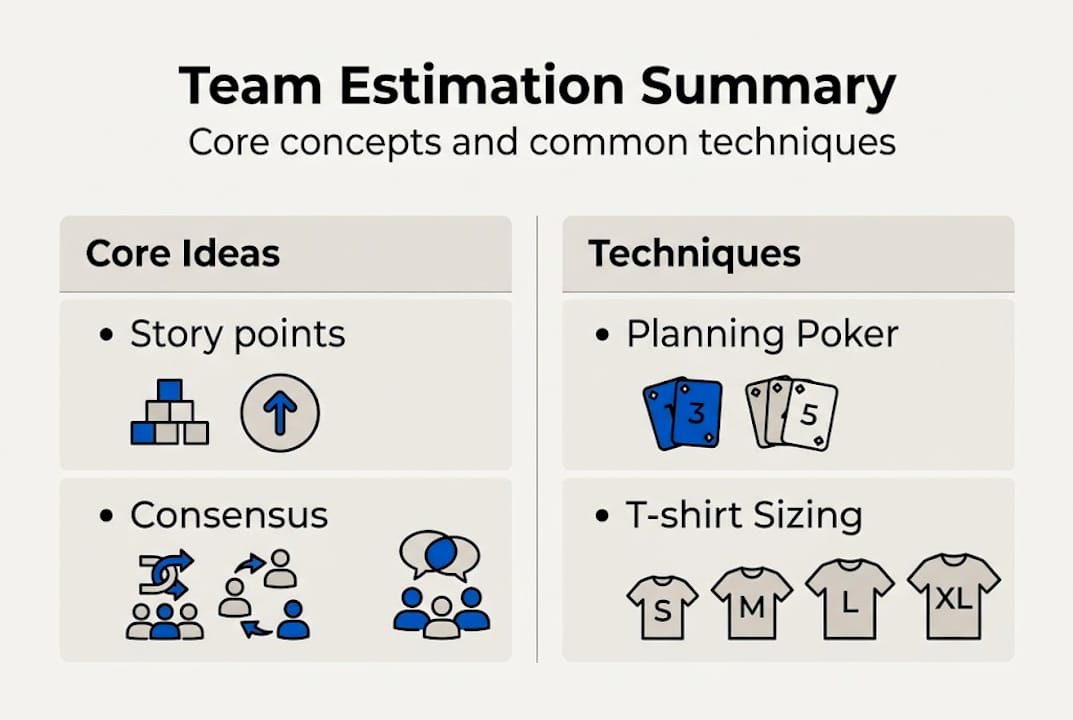
The whole team participates in estimation using story points during backlog refinement or sprint planning sessions. This participation is what separates team estimation from individual guesswork.
Key advantages over individual estimation include:
- Broader risk identification: A QA engineer may spot testing complexity that a developer overlooks.
- Reduced anchoring bias: When everyone votes simultaneously, no single voice dominates the initial estimate.
- Shared ownership: When the team estimates together, they commit together, which improves accountability.
- Faster calibration: Disagreements during estimation surface misunderstandings before work begins, not during it.
Common frameworks used in team estimation include Planning Poker, Wideband Delphi, the Bucket System, and T-shirt sizing. Each uses a different mechanism to reach estimation consensus, but all share the same goal: replace individual guessing with collective judgment.
"The goal of team estimation is not a perfect number. It is a shared understanding of what the work actually involves."
Pro Tip: Invite your Product Owner to estimation sessions as an observer, not a voter. Their presence helps clarify requirements on the spot without skewing the team's independent judgment.
How does team estimation improve project accuracy?
Team estimation improves accuracy by replacing isolated guesses with calibrated, data-informed consensus. The mechanism that makes this work over time is velocity, which is the average number of story points a team completes per sprint.

Velocity is not a target. It is a measurement. Teams track their velocity across three to five sprints and use the rolling average to forecast how much work they can realistically complete in future sprints. This approach grounds planning in actual performance rather than optimistic assumptions.
Sprint commitment accuracy reaches 85-95% with consistent team velocity, and consensus methods improve estimation accuracy by 35-50% compared to individual estimation. Those numbers matter significantly when you are managing a fixed budget or a contractual deadline.
Here is how accuracy improves through the estimation cycle:
- Baseline sprint: The team estimates and completes a sprint, recording actual story points delivered.
- Velocity calculation: Average points per sprint are calculated over three to five sprints.
- Forecast adjustment: Future sprint plans are adjusted based on real velocity, not assumptions.
- Retrospective calibration: Estimates are compared to actuals, and the team recalibrates sizing for similar tasks.
- Ongoing refinement: Accuracy compounds over time as the team's shared understanding of complexity deepens.
Running structured estimation workshops at the start of a project helps establish a reliable baseline faster. These sessions align the team on complexity before a single line of code is written.
| Estimation approach | Accuracy range | Time to calibrate |
|---|---|---|
| Individual expert estimate | 40-60% | Varies widely |
| Team consensus (no velocity) | 60-75% | 2-3 sprints |
| Team consensus with velocity | 85-95% | 3-5 sprints |
Understanding estimating team size alongside task complexity also helps teams set realistic sprint capacities, since a team of five delivers differently than a team of eight even with identical velocity per person.
Popular team estimation techniques explained
With the value of team estimation established, let's break down the most popular techniques teams use today.
Planning Poker is the most widely adopted method. Each team member holds a set of cards with values based on the Fibonacci sequence (1, 2, 3, 5, 8, 13, 21). Everyone reveals their card simultaneously after a brief discussion. When estimates diverge, the team discusses the reasoning and votes again until consensus is reached. Planning Poker is more engaging while Wideband Delphi and the Bucket System provide comparable accuracy for larger backlogs.
Wideband Delphi uses anonymous written estimates followed by structured discussion rounds. It reduces social pressure and is particularly effective for distributed teams or situations where senior voices tend to dominate.
The Bucket System is designed for speed. Tasks are sorted into predefined effort buckets (similar to T-shirt sizes) rather than voted on individually. It works well when a team needs to estimate a large backlog quickly, such as during initial project scoping.
T-shirt sizing (XS, S, M, L, XL) provides a fast, low-friction way to categorize features by relative effort. It is often used in early discovery phases before the team moves to numerical story points for sprint planning.
Here is a comparison of the four main techniques:
| Technique | Best for | Engagement level | Accuracy |
|---|---|---|---|
| Planning Poker | Sprint planning | High | High |
| Wideband Delphi | Distributed teams | Medium | High |
| Bucket System | Large backlogs | Medium | Medium-High |
| T-shirt sizing | Early scoping | Low-Medium | Medium |
Key considerations when choosing a technique:
- Use Planning Poker for regular sprint ceremonies where engagement matters.
- Use the Bucket System when you have 50+ backlog items to size in a single session.
- Use T-shirt sizing during sales or discovery phases before committing to a detailed backlog.
- Consider using effort estimation frameworks that align with your team's existing agile methodology practices.
Pro Tip: Rotate the facilitator role across team members during Planning Poker sessions. This prevents one person from unconsciously steering the discussion and keeps estimates independent.
Expert tips and pitfalls: Getting the most from team estimation
Understanding frameworks is just the start. The real value of team estimation comes from consistent calibration and avoiding the common traps that erode accuracy over time.
Calibration is the core discipline. Track estimation vs. actuals, timebox discussions, split large stories, avoid converting points to hours, and use ML for early estimates. Without this feedback loop, story points drift in meaning and velocity becomes unreliable.
Key expert practices to follow:
- Use baseline stories: Keep two or three well-understood reference stories in your backlog. When estimating new tasks, compare them to these baselines rather than estimating in isolation.
- Timebox every discussion: Set a two to three minute limit per story during estimation. Longer debates rarely improve accuracy and drain team energy.
- Split stories that exceed 13 points: Large stories carry hidden complexity. Break them into smaller, independently estimable pieces before the sprint begins.
- Never convert story points to hours: This destroys the relative nature of story points and creates false precision. Stakeholders who demand hour-based estimates need a conversation about velocity and delivery forecasting instead.
- Avoid comparing velocity across teams: A team with an average velocity of 40 points per sprint is not necessarily faster than one averaging 20. Story point scales are team-specific.
ML emerging for initial estimates yields 4-32% better accuracy in early project phases, particularly for feature sizing before a team has established its own velocity baseline.
Combining story points with cycle time and DORA metrics (deployment frequency, lead time for changes, change failure rate, and time to restore service) gives project managers a fuller picture of team performance beyond estimation alone.
"The teams that improve fastest are not the ones with the best initial estimates. They are the ones that review their estimates honestly and adjust."
Avoiding software estimation mistakes early in a project is significantly easier than correcting them mid-sprint. Build a habit of reviewing project estimations at the end of every sprint, not just at project retrospectives.
Pro Tip: Schedule a 15-minute estimation review at the end of each sprint. Compare what you estimated to what you delivered, and flag any stories where the gap exceeded 50%. Those gaps are your best learning opportunities.
A fresh perspective: Why team estimation beats old-school guessing
Most project managers have experienced the same cycle: a senior developer estimates a feature in two days, the team builds it in six, and everyone scrambles to explain the gap. The root problem is not incompetence. It is that individual estimation ignores the distributed nature of software knowledge.
No single person on a team holds complete context for every task. A backend developer does not fully see the frontend complexity. A designer does not anticipate the API integration challenges. Team estimation is not just a process improvement. It is an acknowledgment that software projects are genuinely collaborative and that estimates should reflect that reality.
The common misconception is that story points are a softer version of hours. They are not. They are a fundamentally different unit of measurement, one that improves with team experience rather than degrading under pressure. Teams that understand why estimation fails recognize that the failure is almost always in the method, not the people. Switching to team-based, consensus-driven estimation does not eliminate uncertainty. It manages it honestly, which is the most any planning process can realistically do.
Take your estimation further with smart tools
Team estimation gives you the methodology. Smart tools give you the speed and structure to apply it at scale. For project managers and business stakeholders who need concrete budget and timeline figures alongside their agile planning, digital calculators bridge the gap between story point forecasts and real-world financial planning.
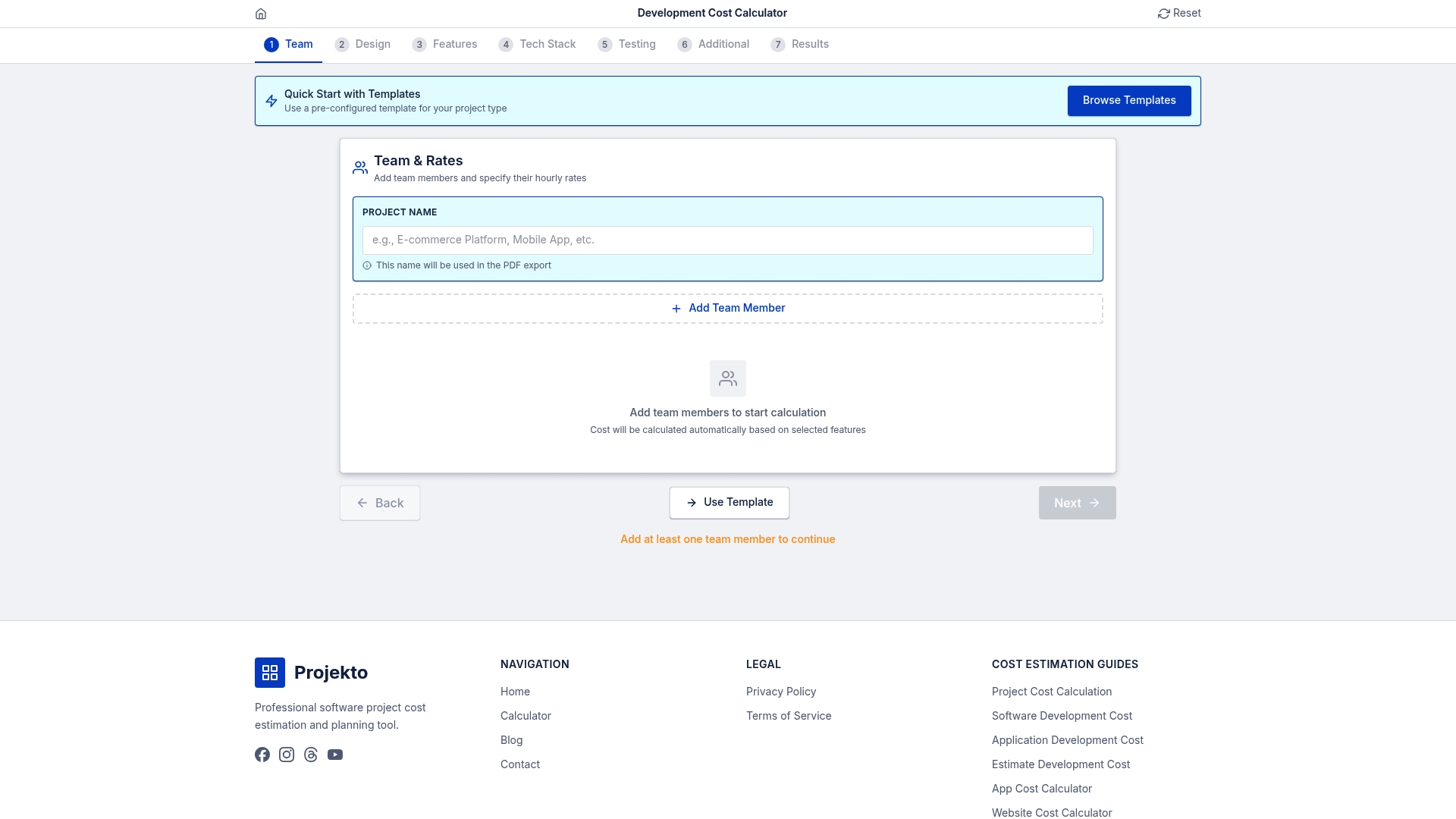
Our project cost calculator translates your feature requirements into time and budget estimates instantly, giving your team a reliable starting point before sprint planning begins. Whether you are scoping a specialized platform like an event management app or a regulated product like a healthcare app, you can generate structured cost breakdowns that align with your team's estimation process and stakeholder expectations.
Frequently asked questions
What's the difference between story points and hours?
Story points measure relative effort, not direct hours or days, making them more effective for varied tasks where complexity and risk differ significantly across the team.
How does team velocity affect project delivery?
Tracking team velocity helps forecast delivery dates and increases sprint commitment accuracy to 85-95%, making planning more predictable and reducing last-minute scope adjustments.
What is Planning Poker, and why is it popular?
Planning Poker is an engaging consensus method where team members estimate effort by discussing and voting simultaneously, which helps uncover hidden risks and misaligned assumptions early.
Can machine learning improve estimation accuracy?
Yes, ML models yield 4-32% better accuracy in early project phases, particularly useful before a team has established a reliable velocity baseline.
Should teams convert story points to hours?
Avoid converting points to hours; story points are designed for relative estimation, and converting them to absolute time undermines their core value and accuracy.
Recommended
- Estimation consensus: align your team for accurate planning
- Accurate project estimation: workshops that build trust
- Understanding project estimators: key to accurate app budgets
- Why estimation fails: common pitfalls in software projects
- Cost Estimation Explained: Building With Confidence
- Efficient Project Management Processes Explained