

TL;DR:
- Organizations waste $122 million per billion dollars on poor effort estimation leading to budget and schedule overruns. Effective estimation improves resource planning, budgeting, scheduling, and risk management, reducing project failures. Combining various estimation techniques with experienced judgment and contingency buffers enhances accuracy in software and app development projects.
Organizations waste $122M per $1B invested in software projects due to poor effort estimation. That figure is not a rounding error. It represents blown budgets, missed deadlines, and products that never reach users. For business owners and project managers overseeing web or mobile app development, effort estimation is the difference between a project that delivers value and one that quietly drains resources. This guide explains what effort estimation is, why it matters, which techniques work best in different contexts, and how to apply it practically so your next project stays on track.
Table of Contents
- Why effort estimation matters in web and app projects
- Core benefits of effective effort estimation
- Popular effort estimation techniques for software projects
- Practical tips and edge cases for realistic estimations
- The uncomfortable truth about effort estimation: experience matters more than formulas
- Easily estimate your next project with EstimateCalc
- Frequently asked questions
Key Takeaways
| Point | Details |
|---|---|
| Estimation prevents failures | Accurate effort estimates reduce the risk of cost overruns, missed deadlines, and project collapse. |
| Techniques must fit the context | Choose estimation methods based on team needs, project size, and process (Agile vs Waterfall). |
| Don't skip buffers | Always add a contingency reserve for edge cases and hidden work. |
| Experience drives accuracy | Seasoned judgment and team calibration are as crucial as estimation formulas. |
Why effort estimation matters in web and app projects
Effort estimation is the process of calculating how much work, measured in time and human resources, a software project will require from start to finish. It sounds straightforward. In practice, it is one of the most difficult and consequential activities in project management.
The numbers tell a sobering story. Only 31% of software projects are completed on time, within budget, and to scope. Fifty percent are considered challenged, meaning they finish late, over budget, or with reduced functionality. Nineteen percent fail outright. Poor estimation is consistently cited as a primary driver of these outcomes.
When estimates are off, the consequences cascade quickly:
- Budget overruns force teams to cut features or request emergency funding
- Timeline slippage delays product launches and erodes competitive advantage
- Scope creep expands unchecked when no baseline effort was defined
- Team burnout follows when developers are asked to absorb unplanned work
- Stakeholder trust erodes when delivery dates are missed repeatedly
For app development specifically, underestimating effort is especially common because teams focus on core features and overlook integration complexity, third-party API dependencies, and platform-specific requirements. A native iOS build, for example, requires different effort than a cross-platform React Native build, and conflating the two at the estimation stage creates problems that compound throughout the project lifecycle.
"Accurate effort estimation is not about predicting the future perfectly. It is about reducing uncertainty enough to make confident decisions about scope, staffing, and schedule."
Understanding common estimation pitfalls before starting a project gives teams a structural advantage. Teams that invest time upfront in rigorous estimation consistently report fewer surprises, better resource utilization, and stronger ROI. Those that skip it often find themselves trying to avoid estimation mistakes reactively, which is far more costly.
Core benefits of effective effort estimation
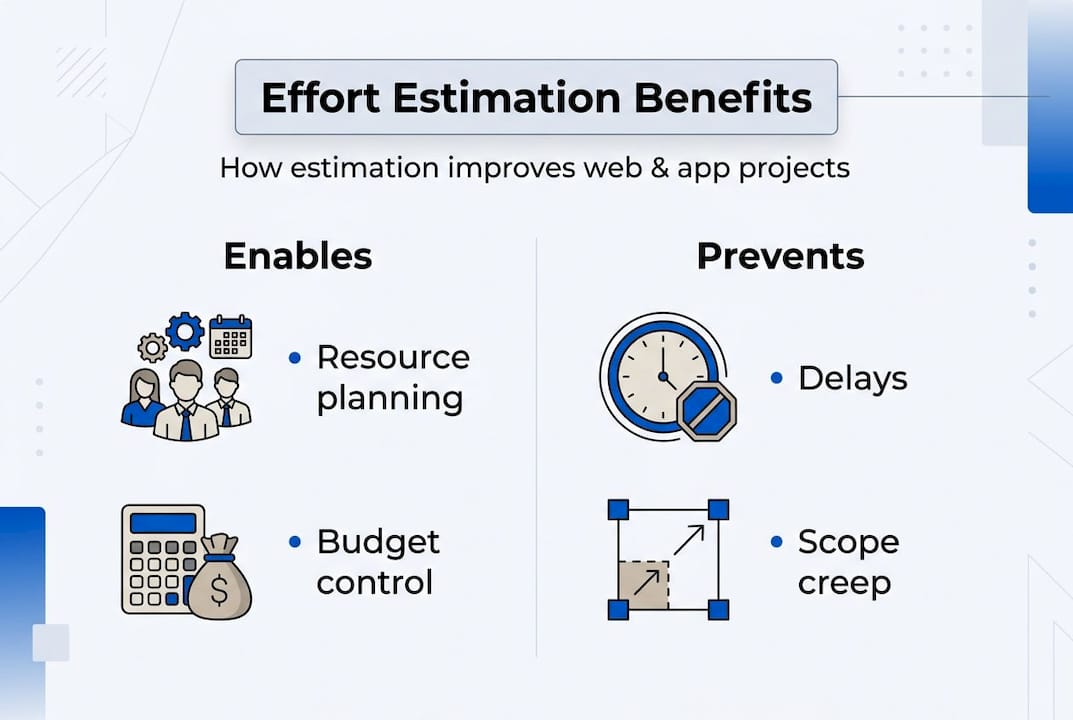
When effort estimation is done well, it delivers four measurable benefits that directly affect project outcomes: resource planning, budget development, schedule creation, and risk management. Each one compounds the others.
| Benefit | What it enables | Impact without it |
|---|---|---|
| Resource planning | Assign the right developers to the right tasks | Bottlenecks, idle time, skill mismatches |
| Budget development | Set realistic cost ceilings and contingencies | Cost overruns, funding gaps |
| Schedule creation | Define achievable milestones and release dates | Missed deadlines, stakeholder friction |
| Risk management | Spot gaps before they become blockers | Late-stage surprises, scope explosions |
Resource planning is where estimation has the most immediate operational impact. Knowing that a feature requires 80 hours of backend development and 40 hours of frontend work lets you assign the right people at the right time. Without that data, you are guessing, and guessing leads to bottlenecks.

Budget development depends entirely on effort estimates. Labor is typically the largest cost in software projects, so an inaccurate effort figure produces an inaccurate budget. Understanding estimation scope before finalizing a budget prevents the painful conversations that happen when a project runs 30% over cost.
Schedule creation becomes realistic only when effort is quantified. A team that knows a sprint requires 200 person-hours can plan accordingly. A team working from intuition will routinely overpromise.
Risk management is the least visible benefit but arguably the most valuable. Effort estimation forces teams to examine every component of a project, which surfaces dependencies, unknowns, and potential blockers early. Building consensus in estimation across stakeholders also aligns expectations before commitments are made.
Pro Tip: Run a pre-estimation workshop with your development team before finalizing any project scope. Surfacing unknowns early reduces the likelihood of mid-project surprises by a significant margin.
Popular effort estimation techniques for software projects
No single estimation method works for every project. The right technique depends on how much information you have, how complex the project is, and whether your team follows a waterfall or Agile workflow. Common methodologies include analogous estimating, parametric models, bottom-up estimating, three-point estimating, story points, and planning poker.
Here is how the main approaches compare:
| Technique | Best for | Key limitation |
|---|---|---|
| Analogous estimating | Early-stage scoping with limited detail | Relies on comparable past projects |
| Parametric (COCOMO, function points) | Large, well-defined projects | Requires detailed historical data |
| Bottom-up estimating | Detailed, late-stage planning | Time-intensive to produce |
| Three-point estimating | Projects with high uncertainty | Requires experienced estimators |
| Story points and planning poker | Agile sprints and iterative builds | Less useful for fixed-price contracts |
- Analogous estimating uses data from similar past projects to set a baseline. It is fast and useful in early conversations with clients, but it breaks down when the current project has meaningfully different complexity.
- Parametric models like COCOMO use mathematical formulas and historical data to calculate effort. They are rigorous but require clean historical inputs that many teams do not maintain.
- Bottom-up estimating breaks the project into individual tasks and estimates each one separately before rolling up totals. It is the most accurate method but also the most time-consuming.
- Three-point estimating calculates a weighted average of optimistic, pessimistic, and most-likely scenarios. It is particularly useful for novel features where uncertainty is high.
- Story points and planning poker are Agile-native tools that prioritize relative sizing and team consensus over precise hour counts. They work well in iterative environments.
It is worth noting that estimation in Agile remains challenging despite the availability of these techniques. Replication studies question whether any method has truly solved the estimation problem. Understanding project estimator techniques in depth, comparing estimation tools across platforms, and estimating team size accurately all contribute to better outcomes.
Pro Tip: Combine bottom-up estimating for known features with three-point estimating for unknowns. This hybrid approach captures both precision and uncertainty in a single estimate.
Practical tips and edge cases for realistic estimations
Even teams using the right techniques routinely produce estimates that fall short. The reason is almost always the same: they estimate the visible work and forget the invisible work.
Tasks that are commonly undercounted include:
- Quality assurance and testing: Often 20-30% of total development effort
- Documentation: Technical and user-facing docs that take real time to produce
- Deployment and DevOps: CI/CD pipeline setup, environment configuration, and release management
- Meetings and reviews: Sprint ceremonies, client calls, and code reviews add up fast
- Bug fixing post-launch: Rarely budgeted but almost always necessary
Adding a contingency buffer of 5-15% to your total estimate is not pessimism. It is professional practice. The exact percentage depends on project novelty and team familiarity with the technology stack.
"The projects most likely to exceed budget are the ones where the team was most confident in their initial estimate."
For mobile app development specifically, MVP scoping and platform choice are two of the most consequential estimation decisions you will make. A native iOS and Android build can cost two to three times more than a cross-platform alternative. Locking that decision early prevents scope creep from expanding the estimate mid-project.
Scope creep is the silent budget killer in app projects. Requirements that seem minor, adding a filter to a search screen, integrating a new payment provider, often carry hidden complexity that multiplies effort. Locking requirements before estimation begins, and documenting any post-estimate changes as formal scope additions, keeps the original estimate valid.
For teams building an MVP, estimation should be scoped tightly around core user flows only. Every feature added to the MVP scope increases estimation complexity and delivery risk. Detailed guidance on estimating testing efforts is particularly useful here, since QA is the most commonly underestimated phase in early-stage builds.
Pro Tip: Create a "not in scope" list alongside your estimate. Explicitly documenting what is excluded reduces scope creep disputes and protects your timeline.
The uncomfortable truth about effort estimation: experience matters more than formulas
Every estimation framework covered in this guide provides genuine value. But the teams that consistently produce accurate estimates are not the ones using the most sophisticated tools. They are the ones with experienced estimators who have been wrong before and learned from it.
Formulas provide structure. They reduce bias and create a shared language for discussing complexity. But they cannot account for the specific dynamics of your team, your client, or your technology choices. A senior developer who has built three similar apps will produce a more accurate estimate than a junior developer following a COCOMO formula perfectly.
The most effective approach is iterative. Estimate early, revisit often, and treat the initial estimate as a hypothesis rather than a contract. Teams that calibrate estimates against actual delivery data over multiple projects build institutional knowledge that no tool can replicate. Understanding why estimation fails is as important as knowing how to estimate correctly.
Invest in estimation skill-building across your team. Run retrospectives that compare estimated versus actual effort. That feedback loop, more than any methodology, is what separates teams that consistently deliver from those that consistently overrun.
Easily estimate your next project with EstimateCalc
Understanding effort estimation theory is the first step. Applying it to a real project with real constraints is where most teams need support.
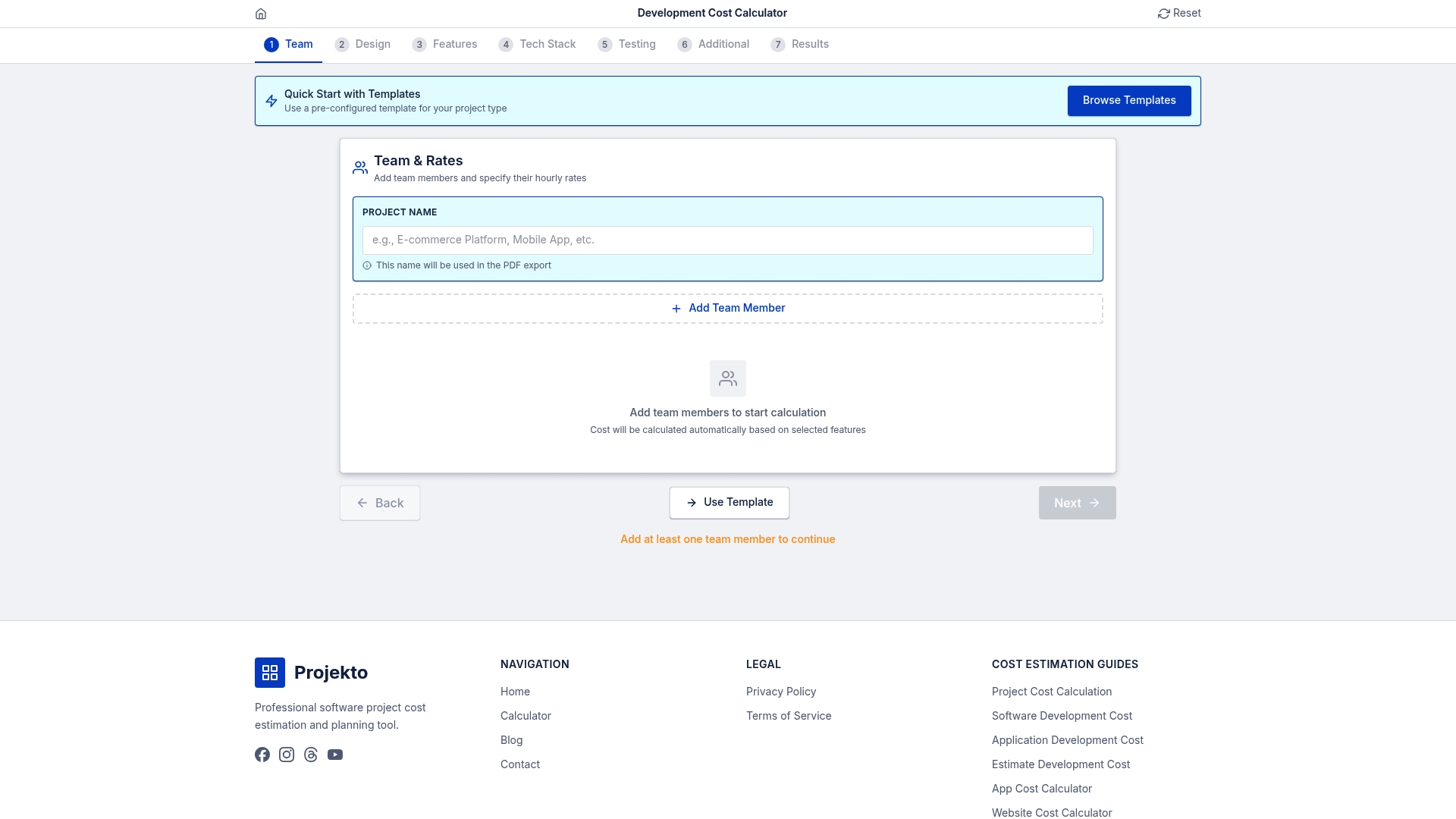
EstimateCalc gives business owners and project managers a fast, transparent way to generate effort and cost estimates for web and mobile app projects. You can use the development cost calculator to get a structured baseline for your next build, or explore purpose-built tools like the cost for event management app and the cost for healthcare app for domain-specific estimates. Stop guessing and start planning with data.
Frequently asked questions
What is effort estimation in app and web projects?
Effort estimation is the process of predicting how much time and resources a project will require from start to finish, covering development, testing, deployment, and all supporting activities.
Why do so many projects fail despite estimation?
Many projects fail because estimates are overly optimistic or exclude hidden tasks like QA and deployment. Only 31% of projects are completed successfully on time, within budget, and to scope.
Which effort estimation technique is best for app development?
No single method fits every project. Analogous and bottom-up methods are widely useful, while Agile teams benefit most from story points and planning poker for iterative sprint planning.
How much contingency should I add to an estimate?
A contingency buffer of 5-15% is the standard recommendation, sized based on project novelty, team experience, and how well requirements are defined at the time of estimation.