
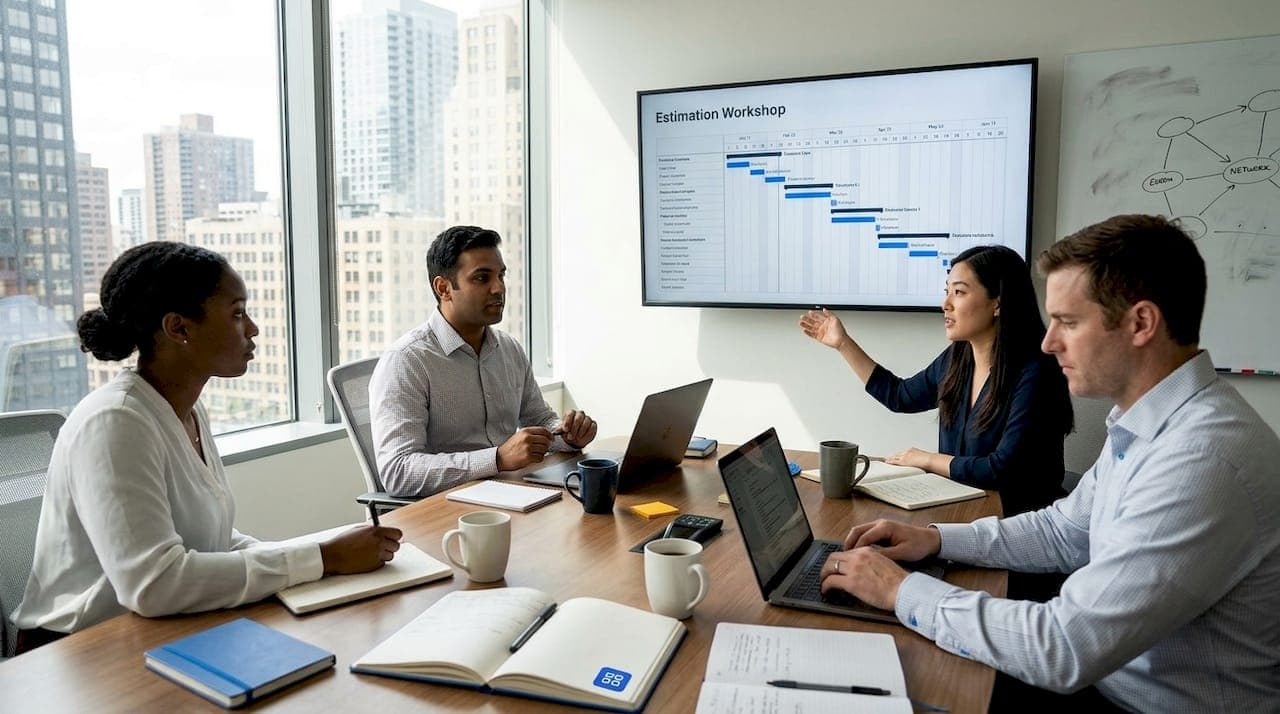
Most software projects that fail do so long before a single line of code is written. The root cause is almost always the same: estimates built on incomplete information, unchallenged assumptions, and the judgment of one or two individuals working in isolation. When scope is misunderstood and risk is invisible, budgets collapse and deadlines slip. Estimation workshops change this dynamic by replacing guesswork with structured, collaborative dialogue that surfaces what everyone in the room actually knows. This article explains why workshops are the most reliable path to accurate estimates, which techniques work best, and how project managers and business stakeholders can use them to protect budgets and build credibility.
Table of Contents
- Why workshops matter for accurate project estimation
- Core workshop techniques: From Planning Poker to T-shirt sizing
- Workshops vs. traditional estimation approaches: A clear comparison
- How workshops improve accuracy and stakeholder buy-in
- Best practices for running effective estimation workshops
- Our take: Why estimation workshops are an investment, not a cost
- Estimate smarter with EstimateCalc's free cost calculator
- Frequently asked questions
Key Takeaways
| Point | Details |
|---|---|
| Workshops build consensus | Gathering diverse perspectives reduces estimation bias and aligns teams behind shared numbers. |
| Relative methods outperform hours | Techniques like Planning Poker and T-shirt sizing help teams handle uncertainty far better than traditional hours-based guessing. |
| Transparency earns trust | Open, collaborative workshops make estimates defensible for business and technical stakeholders alike. |
| Preparation drives success | Effective workshops depend on clear agendas, shared definitions, and strong facilitation. |
Why workshops matter for accurate project estimation
An estimation workshop is a structured meeting where cross-functional participants, including developers, designers, product owners, and business stakeholders, work together to size project tasks and reach shared agreement on effort and timeline. This is fundamentally different from asking a single senior engineer or project manager to produce a number in isolation.
The core advantage is collective intelligence. When multiple people with different vantage points evaluate the same task, individual cognitive biases cancel out. Developers who know the technical debt, designers who understand UX complexity, and stakeholders who hold business context all contribute information that no single expert possesses alone. The result is an estimate grounded in reality rather than optimism or fear.
"Collaborative estimation methods such as Planning Poker are consensus-based techniques used in Agile software development to align teams on effort and reduce individual bias."
Workshops also produce estimation consensus that stakeholders can trust. When a budget figure emerges from a documented group process rather than a black box, it is far easier to defend in executive reviews or client conversations.
Common activities in estimation workshops include:
- Planning Poker: Each participant privately selects a card representing their effort estimate, then all cards are revealed simultaneously to spark discussion.
- Scoping exercises: Teams walk through user stories or feature lists to identify dependencies and clarify acceptance criteria before sizing.
- Risk identification rounds: Participants flag unknowns or assumptions that could inflate actual effort.
The direct business impact is significant. Fewer cost overruns, more defensible budgets, and higher team morale all follow from a process where everyone understands why an estimate was set at a particular level.
Pro Tip: Invite at least one business stakeholder to every estimation workshop. Their presence prevents scope creep from being baked in silently and ensures the team understands the commercial priority behind each feature.
Core workshop techniques: From Planning Poker to T-shirt sizing
Estimation workshops rely on several well-established techniques, each suited to different levels of project detail and uncertainty. Understanding when to apply each one is as important as knowing how they work.
Top techniques used in practice:
- Planning Poker: Participants use a modified Fibonacci scale (1, 2, 3, 5, 8, 13, 21) to vote on story points for individual tasks. Divergent votes trigger discussion, which is where the real value lies.
- T-shirt sizing: Features or epics are assigned relative sizes (XS, S, M, L, XL) for high-level roadmap planning. Fast and effective when precise numbers are premature.
- Affinity mapping: The team silently sorts tasks into size buckets on a wall or digital board, then discusses outliers. Useful for large backlogs where individual discussion would take too long.
| Technique | Best for | Granularity | Speed |
|---|---|---|---|
| Planning Poker | Sprint-level tasks | High | Moderate |
| T-shirt sizing | Roadmap features | Low | Fast |
| Affinity mapping | Large backlogs | Medium | Fast |
All three techniques rely on relative estimation, which compares tasks against each other rather than assigning absolute hours. This approach handles uncertainty and risk far better than hour-based estimation, because it acknowledges that teams rarely know exact durations upfront but can reliably judge whether one task is twice as complex as another.
Understanding software sizing methods in depth helps teams calibrate their reference points before a workshop begins, which dramatically reduces the time spent debating what a "5" actually means.
Pro Tip: Before the first workshop, agree on a reference story. Pick one completed task the whole team knows well and assign it a baseline value. All future estimates are then made relative to that anchor, cutting calibration time in half.
Workshops vs. traditional estimation approaches: A clear comparison
Traditional estimation methods have served the industry for decades, but they carry well-documented limitations that workshops are specifically designed to address.
Traditional approaches include:
- Expert judgment: A senior developer or architect produces estimates based on experience. Fast, but highly susceptible to individual bias and knowledge gaps.
- Bottom-up estimation: Tasks are broken into the smallest possible units and summed. Accurate when scope is fully defined, but less flexible and less adaptive than workshop methods when requirements evolve.
- Analogous estimation: Past project data is used to size the current one. Reliable only when the analogy is genuinely close.
- #NoEstimates: Teams track throughput and use probabilistic forecasting instead of upfront estimates. Powerful for mature teams but difficult to sell to external stakeholders.
| Dimension | Workshop-based | Traditional (expert/bottom-up) |
|---|---|---|
| Accuracy | High (group calibration) | Variable (depends on expert) |
| Transparency | High | Low to moderate |
| Stakeholder trust | High | Moderate |
| Speed | Moderate | Fast (expert) / Slow (bottom-up) |
| Adaptability | High | Low |
| Risk coverage | Explicit | Often implicit |
Workshops shine on complex, uncertain, or strategically important projects where hidden estimation pitfalls can derail budgets. Expert-only methods remain useful for small, well-understood tasks where convening a group would cost more time than the estimate is worth.
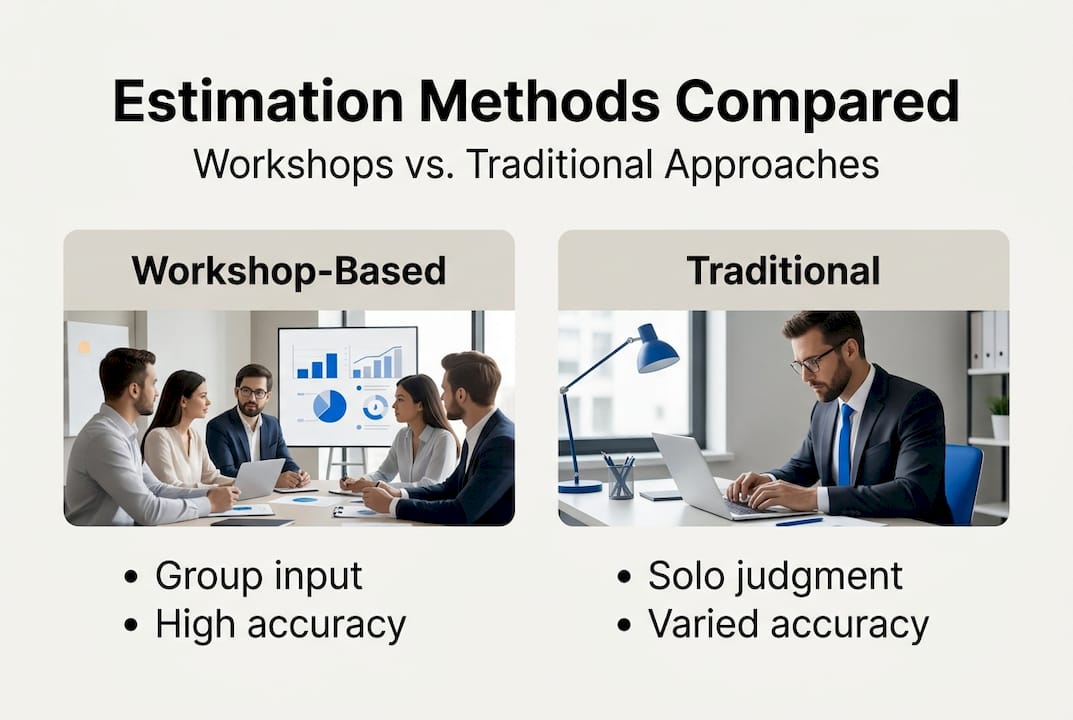
For anyone working through the process of estimating software costs for the first time, the table above makes the trade-offs concrete: workshops trade some speed for substantially better accuracy and trust.
How workshops improve accuracy and stakeholder buy-in
The accuracy gains from workshops are not accidental. They follow directly from the structure of the process itself.
Open discussion during a workshop surfaces hidden assumptions that would otherwise remain invisible until they cause problems mid-project. A developer might know that a third-party API integration requires a custom authentication layer. A designer might flag that a requested feature conflicts with the existing design system. A stakeholder might clarify that a "nice to have" feature is actually a contractual requirement. None of this information reaches the estimate if only one person produces it.
"Workshop-based estimates provide defensible figures via group consensus, reducing cost overruns and building trust with business stakeholders who need to approve and govern project budgets."
Key accuracy and buy-in benefits include:
- Reduced estimation error: Group calibration corrects for individual optimism bias and knowledge gaps.
- Explicit risk documentation: Risks identified during the workshop are recorded and factored into contingency planning.
- Shared ownership: When the team builds the estimate together, they are more committed to delivering within it.
- Governance readiness: A documented workshop process gives finance and executive teams the audit trail they need to approve budgets confidently.
For project managers focused on validating time estimates before committing to a delivery date, workshops provide the structured validation mechanism that solo estimation cannot replicate. Teams that invest in collaborative estimation also report fewer surprises during execution, which directly supports the goal of preventing budget overruns on complex integrations.
Best practices for running effective estimation workshops
A well-run estimation workshop does not happen by accident. It requires deliberate preparation, clear facilitation, and disciplined follow-through.
Workshop preparation checklist:
- Define the scope in advance. Share user stories, feature lists, or a work breakdown structure with participants at least 24 hours before the session so no one arrives cold.
- Select the right participants. Include representatives from every discipline that will contribute to the work: engineering, design, QA, and at least one business stakeholder.
- Choose the technique that fits the session goal. Use Planning Poker for sprint planning, T-shirt sizing for roadmap reviews, and Affinity mapping for large backlog grooming.
- Set a time limit per item. Cap discussion on any single task at five minutes. If consensus is not reached, flag it for async follow-up and move on.
- Document everything in real time. Use a shared digital board or spreadsheet so all participants see the emerging estimate and can flag discrepancies immediately.
- Debrief at the end. Spend ten minutes reviewing what worked and what slowed the session down. This feedback loop is what improves workshop quality over time.
Workshops involving the entire project team consistently produce better estimates because every contributor has the opportunity to flag complexity that others might miss.
Understanding estimation scope before the workshop begins ensures the team is sizing the right work, not a partial or misunderstood version of it.
Pro Tip: Rotate the facilitator role across workshops. Different facilitators notice different discussion patterns and bring fresh energy to the process. Pair rotation with a short retrospective and workshop quality improves measurably within three to four sessions.
Our take: Why estimation workshops are an investment, not a cost
There is a persistent belief in the industry that workshops are a luxury, a time-consuming ritual that slows teams down when they should be building. This view is expensive.
Skipping a two-hour estimation workshop to save time is a false economy when the alternative is discovering a missed dependency in week six of a twelve-week project. The cost of rework, scope renegotiation, and stakeholder trust repair dwarfs the cost of the workshop many times over.
More importantly, companies that build a culture of collaborative estimation develop an organizational capability that compounds over time. Teams that estimate together regularly get faster and more accurate. They build shared vocabulary, calibrated reference points, and the psychological safety to challenge assumptions openly.
For business leaders evaluating whether to mandate workshops on strategic projects, the question is not whether you can afford the time. It is whether you can afford the alternative. Understanding how project estimators function within a broader estimation system helps leaders position workshops as a governance requirement rather than an optional team ritual. High-uncertainty projects, in particular, have no reliable path to accurate budgets without them.
Estimate smarter with EstimateCalc's free cost calculator
Workshops give your team the collaborative foundation for accurate estimates. The next step is translating that consensus into concrete numbers your business can plan around.
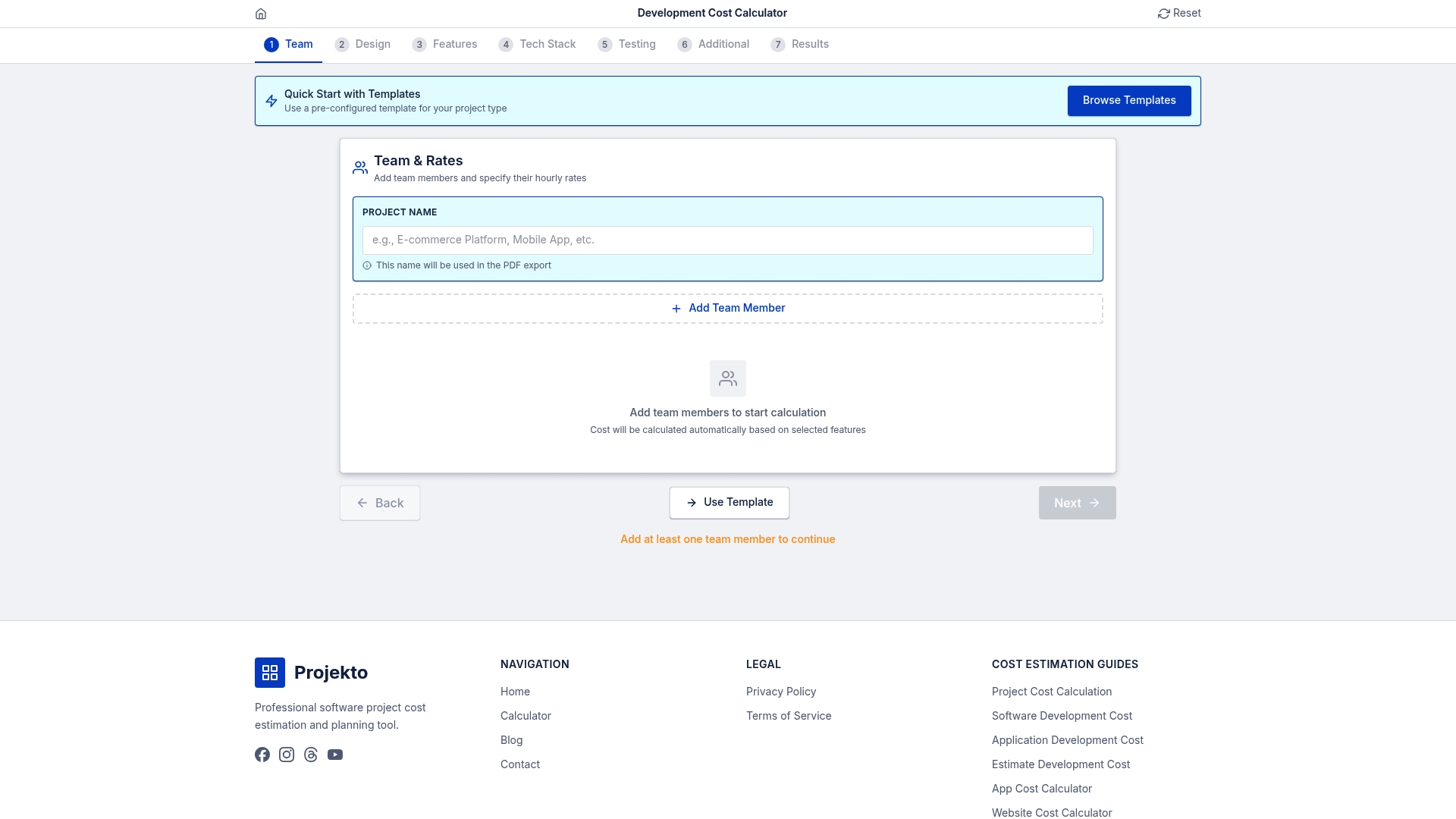
EstimateCalc is a professional tool built specifically for project managers and stakeholders who need transparent, defensible cost and timeline estimates for web and mobile app development. Use the Development Cost Calculator before or after your estimation workshop to validate team consensus against structured data inputs. It takes minutes to run, produces clear outputs that non-technical stakeholders can read immediately, and gives your estimates the documented backing they need for budget approval. Pair workshop insights with data-driven calculation for estimates your whole organization can stand behind.
Frequently asked questions
What is the main purpose of estimation workshops?
Estimation workshops build consensus among team members and stakeholders to produce accurate, transparent project estimates that are grounded in collective knowledge rather than individual judgment.
How do workshop-based estimates compare to expert judgment?
Workshop estimates are more defensible and adaptable because group input reduces the individual biases inherent in solo expert estimates, and relative estimation handles uncertainty better than absolute hour-based approaches.
When should you use workshops for estimation?
Workshops are best suited to new, complex, or strategically important projects where shared understanding, risk visibility, and stakeholder buy-in are critical to project success.
What techniques are commonly used in estimation workshops?
Planning Poker, T-shirt sizing, and Affinity mapping are the most widely used techniques, each relying on collaborative group estimation to produce calibrated, consensus-based results.
Can workshops prevent budget overruns?
Yes. By involving all key contributors, workshops surface risks and hidden assumptions early, resulting in more realistic estimates that reduce the likelihood of costly overruns during execution.