

Between 60% and 80% of software projects overrun their original cost and schedule targets. For business executives and project managers, that statistic is not just alarming, it is a direct threat to profitability, stakeholder confidence, and competitive positioning. The root cause is rarely poor execution alone. More often, it traces back to weak or absent estimation practices at the start of the project. Project estimators are the professionals who address this gap, yet their role remains one of the most misunderstood in software development. This guide explains what project estimators do, how they work, and why their involvement is critical for any web or mobile app initiative.
Table of Contents
- What is a project estimator and why do they matter?
- Core responsibilities in web and mobile app estimation
- Top estimation methodologies and frameworks
- Dealing with uncertainty: buffers, AI, and edge cases
- Best practices for executives and project managers
- Get faster, more accurate estimates for your next project
- Frequently asked questions
Key Takeaways
| Point | Details |
|---|---|
| Estimators reduce budget risk | Involving project estimators early helps prevent costly overruns in web and app development. |
| Multiple methods boost accuracy | Using both expert and algorithmic estimation methods creates more defensible and resilient forecasts. |
| Always plan for uncertainty | Top performers add 15-20% reserves to cover unexpected issues and scope changes. |
| Track and refine estimates | Regularly comparing actuals against estimates improves future project planning and budgeting. |
What is a project estimator and why do they matter?
A project estimator is a specialist who forecasts effort, duration, cost, and confidence for software projects before development begins. Their output is not a single number. It is a ranged forecast with defined confidence intervals, assumptions, and risk flags that allow decision-makers to plan with clarity rather than guesswork.
For executives and project managers, the value is direct. Estimators translate technical complexity into financial and schedule terms that business stakeholders can act on. They surface risks before contracts are signed, budgets are locked, or teams are assembled. Understanding the cost for application development becomes far more reliable when a trained estimator is involved from the start.
Key contributions project estimators make to web and mobile app projects include:
- Quantifying development effort across all phases, not just coding
- Identifying high-risk features that could inflate scope or timeline
- Providing confidence-level ranges rather than false point estimates
- Aligning technical scope with business budget constraints
- Documenting assumptions so estimates can be revisited as requirements evolve
"Project estimators provide ranged estimates with confidence levels, not single-point guesses. This distinction is what separates defensible forecasts from wishful thinking." — Software estimation experts
Core responsibilities in web and mobile app estimation
Now that you know the value project estimators bring, it is important to understand their day-to-day responsibilities in app development. Estimators do far more than calculate hours. They analyze requirements, assess feature complexity, evaluate integration points, and factor in technology stack decisions that affect both cost and timeline.
A critical and often overlooked part of their work is accounting for non-coding phases such as testing (typically 15 to 20% of total effort), code reviews (5 to 10%), deployment, compliance checks, and post-launch support. These phases are where many projects bleed budget when estimators are not involved. Knowing how to estimate software development cost accurately requires capturing all of these layers, not just feature development hours.
Platform selection is another major variable. Native iOS and Android development typically costs more than cross-platform frameworks like React Native or Flutter, which can reduce effort by 30 to 40% for certain project types. Estimators weigh these tradeoffs against performance requirements and long-term maintenance costs. This is especially relevant in regulated sectors where, for example, healthcare software development cost is shaped by compliance requirements that add significant non-coding overhead.

Sample effort allocation for a typical web or mobile app project:
| Phase | Estimated effort share |
|---|---|
| Feature development (coding) | 40 to 50% |
| Testing and QA | 15 to 20% |
| UI/UX design and review | 10 to 15% |
| Code review and refactoring | 5 to 10% |
| Deployment and DevOps | 5 to 8% |
| Post-launch fixes and support | 5 to 10% |
Pro Tip: Always budget a separate line item for app store review cycles and post-launch bug fixes. Apple and Google review timelines are unpredictable, and first-release defect rates routinely consume 5 to 10% of total project budget if not planned for in advance.
Top estimation methodologies and frameworks
Understanding responsibilities is one thing. Knowing the right techniques is another. Estimators draw from a range of established methodologies including expert judgment (such as Planning Poker), analogous estimation, parametric models like COCOMO II, bottom-up work breakdown structure (WBS), three-point PERT analysis, and Agile story points.
Methodology comparison:
| Method | Best for | Strength | Limitation |
|---|---|---|---|
| Expert judgment / Planning Poker | Agile sprints, team consensus | Fast, collaborative | Subjective, bias-prone |
| Analogous estimation | Early scoping with similar past projects | Quick, low data needed | Less accurate for novel work |
| Parametric (COCOMO II) | Large, well-defined projects | Data-driven, repeatable | Requires historical data |
| Bottom-up WBS | Detailed planning with defined scope | High accuracy | Time-intensive |
| Three-point PERT | Projects with high uncertainty | Captures risk range | Requires three estimates per task |
| Agile story points | Iterative development | Velocity-based, flexible | Not directly tied to hours or cost |
Avoiding common estimation pitfalls often comes down to selecting the right method for the project phase. Early scoping calls for analogous or expert judgment approaches. Detailed planning benefits from bottom-up WBS or parametric models. Understanding software sizing is a prerequisite for parametric accuracy.
"Hybrid approaches that combine two or more methodologies are recommended for large or ambiguous projects, balancing speed with defensible accuracy."
Steps to select the right estimation method for your project:
- Assess how well-defined the requirements are at the current project phase
- Determine whether historical data from similar projects is available
- Identify the level of uncertainty and risk in the feature set
- Match the method to the phase: analogous for early scoping, WBS for detailed planning
- Use estimation consensus techniques to align the team before finalizing numbers
Pro Tip: For large or ambiguous projects, combine at least two methodologies. Use parametric models to set a baseline, then validate with bottom-up WBS for the highest-risk components.
Dealing with uncertainty: buffers, AI, and edge cases
No estimation approach is foolproof. Experienced estimators know that optimism bias leads to 25 to 50% underestimation in software projects, and that unknown unknowns require a management reserve of 15 to 20% to protect delivery commitments. Scope creep, late requirement changes, and third-party integration failures are recurring sources of overrun that no methodology eliminates entirely.
AI-assisted estimation tools are increasingly part of the estimator's toolkit. Research shows that AI improves estimation accuracy by 47% in certain contexts, particularly for routine, well-defined tasks. However, AI tools accelerate repetitive work for junior estimators but provide less lift for complex architectural decisions that require contextual judgment and domain expertise.
Common sources of estimation failure to watch for:
- Anchoring on a client's desired budget rather than actual scope
- Failing to separate effort (hours of work) from duration (calendar time)
- Ignoring integration complexity with third-party APIs or legacy systems
- Underestimating testing cycles for regulated or high-availability applications
- Not revisiting estimates when requirements change mid-project
Learning to validate time estimates against actuals is one of the most effective ways to reduce future overruns.
Pro Tip: Always separate effort from duration and cost in your estimates. A task requiring 40 hours of effort may take three calendar weeks due to team availability, review cycles, and dependencies. Conflating these three dimensions is one of the most common causes of schedule slip.
Best practices for executives and project managers
With an understanding of the technical side, the focus shifts to practical steps business leaders can take to maximize the value of project estimators. The single most impactful action is involving estimators during initial discovery, before scope is locked and before vendor contracts are signed.
Integrating estimators early in the discovery phase aligns scope and budget expectations before commitments are made, reducing the risk of mid-project renegotiations that damage vendor relationships and delay delivery.
Steps for executives and project managers to follow:
- Involve estimators at the discovery phase, not after requirements are finalized
- Select the estimation methodology that matches the project's current level of definition
- Establish a baseline estimate and track actuals versus estimates throughout delivery
- Conduct post-mortem reviews to identify where estimates diverged from reality
- Use findings to refine estimation inputs and assumptions for future projects
Real-world impacts of not involving estimators early:
- Budget overruns discovered only after development is underway
- Scope cuts that compromise core product functionality
- Delayed launches due to underestimated testing and compliance phases
- Strained relationships with development vendors over contract disputes
- Reduced stakeholder confidence in future project forecasts
Using a structured estimation scope guide helps teams define boundaries clearly before estimation begins, which directly improves forecast reliability.
Pro Tip: Use bottom-up WBS techniques when scope is well-defined and you need high-accuracy budgets. Switch to parametric models when you need a fast, defensible number for early-stage bids or executive approvals.
Get faster, more accurate estimates for your next project
Applying the practices covered in this guide requires reliable data, structured inputs, and a consistent framework. The Development Cost Calculator at Projecto is built specifically for web and mobile app projects, incorporating industry benchmarks, platform variables, and phase-level effort allocation to generate estimates you can defend to stakeholders.
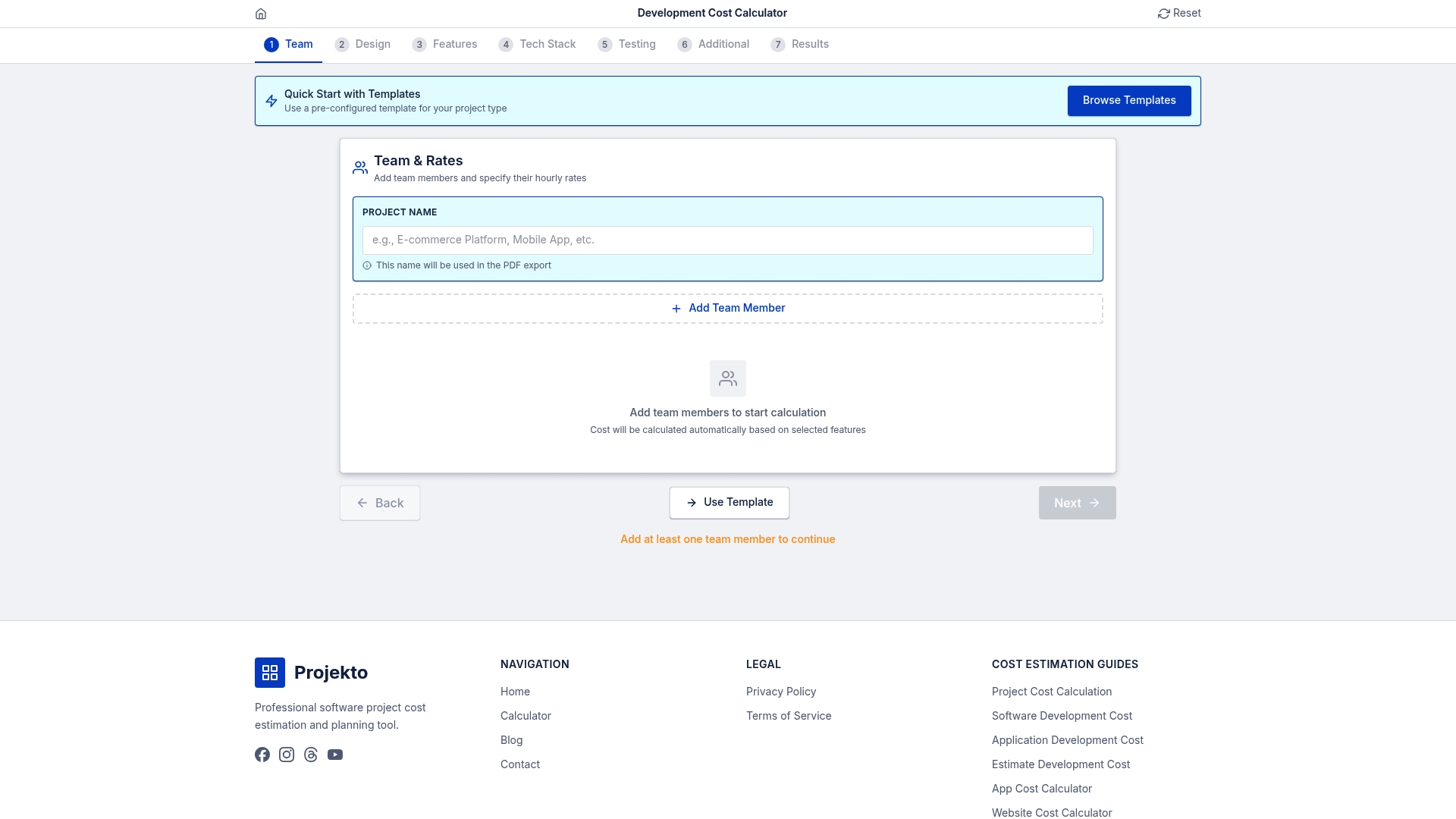
Whether you are scoping a new product or validating a vendor quote, the calculator gives you a structured starting point grounded in real-world data. For specialized use cases, the project management app calculator provides tailored estimates for that specific product category. These tools complement, not replace, the judgment of experienced estimators, giving your team a faster path to defensible numbers.
Frequently asked questions
What is the difference between a project estimator and a project manager?
A project estimator forecasts effort, cost, and timeline before development begins, while a project manager is responsible for executing delivery and managing the team throughout the project lifecycle. The two roles are complementary but distinct.
Which estimation method is best for Agile app projects?
Agile teams most commonly use story points and relative sizing, which support velocity-based planning and adapt well to iterative development cycles rather than fixed-hour commitments.
How much buffer should I add for unknowns in my estimate?
Most experts recommend a management reserve of 15 to 20% to cover unknown unknowns in software projects, applied on top of the base estimate after known risks are already accounted for.
Can AI replace human estimators in software projects?
AI tools accelerate routine tasks by 40 to 70% for junior estimators but cannot replicate the contextual judgment required for complex architecture decisions, novel integrations, or high-stakes regulatory environments.
Why do so many web and mobile projects overrun their original estimates?
Optimism bias, underestimated complexity, and scope changes are the primary drivers, with 60 to 80% of projects exceeding initial estimates due to these compounding factors when estimation discipline is absent from the start.