

TL;DR:
- Accurate team size estimation reduces coordination complexity, costs, and project delays.
- Adding developers to late projects often worsens delays due to Brooks' Law and onboarding overhead.
- Structured frameworks and tools enable better planning and prevent reactive hiring mistakes.
Hiring two extra developers to speed up a delayed app launch sounds logical until the project slips three more weeks and costs $40,000 more than planned. This scenario plays out repeatedly in tech startups, not because founders lack technical knowledge, but because team size estimation is treated as a headcount decision rather than a strategic planning tool. Accurate estimation controls coordination complexity, protects the budget, and keeps delivery timelines realistic. This article walks through the mechanics of team size estimation, the real cost of getting it wrong, actionable frameworks for getting it right, and the most common pitfalls that derail even experienced project managers.
Table of Contents
- Why accurate team size estimation matters
- The impact of team size on project timelines and costs
- Frameworks and best practices for estimating team size
- Common pitfalls and how to avoid them
- A founder's take: Why 'just add more developers' fails (and what does work))
- Estimate smarter with project cost tools
- Frequently asked questions
Key Takeaways
| Point | Details |
|---|---|
| Team size drives outcomes | The right team size controls timelines, costs, and product quality for your app. |
| More isn’t always better | Adding extra developers can slow down progress if not planned carefully. |
| Use proven frameworks | Structured estimation methods prevent overruns and delays in fast‑moving startups. |
| Avoid common mistakes | Watch for early signs of overstaffing and costly miscommunication from the start. |
Why accurate team size estimation matters
Team size is not just a resource variable. It is a direct multiplier on coordination complexity, communication overhead, and ultimately, cost. Every developer added to a project creates new communication channels, introduces onboarding time, and requires alignment on architecture, code standards, and sprint goals. Understanding software sizing basics is the foundation for making these decisions with confidence rather than instinct.
The core mathematical reality is stark. Communication overhead grows quadratically with each new team member, following the formula n(n-1)/2, where n is the number of team members. A team of 5 has 10 communication channels. A team of 10 has 45. A team of 15 has 105. That is not a linear increase in coordination cost. It is an exponential one, and most project budgets do not account for it.
Brooks' Law, first articulated by Fred Brooks in The Mythical Man-Month, states that adding people to a late software project makes it later. This is counterintuitive but consistently validated across development environments. New team members require onboarding, pull experienced developers away from productive work, and fragment decision-making authority. The result is slower output, not faster.
"The bearing of a child takes nine months, no matter how many women are assigned." — Fred Brooks, The Mythical Man-Month
Misestimating team size creates cascading effects across the entire project lifecycle. The consequences are not limited to budget overruns. They extend to team morale, product quality, and market timing. Recognizing estimation pitfalls early is what separates projects that ship on time from those that stall in sprint limbo.
Key areas impacted by poor team size estimation:
- Time: Overstaffed teams spend more time in meetings and code reviews than in productive development
- Budget: Each unnecessary hire adds salary, tooling, licensing, and management overhead
- Team morale: Unclear roles and duplicated responsibilities lower engagement and increase turnover
- Product quality: Fragmented ownership leads to inconsistent architecture and technical debt
The impact of team size on project timelines and costs
Once you understand why estimation matters, it is vital to see the real business impact in dollars and delays. The following table illustrates how different team configurations affect ramp-up time, monthly cost, and potential project delay for a mid-complexity mobile app.
| Team size | Ramp-up time | Monthly cost (est.) | Potential delay risk |
|---|---|---|---|
| 3 developers | 1 week | $24,000 | Low, if scope is controlled |
| 6 developers | 2-3 weeks | $48,000 | Medium, coordination increases |
| 10 developers | 4-6 weeks | $80,000 | High, communication overhead spikes |
| 15 developers | 6-10 weeks | $120,000 | Very high, Brooks' Law territory |
The escalation process from poor team size decisions typically follows a predictable pattern:
- Scope is underestimated. The initial team is too small to meet the deadline, creating pressure to hire fast.
- Reactive hiring begins. New developers are added mid-sprint without proper onboarding plans.
- Coordination costs spike. Senior engineers shift from building to explaining, reviewing, and unblocking.
- Velocity drops. Sprint output decreases even as headcount increases, which triggers more reactive hiring.
- Budget overruns compound. Each new hire adds cost without proportional output, and the timeline extends further.
Avoiding costly estimation mistakes requires treating team size as a calculated input, not a reactive response to schedule pressure. The moment you start hiring to fix a delay, you have already entered a cycle that is difficult to break without pausing the project entirely.
Pro Tip: If your project is already behind schedule, resist the instinct to add developers. Instead, reduce scope, clarify priorities, and stabilize the existing team before considering any new hires. This is the single most effective intervention for recovering a delayed project.
For startups specifically, estimating software costs accurately from the start is what determines whether a product reaches market within budget or burns through runway before launch.
Frameworks and best practices for estimating team size
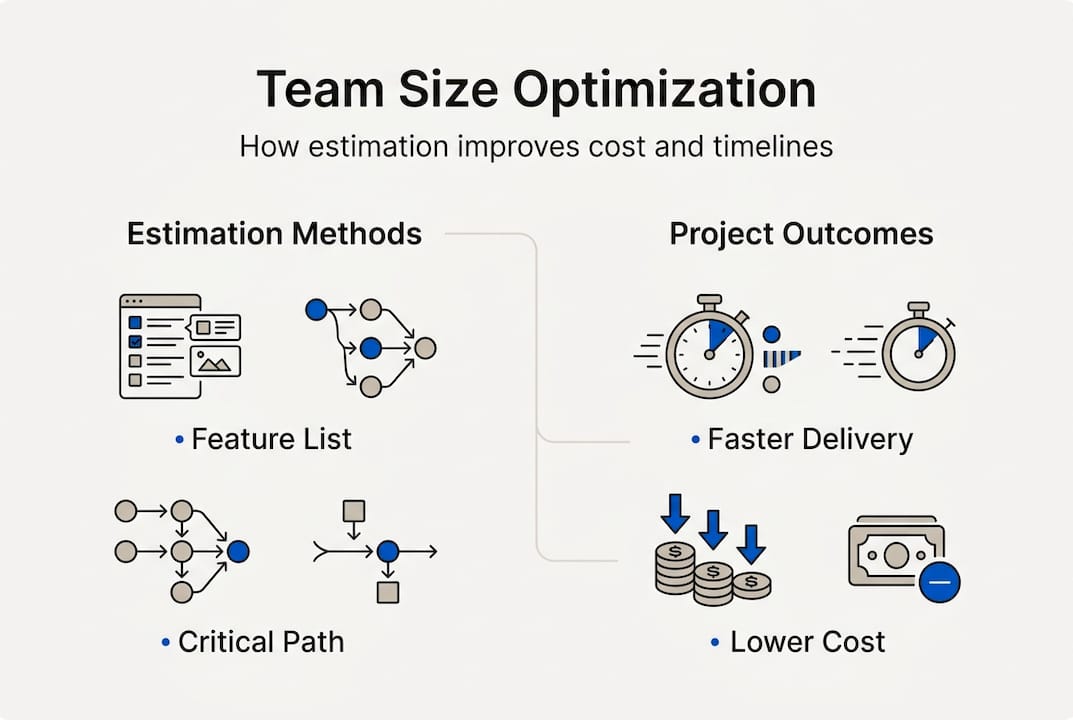
Now, having seen the consequences, let's talk about how to do it right. Two proven frameworks give project managers a structured starting point: feature-driven estimation and timeline backward mapping.
Feature-driven estimation starts with a complete feature list, assigns complexity points to each feature, and calculates the number of developer-weeks required. You then divide total developer-weeks by the available sprint cycles to determine the minimum team size needed. This method works well when the product scope is clearly defined before development begins.

Timeline backward mapping starts from the launch date and works backward. You identify the critical path, assign tasks to roles, and calculate how many parallel workstreams are feasible without creating coordination bottlenecks. This method is particularly effective for time-constrained projects where the deadline is fixed.
| Method | Best for | Key input | Main risk |
|---|---|---|---|
| Feature-driven | Defined scope projects | Feature complexity points | Scope creep inflates team size |
| Timeline backward mapping | Fixed-deadline projects | Launch date and critical path | Underestimating task dependencies |
Core steps for accurate team size estimation:
- Define scope completely before assigning any roles or headcount
- Map dependencies between features to identify which tasks must be sequential vs. parallel
- Assign roles by skill requirement, not by availability
- Calculate developer capacity based on realistic sprint velocity, not theoretical maximums
- Build in buffer for code review, testing, and integration work, which is consistently underestimated
- Validate assumptions with the team before finalizing headcount
Pro Tip: Run an estimation consensus session with your lead developers before locking in team size. When engineers co-own the estimate, they are more likely to flag unrealistic assumptions early and more committed to the plan during execution.
Team size estimation enables faster delivery by keeping coordination lean and decision-making centralized. The goal is not the smallest possible team. It is the most efficient team for the specific scope and timeline.
Common pitfalls and how to avoid them
Clear methodologies are one side, but dodging unseen hazards is just as crucial. Even experienced tech leaders fall into recurring traps when estimating team size, and the consequences are predictable.
"Brooks' Law violation occurs when adding people to a late project increases ramp-up time and coordination costs, making the project even later."
The most common pitfalls and how to address them:
- Overstaffing for status. Founders sometimes grow teams to signal progress to investors rather than to meet genuine development needs. Fix: tie every hire to a specific feature or workstream that cannot be completed without additional capacity.
- Underestimating ramp-up time. New developers rarely contribute at full velocity for the first two to four weeks. Fix: exclude new hires from sprint velocity calculations until they have completed at least two full sprints.
- Ignoring communication costs. Most estimation models account for coding time but not for the hours spent in standups, code reviews, Slack threads, and architecture discussions. Fix: add a 20 to 30 percent overhead factor to any team larger than five people.
- False economies of scale. Hiring junior developers to reduce cost often increases the total hours required, because senior engineers must spend time reviewing and correcting their work. Fix: calculate total cost per feature, not cost per developer.
Understanding estimation pitfalls at a structural level is what separates reactive project management from proactive delivery planning. Equally important is understanding estimation scope, because scope ambiguity is the root cause of most team size errors.
A founder's take: Why 'just add more developers' fails (and what does work)
Founders face a specific pressure that project managers at larger companies do not: every hiring decision is also a cash flow decision. When a sprint falls behind, the instinct is to hire fast and hire more. This instinct is understandable but almost always counterproductive.
The teams that consistently ship on time are not the largest ones. They are the most aligned ones. A team of four developers who share a clear understanding of the architecture, the priorities, and the acceptance criteria will outperform a team of ten developers who are waiting for direction or duplicating each other's work.
The real lever is not headcount. It is clarity. Before adding a single developer, ask whether the existing team has unambiguous ownership of every feature, a shared understanding of the technical constraints, and a realistic sprint plan that accounts for review and testing time. If the answer to any of those is no, more developers will amplify the problem, not solve it.
Running structured estimation workshops before the project kicks off is the single highest-return investment a founder can make in delivery predictability. It costs a day. It saves weeks.
Estimate smarter with project cost tools
Putting these frameworks into practice requires more than a spreadsheet. You need scenario-based tools that account for feature complexity, team structure, and realistic delivery timelines.
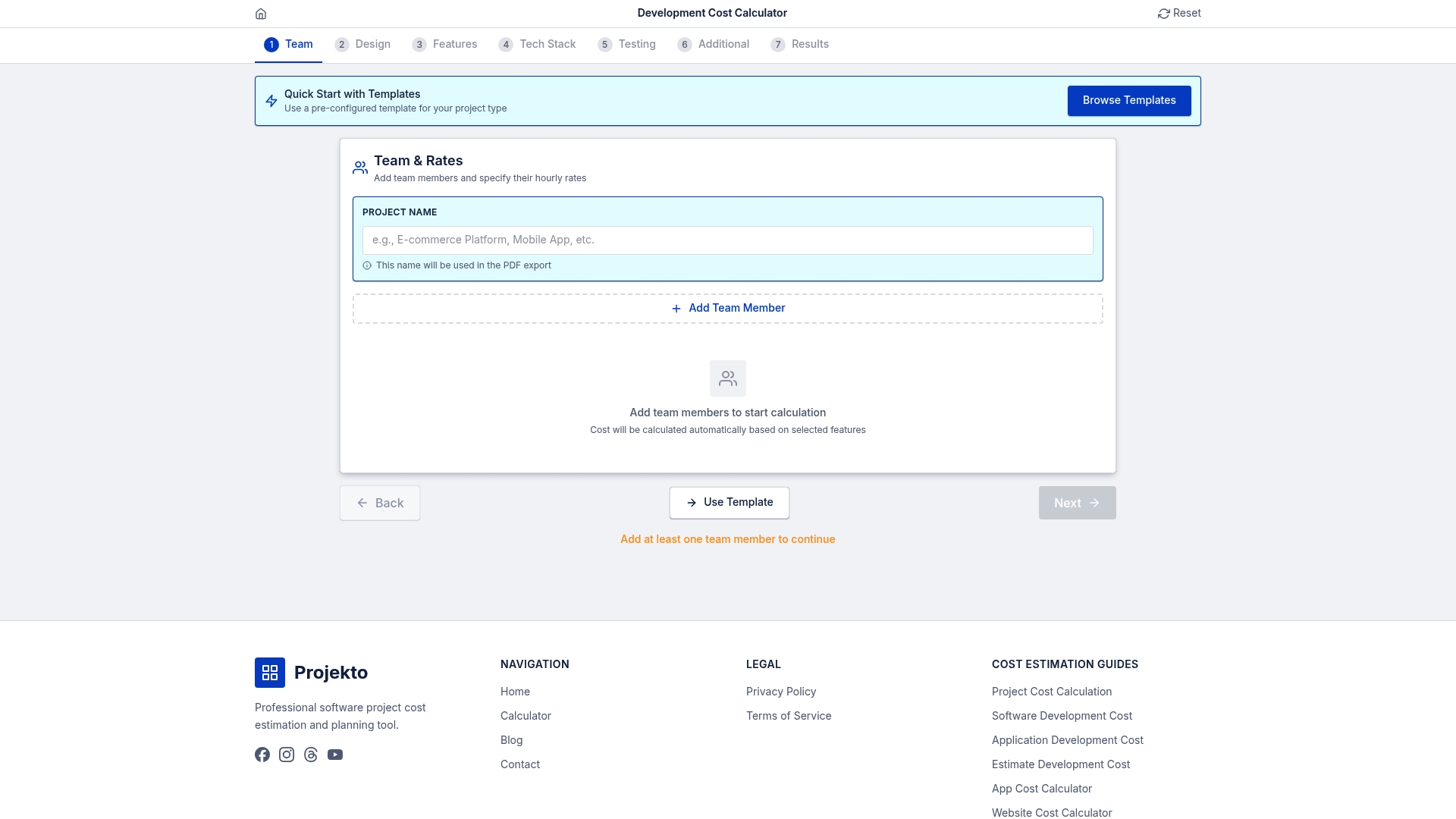
The development cost calculator at Projecto gives you an immediate, structured estimate for both team size and total budget based on your specific app requirements. If you are building in a specialized vertical, the event app cost estimate and healthcare app cost estimate provide scenario-specific breakdowns that reflect real market rates and typical team configurations. Use these tools before your next planning session to anchor your estimates in data rather than assumption.
Frequently asked questions
What is the ideal team size for a startup app project?
Most app projects are well served by teams of 4 to 7 developers, which balances communication efficiency with the capacity to iterate rapidly across parallel workstreams.
How does adding more developers slow down a project?
Each new team member increases the number of communication paths and requires onboarding time, which means that adding people to late projects raises coordination costs and extends the timeline rather than compressing it.
How does accurate team size estimation save money?
It prevents unnecessary hiring, reduces communication overhead costs, and keeps development focused on the highest-priority features, all of which protect the project budget from avoidable overruns.
Is there a tool to help estimate team size for my project?
Yes, online calculators and structured estimation frameworks guide you through scenario-based logic for staffing, helping you match team composition to your specific scope and timeline constraints.