

Software projects overrun initial estimates by 50% in roughly 80% of cases, and the consequences land directly on your budget and launch timeline. Most teams blame scope creep or unclear requirements, but the real culprit is often how estimates get made in the first place. One developer says two weeks, another says five, and someone in the room with seniority wins the argument. Estimation consensus fixes this by replacing individual guesswork with structured team agreement, surfacing unknowns before they become expensive surprises. This guide breaks down exactly how it works and how you can apply it to your next web or mobile app project.
Table of Contents
- What is estimation consensus?
- Popular estimation consensus techniques: Planning Poker and Wideband Delphi
- How estimation consensus improves project planning and reduces risk
- Addressing challenges and advanced tips for estimation consensus
- When estimation consensus isn't enough: Alternative and hybrid approaches
- Estimate your development project with confidence
- Frequently asked questions
Key Takeaways
| Point | Details |
|---|---|
| Consensus boosts estimate accuracy | Getting the whole team aligned makes planning more reliable and reduces costly surprises. |
| Techniques like Planning Poker work | Voting rounds and discussion help teams overcome bias and agree on believable estimates. |
| Consensus is about confidence, not unanimity | It's more important that everyone feels the estimate is reasonable than for everyone to agree on the exact number. |
| Data shows improved outcomes | Teams using consensus see fewer overruns and hit deadlines more often than those using solo estimates. |
| Not all tasks need consensus | For tiny or very routine work, simple or automated approaches might be more practical. |
What is estimation consensus?
Estimation consensus is the process by which a development team jointly agrees on the effort required for a task or user story, using structured methods rather than top-down directives. Collaborative agreement on effort estimates using Agile methods like Planning Poker and Wideband Delphi is the foundation of this approach. The goal is not to find the average of everyone's opinion but to reach a shared understanding of what a task actually involves.
Individuals estimating alone are vulnerable to anchoring bias, where the first number heard becomes the reference point, and optimism bias, where people underestimate effort on tasks they find interesting. When a team estimates together using a structured process, these biases cancel out. You get a number that reflects collective knowledge, including edge cases that only the QA engineer or the backend developer might know about.
For app projects specifically, the benefits are significant:
- More accurate timelines because hidden complexity gets surfaced during discussion
- Better budget predictability because effort estimates feed directly into cost calculations
- Stronger team buy-in because developers who helped set the estimate are more committed to hitting it
- Earlier risk detection because disagreements during estimation reveal misunderstood requirements
Understanding estimation scope is a natural next step once your team commits to consensus-based planning.
"The purpose of estimation is not to predict the future but to understand the present state of a project well enough to make good decisions."
Popular estimation consensus techniques: Planning Poker and Wideband Delphi
Planning Poker and Wideband Delphi are the most widely used methods for achieving estimation consensus in software teams. Both are designed to prevent dominant voices from skewing results while encouraging every team member to contribute their perspective.
Planning Poker works like this:
- The product manager or facilitator reads a user story aloud, for example: "As a user, I want to reset my password via email."
- Each team member privately selects a card from a Fibonacci sequence deck (1, 2, 3, 5, 8, 13, 21) representing their effort estimate in story points.
- Everyone reveals their cards simultaneously to prevent anchoring.
- The highest and lowest estimators explain their reasoning.
- The team discusses and re-votes. Most stories reach consensus in 2 to 3 rounds.
Wideband Delphi follows a similar logic but is better suited to distributed teams or early-stage planning where stories are still vague. Participants submit estimates independently, a facilitator shares the range anonymously, and structured discussion rounds continue until the group converges.
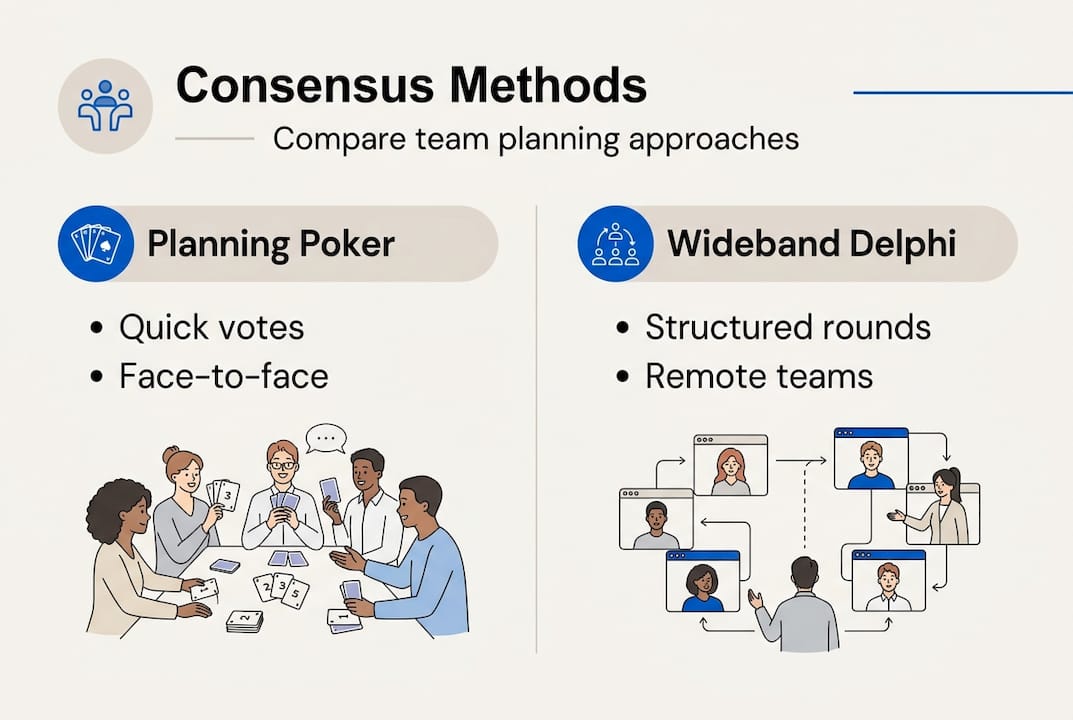
| Criteria | Planning Poker | Wideband Delphi |
|---|---|---|
| Speed | Fast (minutes per story) | Slower (structured rounds) |
| Anonymity | Simultaneous reveal | Fully anonymous rounds |
| Best group size | 3 to 8 people | 5 to 20 people |
| Accuracy | High for well-defined stories | High for ambiguous or large features |
| Tool requirement | Cards or app | Spreadsheet or facilitation tool |
For software sizing methods that go beyond story points, both techniques can be adapted to use hours, T-shirt sizes, or complexity buckets.
Pro Tip: If your team cannot reach consensus after three rounds, the story is probably too large or too vague. Split it into smaller tasks or park it for a refinement session with more context. Forcing a number on an unclear story is worse than deferring the estimate.
How estimation consensus improves project planning and reduces risk
The practical payoff of consensus estimation shows up in your delivery metrics. Consensus methods reduce variance in estimates and lead to more predictable deliveries, which means fewer budget shocks and more reliable roadmaps for stakeholders.

Here is what the data looks like in practice:
| Method | Variance reduction | On-time delivery improvement |
|---|---|---|
| Individual estimation | Baseline | Baseline |
| Planning Poker | Up to 10% variance | Significant improvement |
| Wideband Delphi | ~18% more accurate | Measurable improvement |
| Mature consensus teams | Best results | 70 to 85% on-time |
Those numbers matter when you are trying to get budget approval or set a launch date with confidence. A team that consistently delivers within its estimates builds credibility with stakeholders and reduces the firefighting that eats into development time.
Consensus estimation also directly addresses two of the most damaging cognitive traps in project planning. Anchoring bias is neutralized because everyone votes simultaneously before hearing others' numbers. Groupthink is reduced because the structured process requires every voice to be heard, not just the loudest one in the room.
Key ways consensus adds value to your app project:
- Aligns the PM, business owner, and dev team on what a feature actually requires before work begins
- Surfaces unknowns early, such as third-party API dependencies or security requirements that inflate effort
- Documents assumptions made during estimation, creating a reference point for scope change conversations later
- Improves budget alignment by connecting effort estimates to realistic cost ranges
For a deeper look at what causes estimates to go wrong in the first place, why estimates fail is worth reading before your next planning session.
"Estimates support decisions, not commitments. Treat them as informed forecasts, not contracts."
Addressing challenges and advanced tips for estimation consensus
Even well-run consensus sessions hit friction. Large stories, lack of consensus after several rounds, and dominant voices are the most common edge cases, and each has a practical fix.
Here is how to handle the most frequent challenges:
- Dominant personalities: Use blind voting tools or physical card reveals to prevent anchoring before discussion. The facilitator's job is to protect the process, not the senior engineer's opinion.
- Unclear stories: Introduce reference stories, tasks the team has already completed and agreed on, as calibration anchors. If a new story feels like "twice the effort" of a reference story, that is your estimate.
- New teams without velocity data: Start with relative sizing using T-shirt sizes (S, M, L, XL) before converting to story points. Precision comes after a few sprints of real data.
- Stalled rounds: If three rounds produce no convergence, split the story or defer it. A forced consensus is worse than an honest "we don't know yet."
For advanced teams, combining story points with three-point estimates (optimistic, most likely, pessimistic) gives you a confidence range rather than a single number. This is especially useful when presenting timelines to business owners who need to understand risk, not just averages. Tracking velocity over multiple sprints also calibrates your team's story point scale to real-world output.
ML estimation advances are starting to assist teams by analyzing historical project data to suggest initial estimates, which teams then validate through consensus. This hybrid approach reduces the cold-start problem for new teams.
Importantly, consensus is confidence, not unanimity. If seven out of eight team members agree on an eight-point story and one person votes five, that is close enough to proceed. The goal is shared understanding, not a unanimous vote.
Pro Tip: Use the consensus process itself as a buy-in tool. When developers help set the estimate, they own it. That ownership translates into accountability during the sprint, which is worth more than a perfectly precise number.
For teams struggling with recurring estimation pitfalls or looking to debunk app budgeting myths, both resources offer concrete frameworks to strengthen your planning process.
When estimation consensus isn't enough: Alternative and hybrid approaches
Estimation consensus is powerful but not always the right tool. As methodologies evolve, product managers and business owners need to know when to use it and when to step back.
Here is when consensus estimation may not be optimal:
- Small, repetitive tasks: If your team handles continuous flow work like bug fixes or minor UI tweaks, debating story points for each item slows delivery without adding value. Throughput metrics work better here.
- Mature Kanban teams: Teams optimizing for cycle time rather than sprint velocity often find that #NoEstimates approaches, which skip effort estimation in favor of tracking how many items move through the system, fit their workflow better.
- Highly exploratory work: Research spikes and proof-of-concept tasks have inherently unpredictable effort. Time-boxing them is more honest than estimating them.
On the technology side, ML models improve accuracy by 4 to 32% over traditional methods in controlled studies. These tools analyze historical sprint data, story characteristics, and team velocity to generate baseline estimates. However, they work best as a starting point for consensus discussion, not as a replacement for it. A model cannot know that your backend engineer is on vacation next sprint or that a new compliance requirement just added two weeks of work.
For teams evaluating pricing custom development or scoping a new product, the smartest approach in 2026 combines ML-assisted baseline estimates with structured team consensus to validate and adjust those numbers.
Estimate your development project with confidence
Ready to put estimation consensus into practice for your next app project? Understanding the theory is one thing, but translating team estimates into real budget numbers requires the right tools.
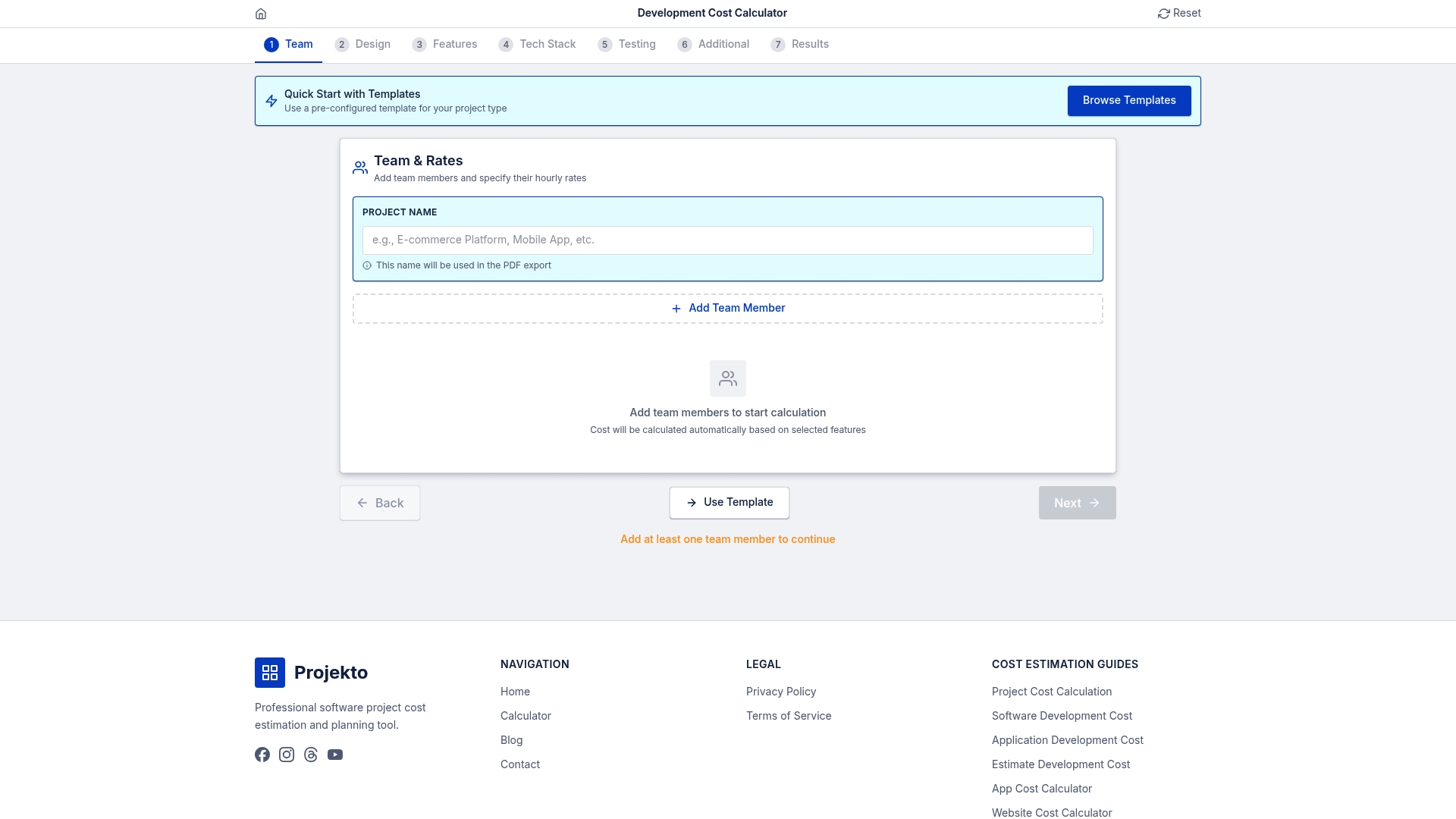
Our development cost calculator is built specifically for product managers and business owners who need fast, structured cost estimates for web and mobile app projects. Whether you are scoping a healthcare app estimate or building out an event management app budget, the calculator gives you a transparent breakdown that aligns with your team's consensus estimates. Accurate estimates reduce budget shocks, speed up stakeholder approvals, and give your development team a realistic foundation to work from. Start with a number your whole team can stand behind.
Frequently asked questions
What is the main goal of estimation consensus in software projects?
Estimation consensus aims to unify team perspectives for more accurate effort and cost planning, particularly for complex or ambiguous features where individual estimates diverge widely.
How does estimation consensus reduce project overruns?
By requiring every team member to reason through a task before committing to a number, consensus surfaces hidden complexity and reduces the bias that inflates or deflates individual estimates, leading to more predictable delivery rates.
Is unanimity necessary for estimation consensus?
No. Consensus means confidence in the estimate, not a unanimous vote. If the team is broadly aligned and the outliers have been heard, you have enough to move forward.
When should you abandon consensus estimation?
For very small or repetitive tasks, or when multiple rounds fail to converge, alternatives like #NoEstimates or time-boxing are more practical than continuing to debate a number that may not matter much anyway.