

Over 80% of software projects exceed initial estimates by 50%, often because teams never properly defined what they were building in the first place. That's the hidden cost of unclear estimation scope. When you skip the hard work of defining boundaries, deliverables, and resource needs upfront, you're essentially guessing at timelines and budgets. This guide breaks down what estimation scope actually means, which methods work best for web and mobile app projects, and how to avoid the common traps that derail even experienced teams. You'll walk away with practical frameworks to estimate smarter and deliver on time.
Table of Contents
- Key Takeaways
- What is estimation scope and why it matters
- Common methodologies for estimating software project scope
- Challenges and risks in estimation scope management
- Applying estimation scope effectively to web and mobile app projects
- How Projekto helps with accurate software project estimation
- Frequently asked questions
Key Takeaways
| Point | Details |
|---|---|
| Define estimation scope | Clarifying boundaries, deliverables, and required resources upfront improves time and budget accuracy and reduces surprises. |
| Bottom-up accuracy gains | Breaking work into tasks and estimating each one yields higher accuracy than guessing from the top down, though it takes more upfront effort. |
| Three point estimation | Optimistic, pessimistic, and most likely estimates are combined to better capture uncertainty in each task. |
| Tailor by project type | Adapting estimation methods to the project type, such as Agile for mobile or web apps, improves outcomes. |
| Contingency buffers | Including a 10 to 15 percent contingency helps absorb uncertainties and edge cases without derailing the plan. |
What is estimation scope and why it matters
Estimation scope defines boundaries, deliverables, objectives, and required resources to inform accurate predictions. Think of it as the blueprint that answers three critical questions: what are we building, what are we not building, and what do we need to make it happen? Without this foundation, you're flying blind.
In web and mobile app development, estimation scope sets the stage for everything that follows. It determines how many developers you need, which technologies make sense, and how long each phase will take. Clear scope definition directly impacts time and budget accuracy for software projects. When stakeholders understand exactly what features make the cut and which ones don't, you eliminate the constant renegotiation that kills momentum.
The core elements of estimation scope include:
- Project objectives that tie directly to business outcomes
- Specific deliverables with measurable acceptance criteria
- Technical and resource constraints that limit what's possible
- Clear boundaries that define what's excluded from the project
- Resource requirements including team size, skills, and tools
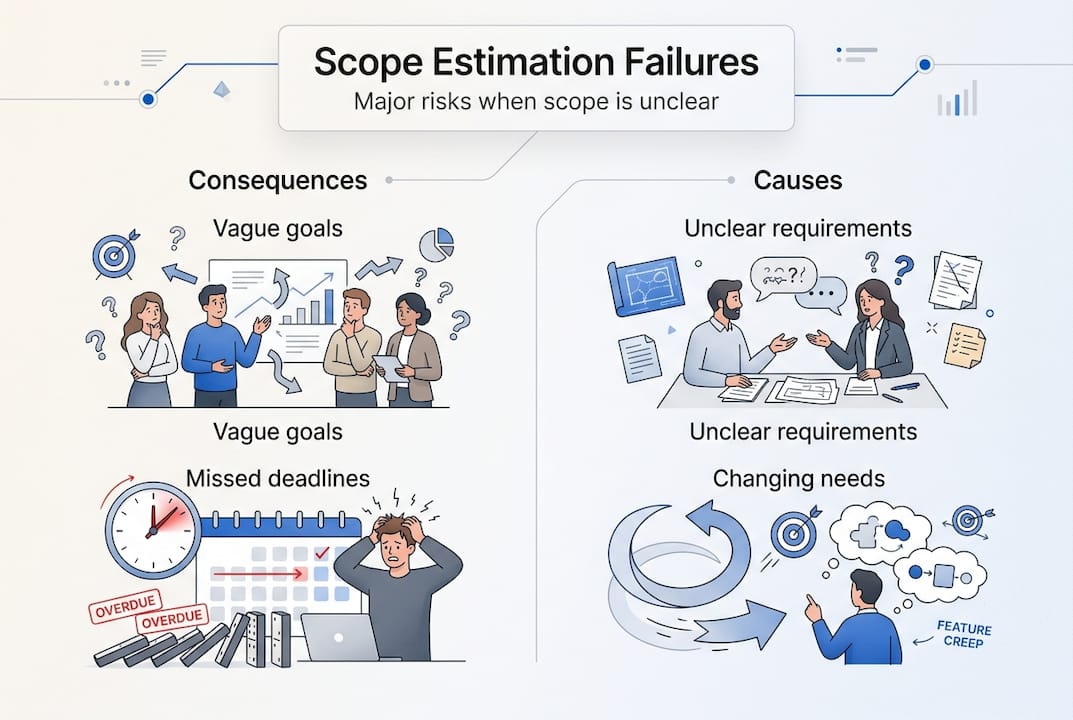
Poor scope definition creates a domino effect. Requirements stay vague, developers make assumptions, stakeholders expect features that were never planned, and suddenly your 12 week project stretches to 20 weeks. The budget balloons because you're constantly adding work that should have been scoped out or explicitly excluded from day one. This is why experienced project managers obsess over getting scope right before a single line of code gets written.
For estimating software development cost accurately, you need estimation scope locked down. It's the difference between a realistic roadmap and a fantasy timeline that sets everyone up for disappointment.
Common methodologies for estimating software project scope
Different estimation methods suit different project types and risk tolerances. Choosing the right approach depends on how much detail you have upfront and how much uncertainty you're willing to accept.
Bottom-up estimation starts with a Work Breakdown Structure that divides your project into tiny, manageable tasks. You estimate each task individually, then roll everything up to get your total. This method delivers roughly 10% higher accuracy than top-down approaches because you're forcing yourself to think through every detail. The tradeoff is time. Breaking down a complex mobile app into hundreds of tasks takes serious effort.
Parametric estimating uses historical data and statistical models to predict effort based on key variables. The COCOMO model is a classic example that factors in lines of code, team experience, and project complexity. Parametric models achieve accuracy within 20% for about 70% of projects. This works well when you have solid historical data from similar projects to reference.
Three-point estimation tackles uncertainty head on by calculating optimistic, pessimistic, and most likely scenarios for each task. You then use a weighted average to land on a realistic estimate. Analogy-based methods compare your current project to past ones with similar characteristics, adjusting for known differences. Both approaches shine when you're working in familiar territory.
Agile teams often use planning poker, where developers independently estimate story points for each feature, then discuss discrepancies until consensus emerges. This collaborative approach surfaces hidden complexity early and builds team buy-in around estimates.
| Method | Accuracy | Best for | Main drawback |
|---|---|---|---|
| Bottom-up (WBS) | ±10% | Well-defined projects with clear requirements | Time-intensive, requires detailed planning |
| Parametric (COCOMO) | ±20% | Projects with strong historical data | Less reliable for novel or unique projects |
| Three-point | ±15% | Projects with moderate uncertainty | Requires experienced estimators |
| Agile (Planning poker) | ±25% | Iterative development, evolving requirements | Less precise for fixed-bid contracts |
| Analogy-based | ±30% | Early-stage projects with limited detail | Depends heavily on comparable past projects |
Pro Tip: Combine bottom-up estimation for critical features with parametric models for standard components. This hybrid approach balances accuracy with efficiency, giving you confidence in high-risk areas while avoiding analysis paralysis on routine work.
For practical application development cost methods, consider your project's maturity. Early stage concepts benefit from analogy-based estimates, while detailed builds demand bottom-up precision. Modern app cost calculator methodologies often blend multiple techniques to capture both known work and anticipated unknowns.
Challenges and risks in estimation scope management
Scope creep is the silent killer of software projects. It happens when requirements expand beyond the original agreement without corresponding adjustments to timeline or budget. A client asks for "just one more feature" that seems small but requires backend changes, new API integrations, and additional testing. Before you know it, that innocent request added three weeks to your schedule.
80% of software projects exceed initial estimates by 50%, often due to scope creep caused by unclear requirements. The root cause is usually poor upfront definition. When stakeholders don't fully understand what they're asking for, or when technical teams don't push back on vague requests, scope naturally expands to fill whatever space it's given.
Planning fallacy is equally destructive. This cognitive bias leads teams to underestimate how long tasks will take, even when they have data showing past projects ran long. Developers think "this time will be different" because they're more experienced or the technology is better. Planning fallacy affects approximately 72% of project teams, leading to chronic underestimation and overruns.
The consequences compound quickly:
- Delayed delivery that misses market windows or contractual deadlines
- Budget overruns that erode profit margins or require additional funding
- Resource conflicts when team members get pulled to other projects
- Quality compromises as teams rush to meet impossible deadlines
- Stakeholder trust erosion that damages long-term relationships
"The single biggest cause of project failure is not technical complexity or resource constraints. It's the gap between what stakeholders expect and what teams actually committed to deliver."
Mitigating these risks requires discipline and clear processes. Document every requirement with acceptance criteria that leave no room for interpretation. Get stakeholders to sign off on scope before development starts, and make them understand that changes mean timeline or budget adjustments. Implement formal change control so new requests go through approval rather than sneaking into sprint backlogs. Build in regular scope reviews where you compare actual progress against the original plan and course correct before small deviations become major problems.
For project cost calculation challenges, the key is making tradeoffs explicit. When scope expands, something else must give: timeline, budget, or features. There's no magic solution that delivers more for the same resources.
Applying estimation scope effectively to web and mobile app projects
Web and mobile app projects follow predictable phases, though durations vary based on complexity. A typical project breaks down into discovery, design, development, testing, and deployment. Discovery usually runs 2 to 3 weeks as teams gather requirements, validate assumptions, and create technical specifications. Design takes another 3 to 4 weeks for wireframes, mockups, and user experience flows. Development is the longest phase at 8 to 16 weeks depending on feature count and technical complexity.
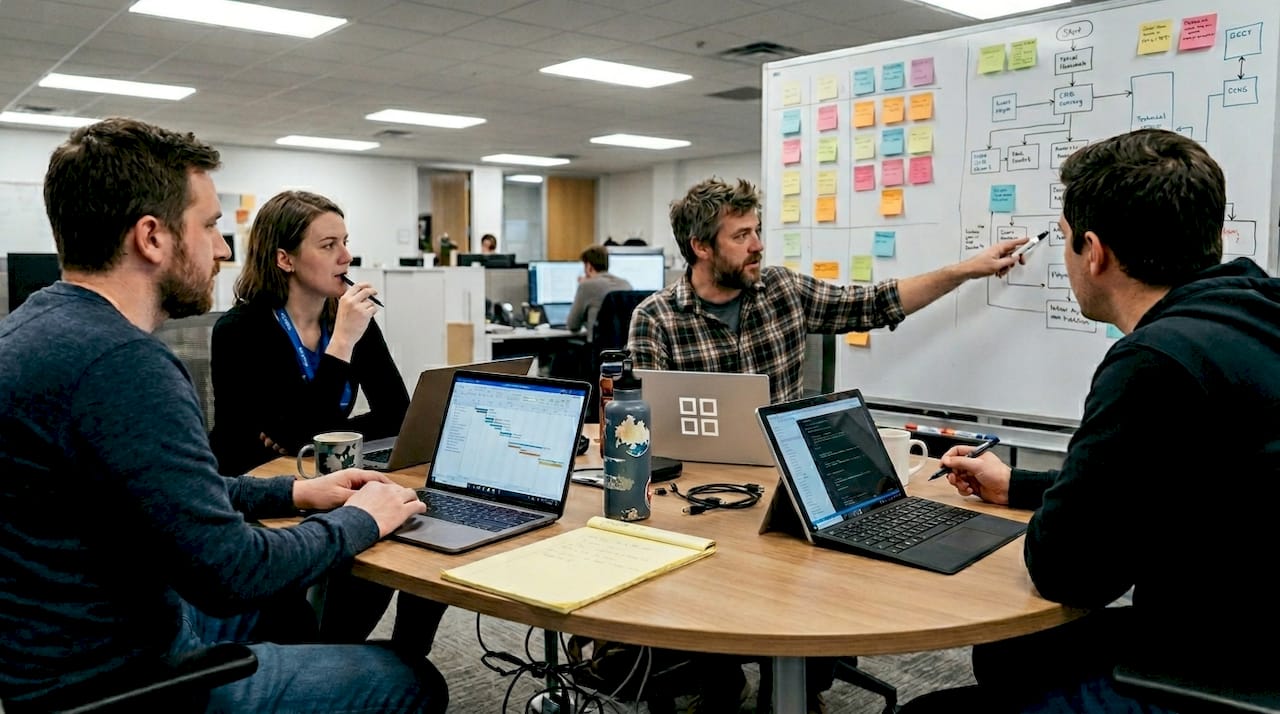
Typical MVP web/mobile projects last 12 to 18 weeks and cost between $50k and $300k depending on complexity. An eCommerce platform with payment processing, inventory management, and customer accounts sits at the higher end. A content-focused app with basic user profiles and social sharing lands toward the lower range.
| Project type | Timeline | Budget range | Key drivers |
|---|---|---|---|
| Simple MVP | 8-12 weeks | $30k-$75k | Basic CRUD operations, minimal integrations |
| Standard web app | 12-16 weeks | $75k-$150k | User authentication, moderate features, API integrations |
| eCommerce platform | 16-24 weeks | $150k-$300k | Payment processing, inventory, admin dashboards |
| Enterprise solution | 24-40 weeks | $300k-$800k+ | Complex workflows, security requirements, legacy integrations |
Applying estimation scope effectively follows a structured process:
- Gather requirements through stakeholder interviews and user research to understand both business goals and technical constraints
- Create a feature prioritization matrix that separates must-haves from nice-to-haves, giving you flexibility when tradeoffs become necessary
- Build a Work Breakdown Structure that maps features to specific tasks with time estimates for each
- Apply your chosen estimation methodology (bottom-up, parametric, or hybrid) to calculate total effort and duration
- Add contingency buffers and review estimates with technical leads to validate assumptions before committing to stakeholders
Pro Tip: Contingency budgets of 10-15% are recommended to cover uncertainties and scope changes. Don't present this as padding. Frame it as risk management for edge cases, integration surprises, and the inevitable requirement clarifications that emerge once development starts.
The shift toward hybrid estimation combines empirical data with iterative Agile practices. You might use parametric models to estimate standard features like user registration or payment processing, then switch to planning poker for custom workflows unique to your client's business. This flexibility lets you move fast on familiar ground while staying rigorous on novel challenges.
Use a software project cost calculator early in planning to pressure test your assumptions. These tools incorporate industry benchmarks and help you spot when your estimates diverge significantly from comparable projects. For ongoing refinement, revisit software estimation best practices as your project evolves and you gather actual data on velocity and productivity.
How Projekto helps with accurate software project estimation
Getting estimation scope right from the start saves you from painful conversations about budget overruns and missed deadlines. Projekto's calculator tools give you data-driven cost estimates in minutes, not days. You input key variables like platform (iOS, Android, web), feature complexity, and integration requirements, and the calculator returns realistic time and budget ranges based on thousands of completed projects.
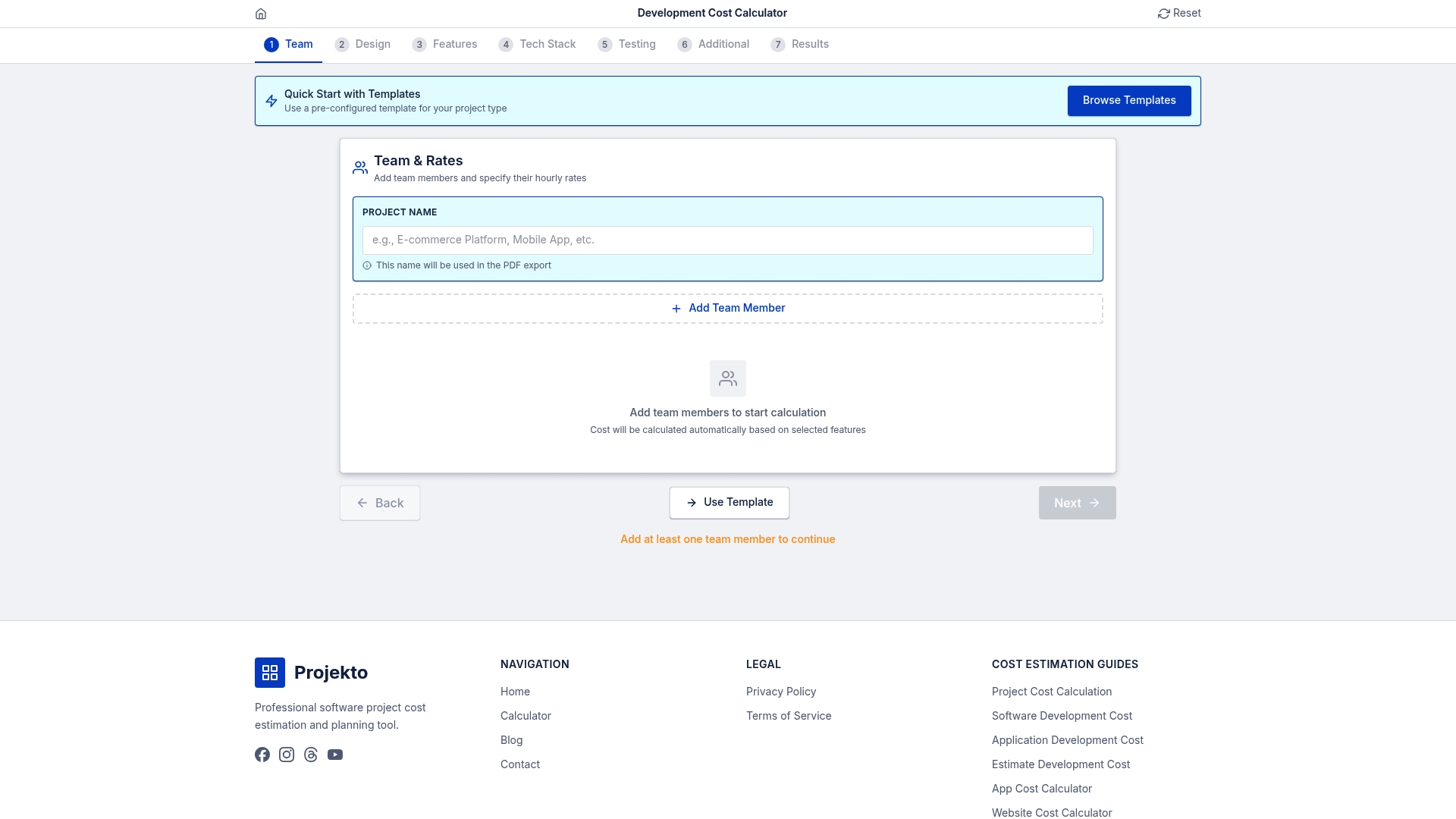
The platform goes beyond generic estimates with specialized cost pages for specific app types. Planning a travel booking app cost estimate? You'll get breakdowns tailored to flight search APIs, payment gateways, and booking confirmation flows. Need an event management app cost estimate? The tool accounts for ticketing systems, venue management, and attendee communication features that generic calculators miss.
Key features that make estimation faster and more reliable:
- Customizable inputs that let you adjust team size, hourly rates, and technology stack to match your specific situation
- Industry benchmarks drawn from real project data so you can validate your estimates against comparable builds
- Feature-level breakdowns that show exactly where time and money get allocated across design, development, and testing
- Export capabilities that turn estimates into stakeholder-ready proposals with detailed justifications
Pro Tip: Run estimates through Projekto during your discovery phase, before you've locked in scope with stakeholders. This gives you negotiating room to adjust features based on budget realities rather than scrambling to cut scope after commitments are made. The software development cost calculator becomes your reality check that prevents overpromising and underdelivering.
Frequently asked questions
What is estimation scope in software development?
Estimation scope defines the boundaries, deliverables, and resource requirements for a software project to enable accurate time and budget predictions. It answers what you're building, what you're not building, and what you need to succeed. Without clear estimation scope, teams struggle with vague requirements that lead to scope creep and cost overruns.
How do estimation scope and project scope differ?
Estimation scope focuses specifically on defining work to enable accurate predictions of time, cost, and resources needed. Project scope is broader, encompassing all work required to deliver the final product, including objectives, deliverables, and acceptance criteria. Estimation scope is a planning tool, while project scope guides execution and defines success.
What are common methods for estimating scope in Agile projects?
Agile teams typically use planning poker where developers independently estimate story points, then discuss differences to reach consensus. Three-point estimation calculates optimistic, pessimistic, and most likely scenarios for each user story. T-shirt sizing groups features into small, medium, or large buckets for quick relative estimation. These methods embrace uncertainty while building team alignment around effort required.
How can we prevent scope creep during estimation?
Document every requirement with specific acceptance criteria that leave no room for interpretation, and get stakeholder sign-off before development starts. Implement formal change control processes that require approval and impact analysis for new requests. Schedule regular scope reviews to compare actual progress against the original plan. Make tradeoffs explicit so stakeholders understand that adding features means adjusting timeline or budget.
Why is a contingency budget important in estimation scope?
Contingency buffers of 10 to 15% accommodate uncertainties like integration challenges, requirement clarifications, and edge cases that emerge during development. They prevent minor surprises from derailing your entire timeline or forcing quality compromises. Framing contingency as risk management rather than padding helps stakeholders understand its value and builds realistic expectations from the start.