

TL;DR:
- Software project estimates fail frequently, with only 31% delivered successfully on time and budget.
- Estimation risk arises from unclear requirements, scope creep, technical unknowns, and optimism bias.
- Using structured methods like three-point estimates, risk reserves, and ongoing review improves accuracy and control.
Software project estimates fail at a rate that should alarm any business owner or project manager: only 31% of IT projects are delivered on time, within budget, and within scope. The remaining 69% either run over budget, miss deadlines, or collapse entirely. Yet most teams treat estimation risk as an unavoidable side effect of doing business rather than a measurable, manageable variable. This guide breaks down what project estimation risk actually is, how it works mechanically, which methods reduce it most effectively, and what the empirical data says about real-world outcomes. Understanding these factors gives you a concrete foundation for smarter budget planning and more realistic time allocation.
Table of Contents
- What is project estimation risk?
- The mechanics: Variability, the Cone of Uncertainty, and estimation frameworks
- Estimation methodologies: How teams forecast time, cost, and risk
- Lessons from the CHAOS Report: Real-world risk and outcomes
- Mitigating estimation risk: Practical tactics and continuous improvement
- Our take: Rethinking estimation risk for smarter software planning
- Take the next step: Estimate with confidence
- Frequently asked questions
Key Takeaways
| Point | Details |
|---|---|
| Estimation risk is unavoidable | Every software project plan contains uncertainty and potential for inaccurate forecasts. |
| Risk changes as projects progress | Estimate variability decreases from early concept to later stages as details emerge. |
| Empirical benchmarks matter | Real-world data shows most projects struggle with estimation, highlighting the need for active risk management. |
| Don’t predict, control | Focus on measuring and controlling risk rather than chasing perfect accuracy. |
| Practical tactics reduce risk | Using proven methods, reviewing estimates often, and learning from past errors helps minimize future overruns. |
What is project estimation risk?
Project estimation risk is not simply the possibility that a project will take longer than planned. It is a broader category of uncertainty that spans effort, cost, timeline, and resource allocation across every phase of a software project. As defined in the field, estimation risk refers to the uncertainty and potential inaccuracy in forecasting effort, time, cost, and resources for software projects, often leading to underestimation, overruns, and failure.
For business owners and project managers, this matters because the consequences are not abstract. Budget overruns consume capital reserves. Missed deadlines erode client trust and market timing. Failed projects destroy sunk investment entirely. The risk is not just financial; it affects team morale, stakeholder confidence, and competitive positioning.
The root causes of estimation risk cluster into three primary categories:
- Unclear or evolving requirements: When stakeholders cannot fully articulate what they need at project start, estimates are built on incomplete information.
- Scope creep: Features added after initial scoping inflate effort without corresponding budget or timeline adjustments.
- Technical unknowns: Integration complexity, third-party API dependencies, and infrastructure decisions introduce variability that is difficult to quantify upfront.
- Optimism bias: Teams consistently underestimate effort because they plan for ideal conditions rather than realistic ones.
- Lack of historical data: Without past project benchmarks, estimates rely on intuition rather than evidence.
"The single most dangerous assumption in software estimation is that the current project will behave like the last one. It rarely does."
Estimation risk also operates at two distinct levels. At the macro level, it affects the overall project sizing steps and total budget commitment. At the micro level, it affects sprint-level accuracy and week-to-week delivery confidence. Both levels require active management, not passive acceptance. Understanding effort estimation for apps at each phase gives teams a structured way to contain uncertainty before it compounds into a crisis.
The mechanics: Variability, the Cone of Uncertainty, and estimation frameworks
With a solid definition in place, let's explore the mechanics and frameworks that drive estimation uncertainty.
The most important structural concept in project estimation is the Cone of Uncertainty. Early estimates vary by 4x, ranging from 0.25x to 4x the actual delivery cost or time. As requirements are defined and designs are approved, that variability narrows to approximately ±10-15% late in the project lifecycle. This is not a flaw in the estimation process; it is a structural property of how information becomes available over time.

Here is how estimate accuracy typically maps to project phases:
| Project phase | Estimate type | Accuracy range |
|---|---|---|
| Concept / ideation | Rough Order of Magnitude (ROM) | -75% to +300% |
| Requirements defined | Budgetary estimate | -25% to +75% |
| Design approved | Definitive estimate | -10% to +25% |
| Development underway | Sprint-level estimate | ±10-15% |
This table illustrates why early budget commitments are inherently risky. A ROM estimate at the concept stage could be off by a factor of four in either direction. Treating that number as a fixed budget is one of the most common and costly mistakes teams make. To avoid estimation mistakes that compound over time, teams should communicate the accuracy range alongside every estimate, not just the number itself.
Frameworks for managing this variability include:
- Rough Order of Magnitude (ROM): Used in early feasibility discussions; always communicated with wide confidence intervals.
- Sprint-based estimation: Breaks work into two-week cycles, allowing frequent recalibration against actual velocity.
- Post-requirements estimation: Conducted after full requirements sign-off to produce the most reliable budget and timeline figures.
Pro Tip: Never present a single-point estimate to stakeholders without a confidence range. A statement like "this will cost $150,000" carries far less planning value than "this will likely cost between $130,000 and $185,000 based on current requirements clarity." The range is the information.
For teams estimating development costs on web or mobile projects, applying the Cone of Uncertainty as a communication tool rather than an excuse for imprecision is a critical shift in practice.
Estimation methodologies: How teams forecast time, cost, and risk
Understanding where uncertainty comes from, it's time to look at how projects forecast risk and effort with specific methods.
Software teams use a range of methodologies depending on project complexity, available data, and stakeholder requirements. Recognized approaches include algorithmic models like COCOMO II and Function Points, expert judgment techniques like Delphi and Planning Poker, analogous estimation, parametric estimation, three-point/PERT analysis, and Monte Carlo simulation for probabilistic risk quantification.
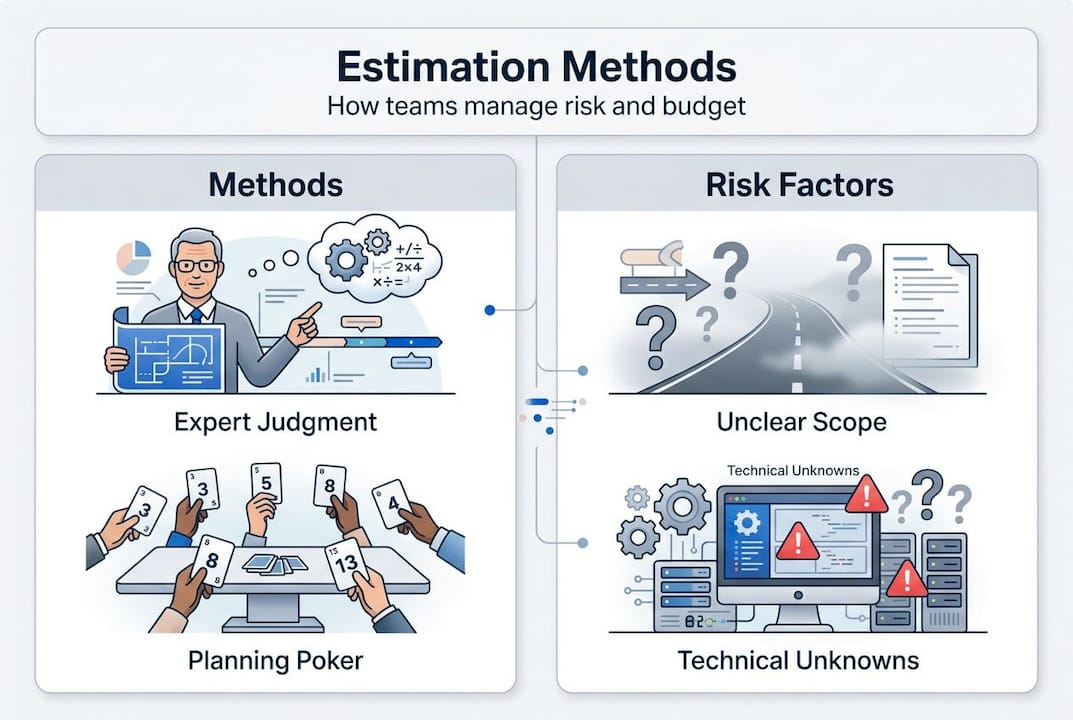
Here is a comparison of the most commonly used methods:
| Method | Best for | Key weakness |
|---|---|---|
| Expert judgment (Delphi, Planning Poker) | Agile teams with experienced members | Subject to groupthink and optimism bias |
| Analogous estimation | Projects similar to past work | Fails when projects differ significantly |
| Three-point / PERT | Risk-aware planning with defined variables | Requires three credible data inputs |
| Monte Carlo simulation | Complex projects with many risk variables | Computationally intensive; needs historical data |
| Algorithmic (COCOMO II) | Large-scale, well-documented projects | Requires calibration to organizational context |
The three-point estimation formula, also known as PERT (Program Evaluation and Review Technique), is particularly useful for business owners who want a structured way to quantify risk. The formula is: (Optimistic + 4 x Most Likely + Pessimistic) / 6. This weighted average accounts for the asymmetric nature of project risk, where pessimistic outcomes tend to be more extreme than optimistic ones.
Key advantages of combining methods:
- Expert judgment captures tacit knowledge that algorithms miss.
- Three-point estimation forces teams to articulate worst-case scenarios explicitly.
- Monte Carlo simulation converts scenario ranges into probability distributions, giving stakeholders a statistically grounded reserve figure.
For team estimation consensus, combining Planning Poker with three-point ranges produces estimates that reflect both collective experience and structured risk thinking.
Lessons from the CHAOS Report: Real-world risk and outcomes
To see how theory translates to practice, let's examine notable industry data on estimation risk.
The Standish Group's CHAOS Report remains the most cited empirical benchmark for software project outcomes. The findings are sobering. Only 31% of projects succeed on time, on budget, and within scope. Fifty percent are challenged, meaning they deliver late, over budget, or with reduced scope. Nineteen percent fail outright. Among challenged projects, budget overruns average 189% of original estimates, and schedule overruns average 222%.
"A project that runs 222% over its original timeline is not a planning failure. It is a risk management failure that began at estimation."
The primary sources of these overruns, as consistently identified across CHAOS research cycles, include:
- Incomplete requirements: Stakeholders approve scope without fully understanding what it entails.
- Lack of user involvement: Insufficient feedback loops lead to rework and scope expansion.
- Unrealistic expectations: Executive pressure to commit to aggressive timelines overrides technical judgment.
- Lack of executive support: Projects without active sponsorship lose resources when conflicts arise.
- Poor change management: Scope changes are absorbed without corresponding estimate revisions.
The data also reveals a size effect. Larger projects fail at higher rates than smaller ones, largely because estimation complexity scales nonlinearly with project size. A $5 million software project carries estimation risks that are not simply five times those of a $1 million project; they are structurally different in kind.
For teams trying to avoid the estimation failure pitfalls documented in CHAOS data, the lesson is clear: the gap between estimate and outcome is almost always traceable to a specific, identifiable cause. Treating overruns as inevitable obscures the root causes that could have been managed.
Mitigating estimation risk: Practical tactics and continuous improvement
Given the real-world risks, let's focus on mitigation strategies you can implement today.
Risk mitigation in project estimation is not about achieving perfect accuracy. It is about reducing the gap between expected and actual outcomes through structured practices. The primary purpose of risk quantification is to assess the realism of targets for control, not prediction, using tools like Expected Monetary Value (EMV) and Monte Carlo simulation to calculate appropriate reserves.
Practical tactics for reducing estimation risk include:
- Build contingency reserves explicitly: A 15-20% reserve for well-defined projects, and 30-40% for projects with significant technical unknowns, is standard practice.
- Use scenario planning: Develop best-case, base-case, and worst-case estimates for every major project phase.
- Conduct frequent estimate reviews: Revisit estimates at each project milestone, not just at kickoff. Reviewing estimations at regular intervals catches scope drift before it becomes a budget crisis.
- Define the estimation scope clearly: Ambiguous scope boundaries are the leading cause of underestimation. A clear estimation scope guide reduces the surface area for surprises.
- Capture lessons learned: After each project, document where estimates diverged from actuals and why. This institutional knowledge is the foundation of improving future accuracy.
- Align the team on estimation strategy: A shared team estimation strategy ensures that developers, project managers, and business owners are working from the same assumptions.
Pro Tip: Do not wait until a project is over budget to revise your estimates. Set a formal review trigger, such as a 10% variance from planned spend, that automatically initiates a re-estimation session. Early intervention is always cheaper than late correction.
For business owners focused on accurate app budgeting, the most impactful single change is shifting from point estimates to range-based estimates with explicit risk reserves. This one practice reduces the frequency of budget shock significantly.
Our take: Rethinking estimation risk for smarter software planning
Most teams approach estimation as a prediction exercise. The goal, as conventionally understood, is to produce a number that matches reality as closely as possible. We think this framing is fundamentally limiting.
The more useful goal is control. An estimate is a planning instrument, not a forecast. When teams treat estimates as tools for conversation and decision-making rather than fixed commitments, they make better choices at every stage of development. They allocate contingency reserves. They define decision points where scope can be adjusted. They communicate uncertainty honestly to stakeholders instead of hiding it behind false precision.
The data supports this shift. Projects that estimate software development cost using scenario-based approaches and explicit risk buffers consistently outperform those that commit to single-point estimates under stakeholder pressure. The most successful project teams we observe treat every estimate as a hypothesis to be tested and revised, not a contract to be defended. Adaptive estimation is not a concession to uncertainty; it is the most professional response to it.
Take the next step: Estimate with confidence
Understanding estimation risk is the first step. Applying that understanding to your actual projects is where the real value is created.
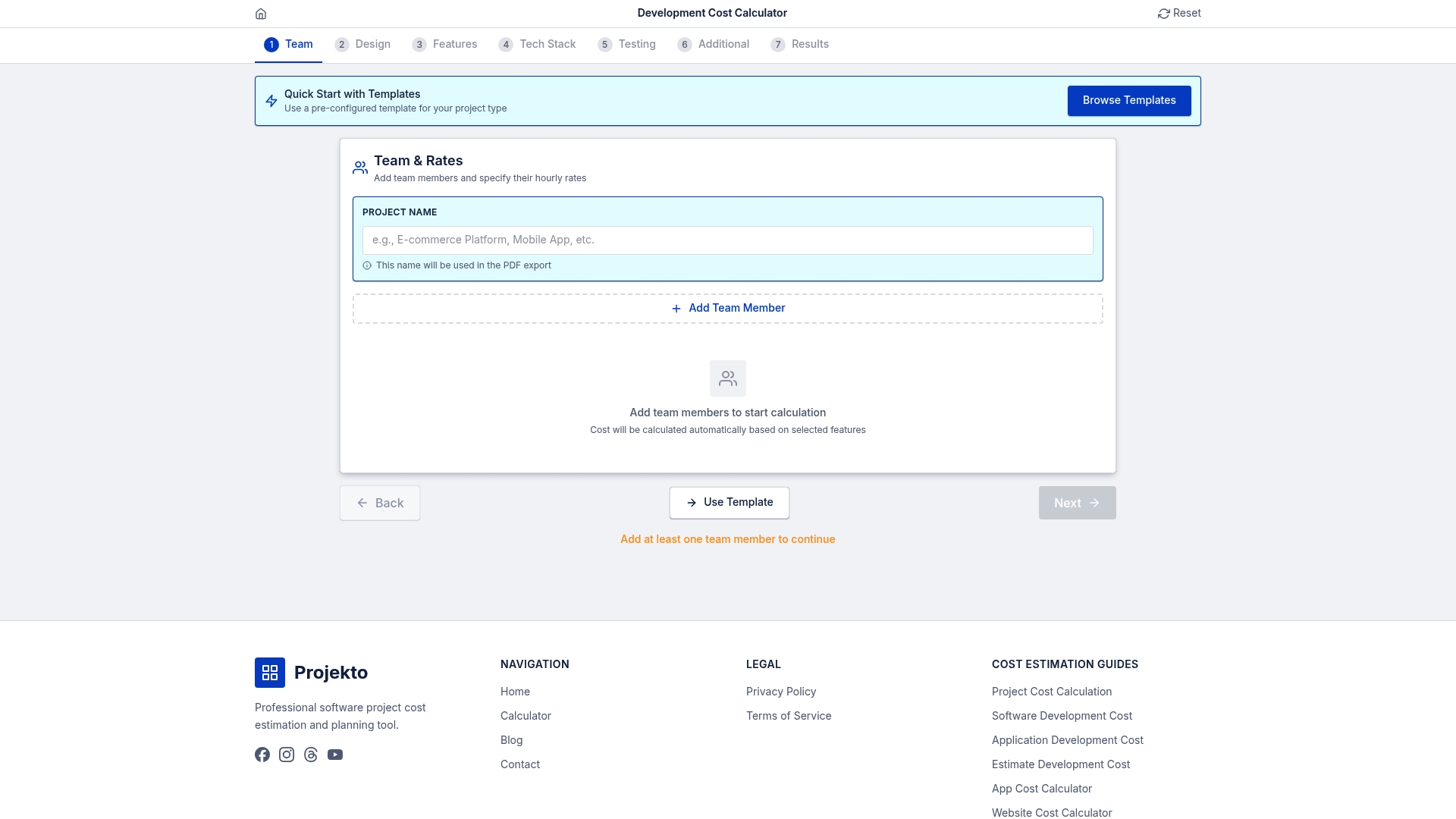
The Projecto Calculator gives business owners and project managers a structured, evidence-based way to generate time and budget estimates for web and mobile app development. Instead of relying on guesswork or rough industry averages, you get a risk-aware starting point grounded in real project parameters. Use the development cost calculator to build your initial estimate, then layer in the scenario planning and contingency practices covered in this guide. Pair the tool with our library of estimation guides to continuously refine your approach and reduce the gap between planned and actual outcomes on every project you manage.
Frequently asked questions
How do you quantify project estimation risk?
Project estimation risk can be quantified using methods like Monte Carlo simulation or Expected Monetary Value analysis to calculate reserves and probability ranges for budget and timeline outcomes.
What are the main causes of estimation errors in software projects?
Most errors stem from unclear requirements, evolving scope, technical unknowns, and reliance on early rough estimates, all of which are identified as core drivers of forecasting inaccuracy in software projects.
How accurate are software project estimates at different stages?
Early estimates vary by 4x actual delivery; accuracy improves to ±10-15% as requirements and designs clarify through the project lifecycle.
Which estimation methods are best for minimizing risk?
Three-point/PERT, expert consensus methods like Planning Poker, and Monte Carlo simulation are recognized for their effectiveness in structuring and reducing estimation risk.
What does the Standish CHAOS Report say about estimation success rates?
Only 31% of IT projects succeed on time, on budget, and within scope; 50% are challenged and 19% fail outright, with average budget overruns of 189%.