

TL;DR:
- Iterative costing involves regularly updating project budgets throughout development to reflect current scope and progress.
- This approach reduces risks, improves accuracy, and enhances client transparency compared to traditional fixed estimates.
- Implementing iterative costing requires structured reviews, clear communication, and dedicated tools for ongoing estimation refinement.
Most entrepreneurs walk into an app development engagement expecting a fixed number: a single estimate that covers every feature, every sprint, and every line of code. That expectation is understandable, but it consistently produces budget overruns, missed deadlines, and strained client-vendor relationships. The root problem is not poor planning. It is the assumption that all requirements are knowable at the start of a complex software project. Iterative costing challenges that assumption directly. By reassessing scope, time, and budget at regular intervals throughout development, this approach produces estimates that stay aligned with reality as the project evolves. This guide explains what iterative costing is, how it compares to traditional methods, the concrete benefits it delivers, and how to implement it effectively on your next app project.
Table of Contents
- What is iterative costing in app development?
- Traditional costing vs iterative costing: A side-by-side view
- Benefits of iterative costing for entrepreneurs and project managers
- How to implement iterative costing in your app project
- A real-world take on iterative costing: What most guides miss
- Streamline your next project with accurate cost estimation
- Frequently asked questions
Key Takeaways
| Point | Details |
|---|---|
| Iterative costing adapts to change | It allows you to update budgets as project needs shift, reducing costly surprises. |
| Higher accuracy and trust | Frequent reviews and updates lead to better predictions and stronger relationships between teams and clients. |
| Step-by-step implementation | You can adopt iterative costing in phases, starting with regular reviews and workshops. |
| Tools make it easier | Online calculators and estimation frameworks streamline the iterative costing process. |
What is iterative costing in app development?
Iterative costing is a structured approach to project budgeting in which cost and time estimates are revisited and updated at defined intervals throughout the development lifecycle, rather than locked in at the project kickoff. Each reassessment incorporates new information: completed work, scope changes, technical discoveries, and stakeholder feedback. The result is a living budget that reflects current project reality instead of an educated guess made weeks or months earlier.
Traditional up-front estimates fail for a predictable reason. Requirements documents written before a single line of code is produced are inherently incomplete. Product owners discover new needs during design reviews. Engineers encounter integration challenges that were not visible during scoping. Third-party API constraints surface mid-development. Any fixed estimate built on pre-development assumptions accumulates error with every passing sprint.
Iterative costing fits naturally into agile and sprint-based development workflows. Each sprint or milestone closes with a retrospective that includes a budget review. The team examines what was built, what changed, and what the remaining work looks like given current knowledge. That review feeds into a revised estimate for the next cycle, keeping all stakeholders aligned before surprises become crises.
This approach is especially valuable when estimating project costs for projects where requirements are complex, user research is ongoing, or regulatory constraints may shift. As a practical rule: the higher the uncertainty in your project, the stronger the case for iterative costing.
Here is when iterative costing is the right fit:
- Requirements are defined at a high level but lack technical detail
- The product involves third-party integrations with uncertain performance characteristics
- The client team expects to refine features based on early user testing
- The scope includes emerging technology with limited precedent
- Stakeholder priorities are likely to evolve during the build phase
Pro Tip: Use iterative costing as your default when working with any new technology stack or when building a product in a regulated industry such as healthcare or fintech. The cost of a missed assumption in these contexts is significantly higher than the overhead of regular estimate reviews.
Iterative costing adapts to changing project requirements and reduces estimation errors by grounding every cycle in verified data rather than projections.
Traditional costing vs iterative costing: A side-by-side view
With a basic understanding of iterative costing, it helps to see how it compares directly with the traditional approach used in fixed-price or waterfall engagements.
| Characteristic | Traditional costing | Iterative costing |
|---|---|---|
| Estimation timing | Single estimate at project start | Revised at each sprint or milestone |
| Flexibility | Low | High |
| Risk exposure | Front-loaded | Distributed across cycles |
| Cost accuracy | Decreases as scope changes | Improves over project lifetime |
| Client transparency | Limited after kickoff | Continuous throughout project |
| Scope change handling | Requires formal change orders | Incorporated in next cycle review |
| Client satisfaction | Often lower due to surprises | Higher due to ongoing alignment |
Iterative costing increases accuracy and transparency compared to traditional methods, particularly in projects where scope evolution is expected rather than the exception.
There are scenarios where traditional costing remains appropriate. A project with fully documented, legally fixed specifications such as a government procurement contract may benefit from fixed-price agreements. Internal tooling with no user-facing unknowns, or a simple feature addition to an existing stable codebase, may also not require iterative review cycles. The key distinction is the level of uncertainty present at the start of the engagement.
The most significant weaknesses of traditional costing include:
- Scope creep goes unpriced: New features get absorbed informally, inflating actual costs without budget authorization
- Deadline pressure compounds: Teams that fall behind schedule often compress testing phases, raising defect rates
- Change orders create friction: Every discovered requirement triggers a negotiation, slowing development momentum
- Estimates age poorly: A six-month-old estimate rarely reflects the current state of a project accurately
- Stakeholder misalignment grows: Clients receive limited financial updates until delivery, at which point surprises are expensive
Avoiding these outcomes requires recognizing them early. Understanding software estimation mistakes is the first step toward choosing the right costing model for your specific project context.
Benefits of iterative costing for entrepreneurs and project managers
Seeing how iterative costing stacks up, let's look at the actual benefits you will notice as a project sponsor or manager working within an iterative budget model.
Budget flexibility with documented control. Iterative costing does not mean unlimited spending. It means that every budget adjustment is visible, justified, and approved before work proceeds. Entrepreneurs retain control because changes surface at review points rather than appearing as line items on a final invoice.
Iterative reviews can improve project outcome reliability by up to 30%, a figure that reflects the compounding value of catching scope drift early rather than absorbing it at delivery.
"The projects that stay on budget are rarely the ones with the most detailed initial estimates. They are the ones with the most disciplined review processes."
Here are the key stages where iterative costing minimizes risk:
- Scope definition phase: Iterative budgeting begins with a rough-order-of-magnitude estimate, reducing the pressure to define every feature before work starts
- End of sprint 1: First real-world data on team velocity and technical complexity informs a revised estimate with substantially lower variance
- Post-design review: UX and UI decisions often reveal new functional requirements. A review at this point resets budget assumptions with current scope
- Integration milestone: API and third-party service integration frequently surfaces unforeseen complexity. A review here prevents cost shock in later sprints
- Beta or user testing phase: User feedback typically generates a prioritized change list. Iterative costing provides a structured mechanism for evaluating which changes fit within budget
- Pre-launch checkpoint: A final review aligns delivery scope with the original business objectives and confirms that post-launch support costs are accounted for
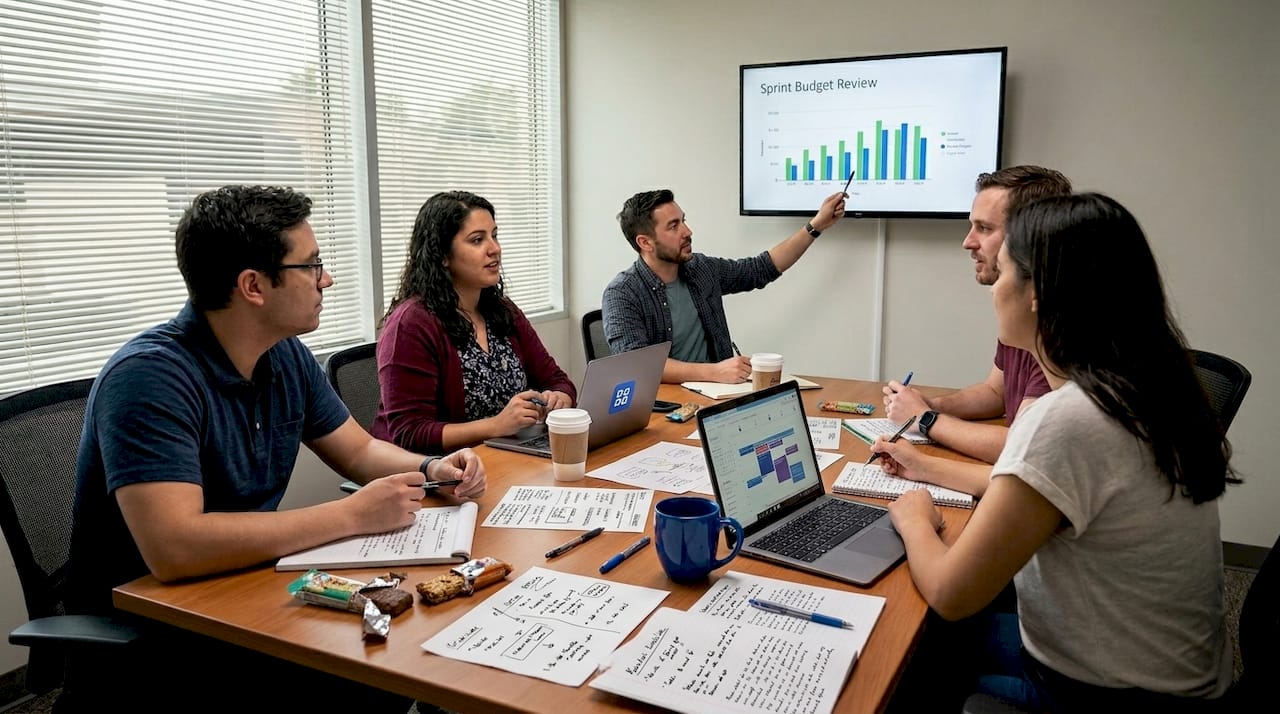
For project managers, the communication benefit is equally valuable. When both client and technical teams share a regularly updated estimate, conversations shift from blame to problem-solving. The budget becomes a shared tool rather than a source of conflict. Improving estimate reliability at each stage also builds the kind of trust that leads to long-term client relationships and repeat engagements.
How to implement iterative costing in your app project
Ready to put iterative costing into action? Here is how to make the switch and position your team for consistent execution.
Step-by-step implementation guide:
- Run an estimation workshop before sprint 1: Bring together product owners, engineers, and designers to walk through requirements and produce initial story-level estimates. Estimation workshops increase predictability and stakeholder buy-in by surfacing assumptions before they become costly surprises
- Define your review cadence: Decide whether reviews will happen every sprint (typically two weeks) or every milestone. Document this schedule and make it non-negotiable
- Assign a budget owner for each review: One person should be accountable for collecting actuals, comparing them to the plan, and presenting the revised estimate to stakeholders
- Communicate updates in writing: Every review should produce a brief written summary of what changed, why it changed, and what the revised estimate is. This creates an audit trail that protects both the client and the development team
- Re-prioritize the backlog at each cycle: Use the revised estimate to inform feature prioritization. If costs are running higher than projected, remove lower-priority items before proceeding
Pro Tip: Document all assumptions explicitly at every review cycle. When an assumption changes, note what it was, why it changed, and what the cost implication is. This practice eliminates the ambiguity that causes disputes at project close.
Here is a practical reference for review intervals and deliverables:
| Review point | Trigger | Deliverable | Re-estimation scope |
|---|---|---|---|
| Sprint retrospective | End of each sprint | Velocity-adjusted forecast | Remaining sprints |
| Milestone review | Feature set completion | Scope and cost summary | Full project remainder |
| Integration checkpoint | Third-party services live | Risk-adjusted estimate | Integration and QA phases |
| Beta feedback session | User testing complete | Change impact analysis | Final sprint and launch prep |
The most common pitfalls in iterative costing include skipping reviews when the team is under delivery pressure, using vague requirements that prevent meaningful re-estimation, and failing to communicate changes to all stakeholders before the next sprint begins. Each of these issues is preventable with consistent process discipline.
A real-world take on iterative costing: What most guides miss
Most articles on iterative costing present it as an obvious improvement over traditional methods. That framing is accurate but incomplete. In practice, the transition is not always comfortable, and understanding the friction points matters as much as understanding the process steps.
Some clients initially resist iterative costing because transparency can feel like unpredictability. A revised estimate mid-project, even when it reflects a genuine improvement in scope clarity, can read as instability. The solution is framing: every review should be presented as a demonstration of control, not a sign of problems. Teams that communicate this consistently build client confidence rather than eroding it.
What actually changes internally when budgets are reviewed regularly is that engineers become more accountable to business outcomes. Estimation stops being a pre-project exercise and becomes an ongoing professional discipline. This shift takes time, but real-world estimating experience consistently shows that teams who practice iterative costing become measurably better estimators over successive projects.
Being "less wrong" through iterative review is structurally superior to being precisely inaccurate with a fixed number. The fixed estimate feels safer, but it consistently produces worse outcomes.
Streamline your next project with accurate cost estimation
Understanding iterative costing is valuable. Applying it to your specific project, with its unique tech stack, team structure, and feature set, requires the right tooling to support each review cycle.
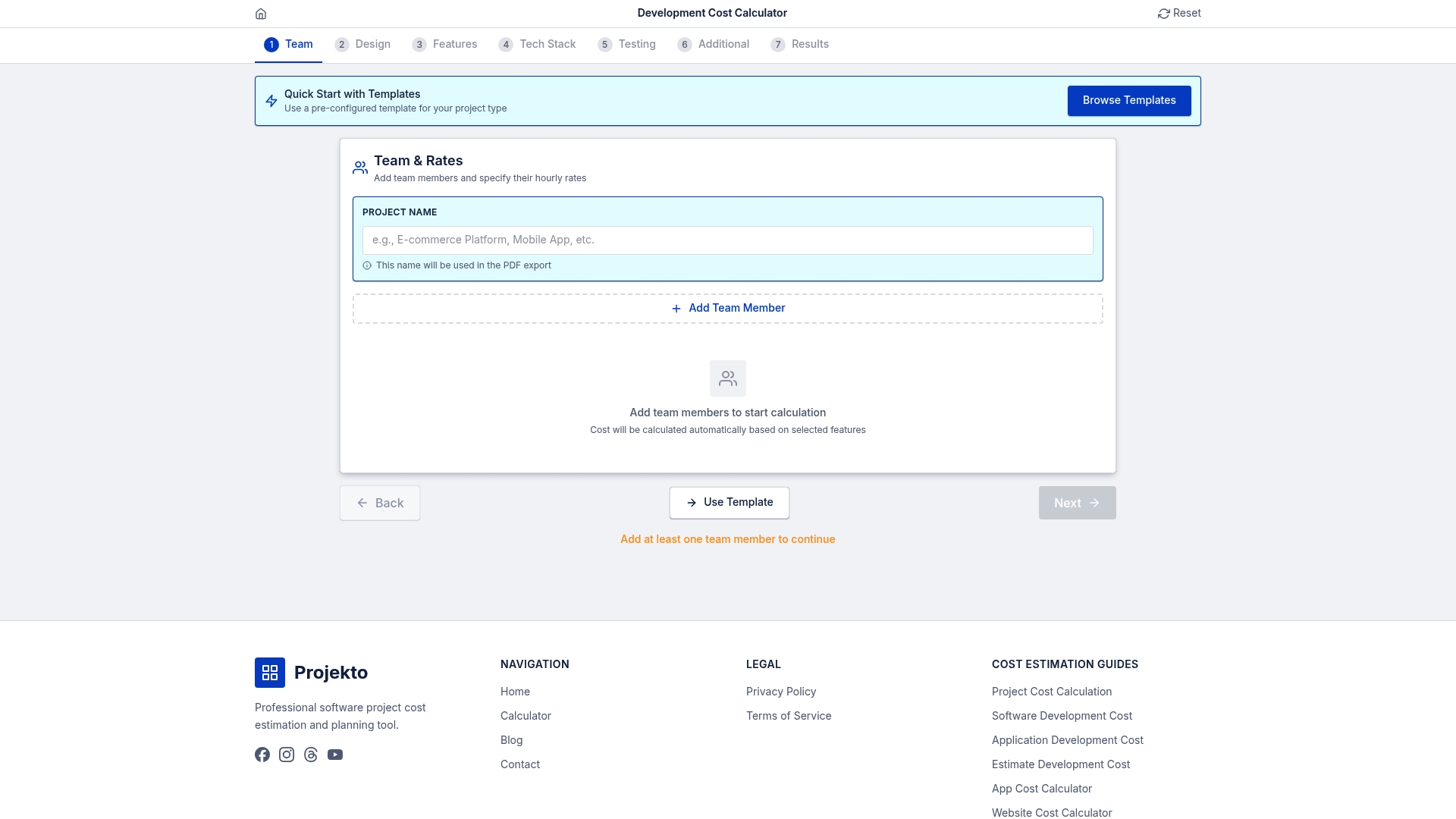
Our cost calculator is purpose-built to support iterative budgeting workflows, allowing you to revise and refine estimates as your project scope evolves rather than committing to a single fixed number. Whether you are scoping a SaaS platform, a marketplace, or reviewing the event app cost for a specific vertical, the calculator provides structured, sprint-aligned estimates that grow more accurate with every project cycle. Start your first iterative estimate today and give your budget the precision it deserves.
Frequently asked questions
What is the main advantage of iterative costing in app development?
Iterative costing provides more accurate budgets by regularly updating estimates as the project evolves, keeping financial projections aligned with actual scope and progress. This reduces estimation errors compared to fixed up-front quotes.
Can any type of app project benefit from iterative costing?
Most projects benefit, especially those with dynamic or evolving requirements. Simple, fully specified projects with low uncertainty may need fewer review cycles, but even these projects gain from at least one mid-project budget checkpoint. Iterative costing adapts to changing requirements across project types.
How often should cost estimates be revisited in an iterative approach?
Reviewing estimates at the end of every sprint or project milestone is the recommended standard. Estimation workshops and structured review cycles increase predictability and ensure stakeholders remain aligned throughout the build.
Does iterative costing increase project management overhead?
It requires more regular reviews than traditional models, but the overhead is offset by fewer budget disputes, lower rework rates, and better stakeholder alignment. Iterative costing increases transparency compared to traditional methods, which reduces costly surprises at delivery.
Where can I find a tool to get started with iterative app cost estimation?
A dedicated estimation calculator supports iterative budgeting by allowing you to update scope and cost assumptions at each project cycle. This approach aligns with the principle that iterative costing adapts to changing project requirements to reduce long-term estimation errors.