

TL;DR:
- Infrastructure cost estimation is crucial for preventing budget overruns and ensuring project longevity.
- Integrating automated tools into development workflows improves accuracy and real-time cost control.
- Addressing edge cases like traffic spikes and multi-region deployment ensures reliable budget predictions.
Software budgets are not just about developer hours. Many projects hit critical funding walls months after launch, not because the code was flawed, but because no one modeled what it would actually cost to run. Unexpected cloud bills from infrastructure changes kill projects by removing the financial visibility needed to detect issues like oversized instances or missing lifecycle policies before they become expensive problems. For business leaders and project managers, infrastructure cost estimation is not a technical afterthought. It is a strategic discipline that determines whether a promising application survives its first year of operation or gets quietly shut down due to uncontrolled operating expenses.
Table of Contents
- The hidden dangers of skipping infrastructure cost estimation
- Why proactive estimation unlocks project control and accountability
- Modern tools and techniques for accurate infrastructure cost estimation
- Addressing edge cases: What most estimators miss
- Connecting infrastructure cost estimates to business outcomes
- Why most infrastructure cost estimates fail—and the mindset shift that changes everything
- Take the guesswork out of project budgeting
- Frequently asked questions
Key Takeaways
| Point | Details |
|---|---|
| Cost estimation prevents overruns | Upfront infrastructure cost estimation eliminates surprises and supports smarter, controlled project growth. |
| Modern tools offer real-time feedback | Integrating calculators like Infracost into CI/CD pipelines enables immediate visibility into cost changes. |
| Model edge cases for accuracy | Address traffic spikes, regional differences, and scale scenarios to avoid underestimating true costs. |
| Tie costs to business metrics | Translate estimates to unit economics and revenue to guide strategic decisions with confidence. |
The hidden dangers of skipping infrastructure cost estimation
Most project teams invest significant effort in estimating application development cost during the planning phase, yet treat infrastructure expenses as a variable to figure out later. This creates a dangerous blind spot. Cloud services scale dynamically, and without a pre-deployment forecast, the gap between expected and actual monthly bills can grow to multiples of the original estimate within weeks of launch.
The consequences of skipping infrastructure cost estimation are not limited to budget overruns. Teams that lack cost forecasts often respond to surprise bills with reactive cuts: downgrading server tiers, disabling monitoring services, or reducing redundancy. Each of these decisions directly degrades product quality and user experience, creating a second-order problem that compounds the original financial one.
Here are the most common failure patterns that emerge when teams skip infrastructure estimation:
- Oversized compute instances provisioned for worst-case load but running at 10% utilization for months
- Missing lifecycle policies on storage buckets that accumulate data and cost indefinitely
- Untracked data egress charges that appear as line items no one budgeted for
- Third-party API costs treated as negligible during development but significant at scale
- Multi-environment sprawl where staging, QA, and development environments run full-time unnecessarily
"Estimating costs before deployment provides visibility into the financial impact of changes, enabling early detection of issues like oversized instances or missing lifecycle policies before they reach production."
Building accurate app budgets requires treating infrastructure as a first-class budget line, not an afterthought. Teams that model infrastructure costs before writing a single line of deployment configuration gain the ability to evaluate architectural tradeoffs with financial data in hand, not just technical preference.
Now that the stakes are clear, let's explore how proactive estimation transforms project outcomes.
Why proactive estimation unlocks project control and accountability
When cost estimation is integrated into the development workflow from the start, it fundamentally changes how technical decisions get made. Rather than treating cloud spend as a post-launch concern, estimating development costs early makes cost a first-class concern in code review alongside security and correctness, creates audit trails linking changes to financial impact, and allows setting hard budget limits to block deployments that exceed thresholds.

This shift has measurable operational benefits. Consider the difference between two project governance models:
| Governance model | Cost visibility | Review lag | Budget enforcement |
|---|---|---|---|
| Reactive monthly review | Low | 30-day lag | Manual, after the fact |
| Pre-deployment estimation | High | Real-time | Automated guardrails |
The FinOps framework, which follows an Inform-Optimize-Operate cycle, mandates pre-deployment estimation for shift-left accountability, explicitly contrasting it against reactive monthly reviews that introduce a 30-day lag before problems are visible. For organizations managing multiple concurrent projects, that lag is the difference between catching a cost anomaly early and absorbing an unexpected five-figure bill.
Audit trails are particularly valuable for project governance. When every infrastructure change is linked to a cost delta, project managers can trace exactly which code change triggered a budget spike. This level of traceability supports both internal accountability and external reporting to stakeholders or investors.
Avoiding costly estimation mistakes also means establishing cost guardrails that enforce business priorities automatically. If a deployment would push monthly infrastructure spend above a defined threshold, the system blocks it and requires explicit approval. This removes the human error factor from cost governance entirely.
Pro Tip: Set cost guardrails at 80% of your monthly infrastructure budget, not 100%. The 20% buffer gives your team time to investigate and respond before the limit is actually breached.
Understanding the benefits leads us to the practical side: what techniques and tools make accurate estimation possible?
Modern tools and techniques for accurate infrastructure cost estimation
The tooling landscape for infrastructure cost estimation has matured significantly. Automated platforms now parse Infrastructure as Code configurations and produce real-time cost feedback without requiring manual spreadsheet work. This removes the bottleneck of waiting for a finance team to review cloud bills after the fact.
Here is a practical sequence for integrating cost estimation into your development workflow:
- Define your infrastructure in code using tools like Terraform or Pulumi, which create machine-readable configurations that estimation tools can parse automatically.
- Integrate an estimation tool into your CI/CD pipeline so that every pull request triggers a cost delta calculation before merging.
- Review cost diffs in pull requests alongside code changes, treating a significant cost increase as a review flag just like a security vulnerability.
- Set budget thresholds in your pipeline configuration to block or flag deployments that exceed defined cost limits.
- Track unit economics by dividing total infrastructure cost by active users or transactions to measure efficiency over time.
Infracost parses Terraform plans to estimate costs and integrates into CI/CD pipelines, generating pull request comments that show delta costs, for example flagging a +$121.76 monthly increase from a single RDS configuration change before it reaches production.
| Tool category | Example | Primary use case |
|---|---|---|
| IaC cost parser | Infracost | Terraform plan cost diffs |
| Cloud native calculator | AWS Pricing Calculator | Service-level estimates |
| FinOps platform | CloudHealth, Apptio | Portfolio-level optimization |
| Custom scripting | Python + cloud APIs | Bespoke unit economics models |
Integrating integration effort estimation alongside infrastructure cost analysis gives project managers a complete picture of both build and run expenses, which is essential for accurate total cost of ownership calculations.
However, estimation is never simple. Edge cases can break even the best tools. Here's what to watch out for.
Addressing edge cases: What most estimators miss
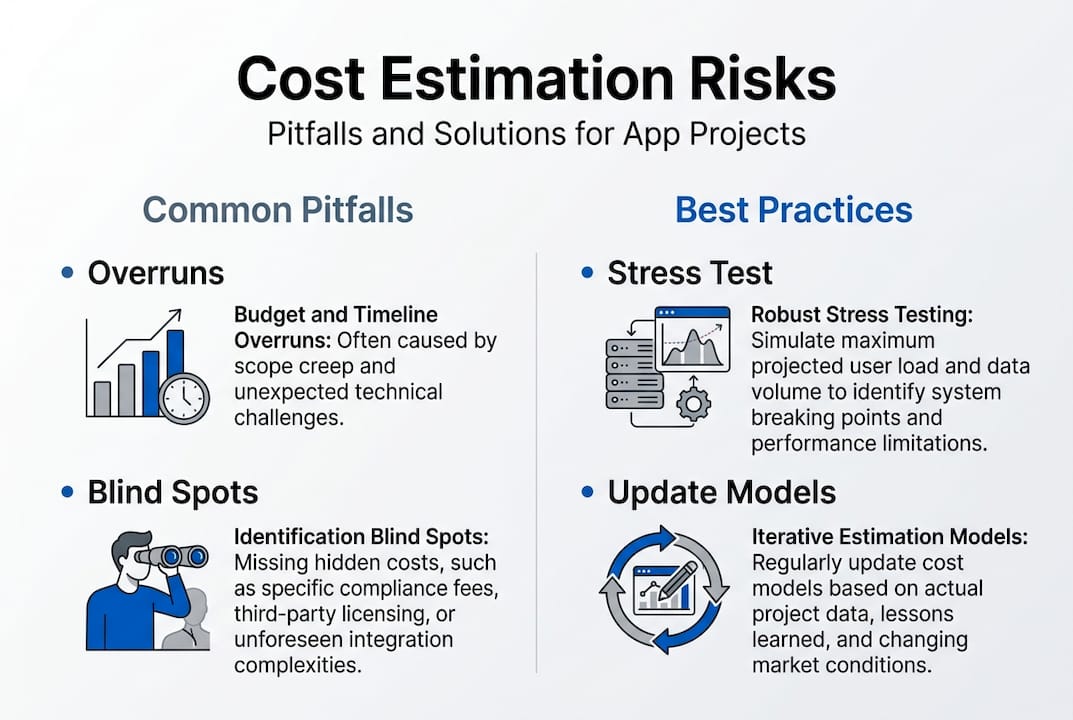
Standard estimation tools perform well under stable, predictable load conditions. The problems emerge when real-world usage patterns deviate from the baseline assumptions baked into those tools. Static calculators fail on fluctuating traffic and autoscaling scenarios, ignore egress and API costs, and cannot account for multi-region deployments or AI and GPU workload spikes without custom modeling.
For any application cost calculation to be defensible, it needs to account for the following edge cases:
- Traffic bursts and autoscaling: A promotional campaign or viral moment can spike compute costs by 5x to 10x within hours. Standard estimates assume flat or gradual growth.
- Data egress fees: Moving data out of a cloud provider's network incurs charges that most pre-deployment calculators ignore entirely. At scale, egress can represent 15% to 30% of total cloud spend.
- Multi-region deployments: Running infrastructure across multiple geographic regions for latency or compliance reasons multiplies costs in ways that single-region estimates do not capture.
- AI and GPU workloads: Machine learning inference and training jobs consume GPU resources at rates that are orders of magnitude higher than standard compute, and usage patterns are highly irregular.
- Third-party API call volume: Per-call pricing from mapping, payment, or communication APIs scales directly with user activity and is frequently underestimated during planning.
Pro Tip: Always model your infrastructure costs at 1x, 5x, and 10x your expected launch traffic. If the 10x scenario is financially unviable, you need to redesign the architecture before building, not after.
Building project estimators accuracy into your process means stress-testing every cost model against growth scenarios. For teams pricing custom development for clients, this level of scenario modeling is also a competitive differentiator that builds client trust.
After mastering the edge cases, you're positioned to make estimation work for your project. Let's put this into action.
Connecting infrastructure cost estimates to business outcomes
Raw infrastructure cost numbers are useful for engineers but rarely actionable for business leaders. The translation layer between technical spend and business decisions is unit economics: expressing infrastructure costs as cost per user, cost per transaction, or cost per active session.
Here is a structured approach to connecting cost estimates to business outcomes:
- Calculate cost per active user by dividing total monthly infrastructure spend by monthly active users. This metric scales with your business model and makes cost discussions concrete.
- Map costs to revenue scenarios by modeling what infrastructure spend looks like at 10,000, 100,000, and 1,000,000 users alongside projected revenue at each tier.
- Use estimates in vendor negotiations by entering conversations with cloud providers armed with detailed usage projections, which enables committed use discounts and reserved instance pricing.
- Separate technical and financial assumptions in your estimates so that stakeholders can challenge each independently without conflating engineering decisions with pricing judgments.
Unit economics over raw dollars give business leaders and project managers the ability to tie infrastructure spend directly to revenue for investment decisions, rather than treating cloud costs as an opaque technical expense.
"The most defensible estimates separate effort, duration, financial, and confidence judgments. When stakeholders can see which assumptions drive the numbers, they can engage with the estimate rather than simply accepting or rejecting it."
Connecting infrastructure costs to SaaS pricing models is particularly important for subscription-based products, where infrastructure cost per user directly determines gross margin and the viability of different pricing tiers.
Now you have the frameworks and best practices. Here is how real experts think about the art and science behind cost estimation.
Why most infrastructure cost estimates fail—and the mindset shift that changes everything
The most common reason infrastructure cost estimates fail is not a lack of tools. It is a flawed mental model. Many teams treat estimation as a ritual: produce a number, get approval, move on. The number becomes a commitment rather than a model, and when reality diverges, the estimate is blamed rather than updated.
Effective estimation separates effort, duration, financial, and confidence judgments and uses analogous or parametric models rather than single-point guesses. A range with explicit confidence intervals is more honest and more useful than a precise number that implies certainty no one actually has.
Avoiding estimation mistakes requires treating your cost model as a living document. Update it when architectural decisions change, when traffic patterns shift, or when vendor pricing changes. The estimate is not done when the project starts. It is done when the project ends.
The teams that consistently deliver projects within budget are not the ones with the most sophisticated tools. They are the ones that treat estimation as an ongoing discipline, not a one-time exercise.
Take the guesswork out of project budgeting
Accurate infrastructure cost estimation is the foundation of every successful app launch. Without it, even well-executed projects face avoidable financial risk.
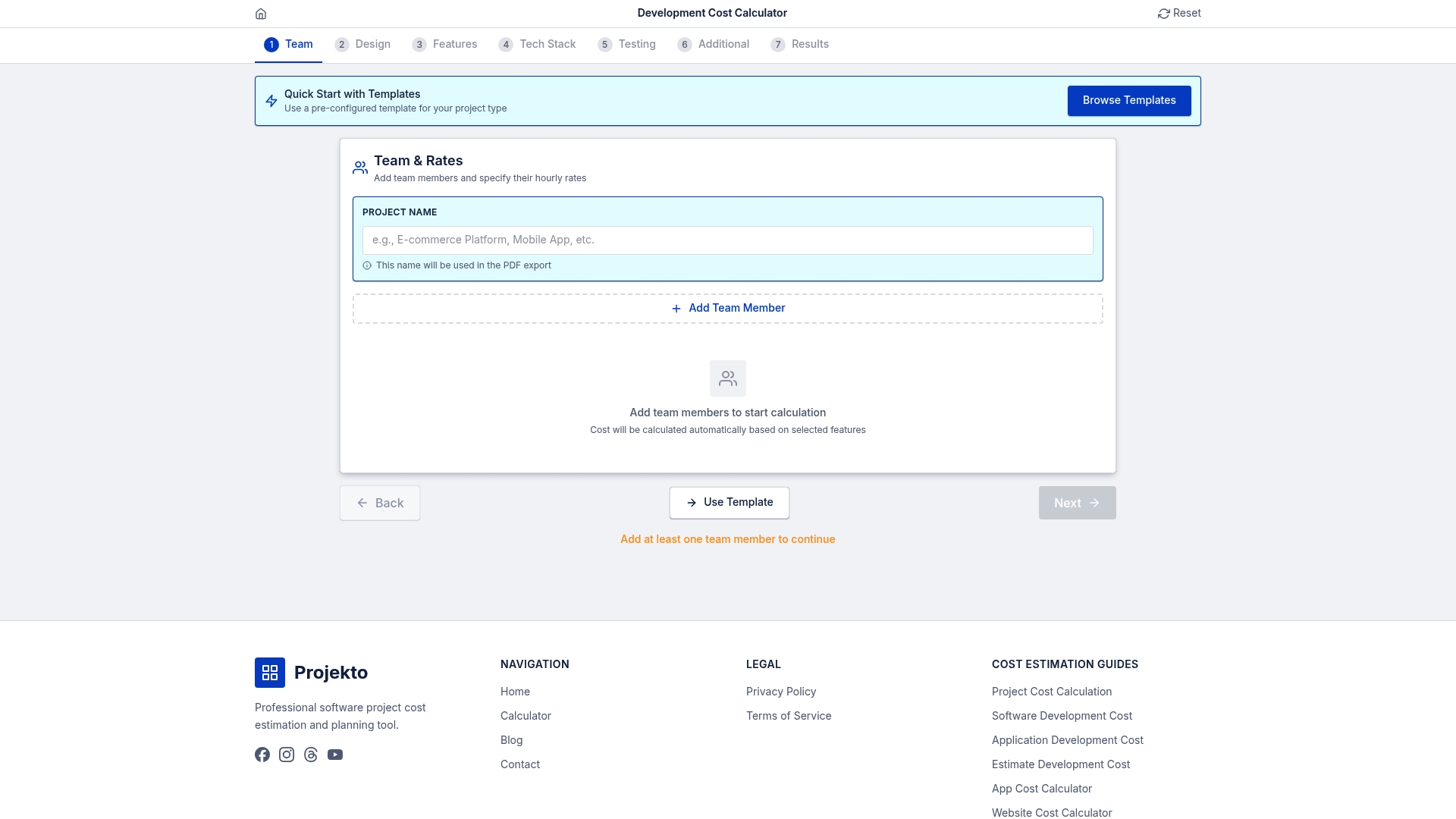
Our infrastructure cost calculator gives project managers and business leaders a structured way to model web and mobile app costs before committing to architecture or vendors. Whether you're planning an event app cost estimate or evaluating a healthcare app cost estimate, scenario-based planning tools help you stress-test assumptions and present defensible budgets to stakeholders. Start integrating cost estimation into every project phase, not just the kickoff meeting.
Frequently asked questions
What is infrastructure cost estimation?
Infrastructure cost estimation forecasts the recurring and variable expenses of hosting, scaling, and running your app's technical environment before launch. Estimating before deployment provides visibility into the financial impact of architectural changes before they reach production.
Why do traditional calculators often underestimate costs?
They miss dynamic factors like traffic spikes, autoscaling behavior, and regional price differences. Static calculators fail on fluctuating traffic and autoscaling scenarios, and they routinely ignore egress, API, and multi-region costs.
How can I connect infrastructure costs to business outcomes?
Focus on unit economics like cost per user or cost per transaction and tie these numbers directly to your revenue forecasts. Unit economics over raw dollars give decision-makers the context needed to evaluate infrastructure spend as a business investment.
What tools automate infrastructure cost estimation?
Tools like Infracost estimate expenses directly from Infrastructure as Code configurations and surface delta costs in CI/CD pull request workflows before changes reach production.
How does early cost estimation support project governance?
It enables pre-deployment cost controls, audit trails linking code changes to budget impact, and automated guardrails that block deployments exceeding limits before costly problems accumulate.