

TL;DR:
- Most software projects fail to deliver on time and within budget due to poor estimation.
- Choosing the right pricing strategy depends on balancing accuracy, flexibility, risk, and transparency.
- Hybrid estimation methods and automation tools improve accuracy and reduce budget overruns.
Software projects have a well-documented budget problem. Only 31-35% of projects deliver on time, within scope, and on budget, which means the majority of development teams are leaving money, time, and credibility on the table before a single line of production code ships. For businesses planning web or mobile applications, choosing the wrong pricing strategy is often the root cause, not the technology stack, not the team size. This article breaks down the most proven development pricing frameworks, their practical trade-offs, and real-world examples that will help your team build accurate estimates and avoid costly overruns from day one.
Table of Contents
- How to evaluate development pricing frameworks
- Fixed price vs time & materials: Core strategies with real-world pros and cons
- Parametric and hybrid pricing: Advanced strategies for flexible budgeting
- Practical examples: Applying pricing strategies to real tech projects
- A critical perspective: Why the 'perfect' pricing model doesn't exist
- Smart next steps: Simplify pricing with advanced tools
- Frequently asked questions
Key Takeaways
| Point | Details |
|---|---|
| Frameworks matter | Clear pricing frameworks help reduce project overruns and budget surprises. |
| Match strategy to project | The optimal pricing approach depends on project complexity, risk, and flexibility needs. |
| Data drives accuracy | Using historical data and parametric models delivers more reliable budgets. |
| Blended models succeed | Hybrid strategies with smart tools cut overruns and adapt to changing scopes. |
How to evaluate development pricing frameworks
Choosing a pricing strategy is not simply about picking the cheapest option or the most familiar contract type. The right framework depends on how well it balances four core properties: accuracy, flexibility, risk allocation, and transparency. When any one of these factors is poorly managed, projects spiral. Understanding what each methodology offers across these dimensions is the first step toward making an informed decision.
The three most widely referenced estimation methodologies in software development are COCOMO, Function Points, and Story Points. COCOMO (Constructive Cost Model) uses mathematical formulas derived from historical project data to estimate effort in person-months. Function Points measure software size based on the number and complexity of user-visible features, independent of technology. Story Points, common in Agile teams, estimate effort relative to a baseline task agreed upon by the development team. Poor estimation is directly tied to 30% budget excesses across software projects, confirming that the choice of methodology carries real financial consequences.
Key criteria to evaluate any pricing framework:
- Accuracy: Does the method produce estimates that consistently track actual effort and cost?
- Flexibility: Can the framework adapt as project scope evolves, especially in Agile contexts?
- Risk allocation: Who bears the financial risk when estimates prove wrong, the client or the vendor?
- Transparency: Does the method make cost drivers visible so stakeholders can make informed trade-off decisions?
Pro Tip: Avoid choosing a pricing strategy based solely on contract preference. Map the methodology to your project's rate of change. High-uncertainty projects need flexibility; well-defined projects benefit from fixed constraints.
Another critical factor is whether your team has access to historical project data. Teams that track actuals against estimates over multiple projects build a feedback loop that dramatically improves future accuracy. Hybrid approaches, combining two or more estimation methodologies, are increasingly common because they compensate for the blind spots any single method introduces. Understanding common estimation pitfalls before committing to a strategy will save your team from predictable and avoidable failures. The project success rates across the industry make it clear that methodology selection is a strategic decision, not a procurement formality.
Fixed price vs time & materials: Core strategies with real-world pros and cons
With selection criteria in mind, let's break down the two most widely used pricing strategies and see how they perform with practical examples.
Fixed Price (FP) is a contract model where the client and vendor agree on a defined scope, timeline, and total cost before work begins. For example, a startup commissioning a basic booking application with a clearly documented feature set might sign a Fixed Price contract for $40,000 to be delivered in 14 weeks. The appeal is budget certainty. However, Fixed Price projects carry a 25% higher rate of scope creep disputes, since any change to the original scope typically triggers a formal change order and renegotiation.

Time & Materials (T&M) charges clients for actual hours worked plus materials, with no predetermined total. This model suits projects where requirements are likely to evolve, such as a SaaS platform with a product roadmap that changes with user feedback. T&M projects report an 83% success rate in controlled studies, making them a statistically stronger choice for dynamic development environments.
Pros and cons at a glance:
- Fixed Price pros: Budget certainty, clear deliverable expectations, lower administrative overhead during execution
- Fixed Price cons: Rigid scope, vendor padding estimates to hedge risk, disputes when requirements shift
- T&M pros: Flexibility for evolving requirements, transparent billing, easier to pivot mid-project
- T&M cons: No cost ceiling, requires active client oversight, risk of budget overrun without strong governance
Pro Tip: If you are building an MVP with a tight initial scope and a deadline tied to a funding milestone, Fixed Price can be effective. For product companies iterating based on user data, T&M is almost always the more pragmatic choice. See our guide on pricing for custom development for a deeper breakdown by project type.
| Factor | Fixed Price | Time & Materials |
|---|---|---|
| Budget certainty | High | Low to medium |
| Scope flexibility | Low | High |
| Vendor risk | High | Low |
| Client oversight needed | Low | High |
| Best for | Well-defined projects | Evolving requirements |
| Success rate indicator | Lower (25% more disputes) | Higher (83% success rate) |
For projects that fall between these two extremes, a hybrid or parametric approach, covered next, often delivers the best outcome. Understanding COCOMO estimation at this stage will prepare you for the more advanced frameworks ahead.
Parametric and hybrid pricing: Advanced strategies for flexible budgeting
Having covered the basics, it's time to look at more modern approaches that offer precision and adaptability.
Parametric pricing relies on statistical relationships between project parameters and historical data to calculate cost. COCOMO uses variables like lines of code, project complexity, and team experience factors to produce a quantified effort estimate. Function Point Analysis (FPA) measures deliverable functionality rather than implementation detail, making it technology-agnostic and well-suited for large enterprise systems where scope is defined at a business level before any technical decisions are finalized. Following project sizing steps carefully is essential before applying these models, since garbage-in produces garbage-out regardless of how sophisticated the formula is.
Hybrid pricing blends two or more approaches to compensate for individual weaknesses. A common pattern: use Function Points to size the initial scope, then apply Story Points for sprint-level planning within a T&M billing structure. This gives clients a top-level budget envelope derived from parametric analysis while preserving Agile flexibility at the execution level.
Key benefits of hybrid approaches:
- Reduces dependence on any single method's assumptions
- Provides early-stage budget ranges alongside iterative billing
- Surfaces risk earlier by cross-validating estimates across methods
- Aligns client and vendor expectations through multiple reference points
Statistic callout: Hybrid strategies reduce budget overruns by 18% when paired with Project Portfolio Management tools, according to Gartner research.
The table below compares outcomes across traditional, parametric, and hybrid approaches:
| Approach | Estimation accuracy | Overrun frequency | Flexibility | Overhead |
|---|---|---|---|---|
| Traditional (FP/Fixed) | Moderate | High (30%+ common) | Low | Low |
| Parametric (COCOMO/FPA) | High | Moderate | Medium | Medium |
| Hybrid | Highest | Low (18% reduction) | High | Medium-High |
For teams that want to learn how to avoid the most expensive errors in this process, reviewing software estimation mistakes provides concrete patterns to watch for. The COCOMO model details are also worth studying if your team is considering parametric methods for the first time.
Practical examples: Applying pricing strategies to real tech projects
Theory is vital, but what does this look like in action? Here are grounded examples to make these strategies real.
-
MVP for a mobile marketplace (Fixed Price): A founder with a documented feature list, wireframes, and a 12-week runway opts for Fixed Price at $28,000. The scope is locked. Any new feature goes into a Phase 2 backlog, preventing scope creep and keeping the initial launch on track. Estimation logic: 800 hours at $35/hr average blended rate.
-
E-commerce platform with evolving catalog requirements (T&M): A retail brand building a custom e-commerce system with changing product taxonomy and third-party integration requirements uses T&M billing at $75/hr. Monthly budget reviews cap spend at $15,000 per sprint cycle, providing flexibility while maintaining governance.
-
Complex SaaS platform with multi-module architecture (Hybrid): A B2B SaaS company uses Function Points to size the total system (estimated at 650 FP, translating to approximately 6,500 hours) and then applies Story Points within each Agile sprint for precise task-level billing. This approach gives the CFO a credible budget envelope while giving the engineering team the flexibility to reprioritize features each sprint.
-
Internal enterprise tool (Parametric COCOMO): A logistics firm estimating an internal route optimization tool applies COCOMO II with a complexity multiplier of 1.3 for a medium-complexity system. Input: 15,000 estimated lines of code. Output: approximately 42 person-months. This directly informs the procurement budget before a vendor is selected.
"Teams that rely on historical data and estimators consistently produce estimates within 10-15% of actual cost, compared to 40-60% variance in teams relying on gut instinct alone."
The benefits of effort estimation extend beyond the budget itself. Teams that estimate formally also develop better sprint planning discipline, more realistic stakeholder communication, and faster identification of scope inflation. T&M projects succeed more at an 83% rate in studies tracking completion against original objectives.
Pro Tip: Document every estimate alongside actual outcomes after each project. Even a simple spreadsheet tracking estimated vs. actual hours by feature category will compound into an accurate internal database that improves every subsequent estimate.
A critical perspective: Why the 'perfect' pricing model doesn't exist
After seeing how strategies unfold in the real world, it is worth addressing a common but costly misconception: that there is one correct pricing model teams should find and implement permanently.
There is not. Every methodology carries trade-offs that become liabilities under specific conditions. Fixed Price punishes teams when requirements are unclear. T&M rewards undisciplined scope expansion if oversight is weak. Even well-calibrated parametric models fail when applied to project types that differ significantly from the historical data used to build them.
The real risk is not using the wrong model. It is spending months debating methodology while neglecting the practices that actually drive accuracy: transparency about assumptions, consistent documentation of outcomes, and the discipline to adjust estimates as new information emerges. Cost estimation insights consistently point to adaptability and rigor as the true differentiators between teams that estimate well and those that do not.
Focus less on finding the perfect framework and more on building a culture where estimates are treated as living documents, not fixed commitments made in ignorance.
Smart next steps: Simplify pricing with advanced tools
Manual estimation, even when informed by solid methodology, is time-consuming and prone to human error. Translating feature lists into hour estimates, applying complexity multipliers, and reconciling those figures with market rates for your target geography is a multi-step process that most teams underestimate in itself.
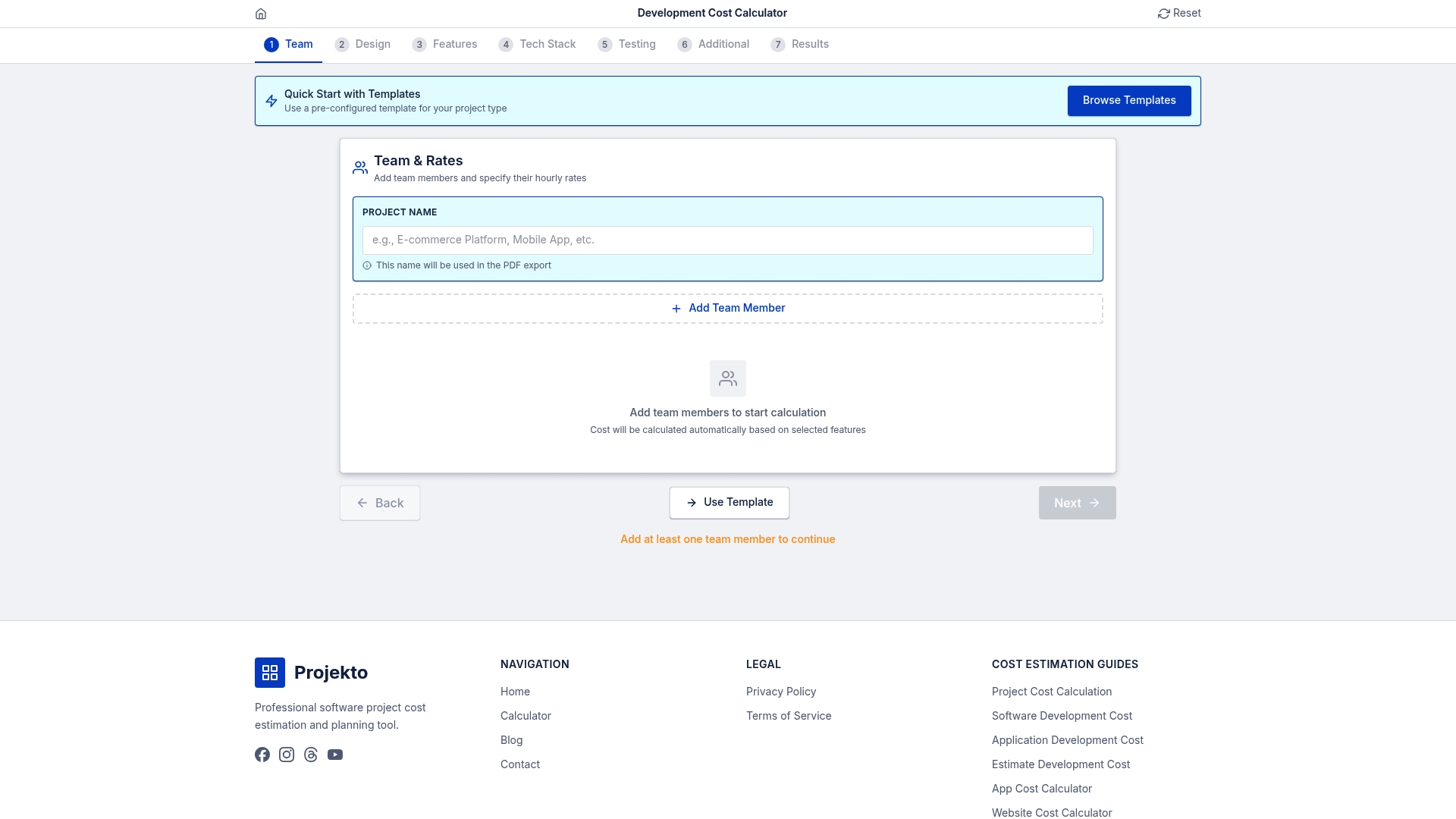
A dedicated development cost calculator automates this process, applying structured estimation logic to your project inputs and returning budget ranges grounded in real development data. Whether you are sizing an MVP, a multi-platform mobile app, or a full SaaS product, Projecto Calculator gives your team a fast, data-backed starting point that you can refine with your chosen pricing strategy. Try it before your next project scoping session and walk into vendor conversations with a credible number already in hand.
Frequently asked questions
What is the most accurate method for development pricing?
Hybrid strategies that blend parametric and traditional approaches, backed by historical project data, are typically the most accurate. Hybrid approaches reduce overruns by 18% compared to single-method estimation.
How do fixed price and time & materials contracts affect project risk?
Fixed Price contracts carry a 25% higher rate of scope creep disputes, while T&M projects report an 83% success rate, making them a lower-risk choice when requirements are likely to evolve.
Why do so many software projects run over budget?
Poor estimation methods cause up to 30% budget excesses, and only 31-35% of software projects fully meet their time, scope, and budget targets.
Can I automate app project pricing with a calculator?
Yes, dedicated development cost calculators automate the estimation process, applying structured logic to project inputs and significantly reducing manual guesswork and human error.