

Choosing the right SaaS pricing model can make or break your startup's growth trajectory. Business owners and decision-makers face a dizzying array of pricing strategies, each with distinct advantages and trade-offs that directly impact revenue predictability, customer acquisition costs, and long-term scalability. This article provides a clear evaluation framework and detailed reviews of the most common SaaS pricing models, helping you make informed decisions that align with your product complexity, customer segments, and business stage. You'll discover actionable insights on matching pricing strategies to your startup's lifecycle, comparing revenue impact across models, and optimizing your approach for maximum profitability.
Table of Contents
- Key Takeaways
- Evaluating SaaS pricing models: key criteria for your startup
- Common SaaS pricing models: overview, features, and examples
- Comparing pricing models: revenue impact, complexity, and startup fit
- Choosing the right SaaS pricing model for your startup
- Explore software development cost calculators for your SaaS project
- FAQ
Key Takeaways
| Point | Details |
|---|---|
| Lifecycle fit strategy | Pricing should align with your startup life cycle from simple validation options to richer models as growth occurs. |
| Simple pricing for early stage | Early stage pricing should be transparent and easy to understand to accelerate sales and reduce buyer friction. |
| Value based pricing | Value based pricing ties price to customer perceived value, improving scalability and long term profitability. |
| Hybrid tiered pricing | Hybrid tiered pricing combines core access with modules and usage controls to balance flexibility and revenue. |
| Usage based pricing | Usage based pricing reflects actual usage but can create revenue forecasting challenges in unpredictable adoption environments. |
Evaluating SaaS pricing models: key criteria for your startup
Before diving into specific pricing models, you need a structured framework to evaluate which approach fits your unique business context. Your startup's lifecycle stage plays a critical role in this decision. Pre-product-market fit companies benefit from simple, transparent pricing that reduces friction during customer validation. Growth-stage startups require models that maximize expansion revenue and accommodate diverse customer segments. Scale-stage companies can handle more sophisticated approaches that optimize for lifetime value and operational efficiency.
Product complexity and customer segmentation shape your pricing strategy significantly. If your SaaS offers a single core feature with minimal configuration, flat-rate or per-user models work well. Complex platforms with multiple modules, integrations, and customization options demand tiered or hybrid approaches that reflect varying customer needs. Consider these evaluation criteria:
- Match your pricing structure to measurable value metrics that customers understand and appreciate
- Segment customers by usage patterns, company size, or industry to capture willingness to pay
- Assess operational complexity and your team's ability to implement metering, billing, and support systems
- Evaluate competitive positioning and whether your model differentiates or aligns with market expectations
Understanding switching costs and market alternatives before selecting your model prevents costly pivots later. If customers face high migration costs or limited alternatives, you have more pricing flexibility. Commoditized markets demand competitive pricing with clear differentiation. The recommendation is to align with customer value metrics, segment thoughtfully, and revisit pricing strategies annually as your business evolves.
Pro Tip: Early-stage startups should prioritize simple pricing models that accelerate sales cycles and reduce customer confusion, then layer in complexity as product-market fit solidifies and operational capabilities mature.
Exploring SaaS pricing model trends reveals how market dynamics shift over time, while understanding on-demand services app pricing provides context for usage-based approaches in adjacent markets.
Common SaaS pricing models: overview, features, and examples
Understanding the landscape of SaaS pricing models helps you identify which approaches align with your product and market position. Each model offers distinct advantages and challenges that affect revenue predictability, customer acquisition, and expansion potential.
Flat-rate pricing charges all customers a single fixed fee for full product access. Basecamp exemplifies this approach with one price for unlimited users and features. This model delivers maximum simplicity for both sellers and buyers, eliminating decision paralysis and reducing sales friction. However, it leaves significant revenue on the table by failing to capture varying customer willingness to pay and usage levels.
Per-seat or per-user pricing scales charges based on the number of users accessing your platform. Slack and Zoom built massive businesses on this foundation because it aligns growth with customer expansion. The model provides predictable revenue forecasting and intuitive value perception. Challenges emerge when customers game the system by sharing accounts or when your product delivers value beyond user count.
Tiered pricing packages features and limits into distinct plans at different price points. HubSpot's tiered structure from Starter to Enterprise captures diverse customer segments while creating clear upgrade paths. This approach maximizes expansion revenue and accommodates customers at various growth stages. The risk lies in overwhelming buyers with too many options or creating tiers that don't align with actual usage patterns.
Usage-based pricing charges customers based on consumption metrics like API calls, storage, or transactions. Twilio and AWS pioneered this model in infrastructure services, aligning costs directly with value delivered. Customers appreciate paying only for what they use, reducing adoption barriers. The trade-off involves unpredictable revenue streams and complex billing infrastructure requirements.

Freemium models offer basic functionality free while charging for premium features or capacity. Dropbox converted millions of free users into paying customers through this approach. It accelerates user acquisition and creates viral growth loops but requires careful balance to avoid cannibalizing paid conversions or supporting unsustainable free user bases.
Hybrid models combine elements from multiple pricing strategies to balance competing objectives. Salesforce layers per-user pricing with feature tiers and usage limits, capturing revenue across multiple dimensions. This flexibility suits complex products serving diverse customer segments but adds operational complexity and potential customer confusion.
| Model | Best For | Revenue Predictability | Implementation Complexity |
|---|---|---|---|
| Flat-rate | Simple products, small markets | High | Low |
| Per-user | Team collaboration tools | High | Low |
| Tiered | Products with clear feature differentiation | Medium-High | Medium |
| Usage-based | Infrastructure, API services | Low-Medium | High |
| Freemium | Consumer products, viral growth | Low | Medium |
| Hybrid | Complex platforms, diverse segments | Medium | High |
Examining software development cost insights helps you understand the investment required to build billing infrastructure for different pricing models. Additional detailed SaaS pricing guides offer deeper strategic frameworks for model selection.
Comparing pricing models: revenue impact, complexity, and startup fit
Direct comparison across key operational dimensions reveals critical trade-offs that impact your bottom line and growth trajectory. Usage-based adoption rising to 43% in 2025 reflects growing demand for consumption-aligned pricing, particularly in AI and infrastructure services. However, this model requires sophisticated metering systems, real-time billing calculations, and customer communication about variable costs. Many startups underestimate the engineering investment needed to implement usage-based pricing reliably.
Per-seat pricing maintains dominance at 57% usage because it delivers predictable revenue streams and simple customer understanding. Enterprise buyers appreciate forecasting costs based on headcount, and sales teams can easily calculate deal values. The limitation surfaces when your product's value doesn't correlate with user count, leaving expansion revenue untapped or creating perverse incentives for account sharing.
Tiered pricing maximizes expansion potential by creating natural upgrade paths as customers grow. Companies using tiered models report higher net revenue retention than flat-rate alternatives. The challenge involves tier design that doesn't confuse customers or create cliffs where slight usage increases trigger disproportionate cost jumps. Poor tier structure causes customer frustration and churn.
Outcome-based or performance pricing ties fees to customer results achieved, offering the highest theoretical value alignment. However, it's notoriously difficult to operationalize due to attribution challenges, delayed payment cycles, and customer resistance to complex contracts. Few startups have the resources or market position to implement this model effectively in early stages.
Hybrid models balance competing priorities by combining per-user base pricing with usage-based overages or tiered feature access. This approach captures revenue across multiple dimensions while maintaining baseline predictability. The operational complexity increases with multiple billing components, requiring clear customer communication and robust systems.
Pro Tip: If you're considering usage-based pricing, pair it with minimum revenue commitments or reserved capacity options to stabilize cash flow while maintaining consumption alignment for customers exceeding baselines.
| Dimension | Flat-rate | Per-user | Tiered | Usage-based | Hybrid |
|---|---|---|---|---|---|
| Revenue predictability | Very High | High | High | Low-Medium | Medium |
| Expansion potential | Very Low | Medium | High | Very High | High |
| Customer acquisition friction | Very Low | Low | Medium | Low | Medium-High |
| Billing complexity | Very Low | Low | Medium | Very High | High |
| Best startup stage | Pre-PMF | Early-Growth | Growth-Scale | Scale | Growth-Scale |
Key considerations for comparison:
- Usage-based models require investment in metering infrastructure and customer education about variable costs
- Per-user pricing works best when value scales directly with team size and collaboration intensity
- Tiered structures demand ongoing optimization to prevent customer confusion and ensure proper segmentation
- Hybrid approaches offer flexibility but increase operational overhead and customer support complexity
Analyzing software development cost benchmarking data helps you budget for the technical infrastructure each pricing model demands. Further pricing model analysis provides strategic frameworks for evaluating trade-offs specific to your market position.
Choosing the right SaaS pricing model for your startup
Selecting and optimizing your pricing model requires matching your business stage, product characteristics, and customer segments to the right approach. Value-based pricing with hybrid models suits B2B tech startups pursuing product-led growth, while usage-based approaches fit AI and infrastructure products when paired with revenue commitments for predictability.
Follow this decision framework:
-
Assess your current stage: Pre-product-market fit startups should implement flat-rate or simple per-user models that minimize sales friction and accelerate customer validation. Avoid complex tiered structures that slow decision-making before you've proven core value.
-
Map value metrics: Identify the single metric that best correlates with customer value delivered. For collaboration tools, active users make sense. For data platforms, records processed or storage consumed align better. Your pricing should track this metric as closely as possible.
-
Segment strategically: Growth-stage startups benefit from tiered pricing that captures different customer segments. Design tiers around meaningful capability differences, not arbitrary limits. Each tier should serve a distinct customer profile with clear upgrade triggers.
-
Test pricing elasticity: Run A/B tests on pricing pages and sales conversations to understand willingness to pay across segments. Small price increases often have minimal impact on conversion while significantly boosting revenue. Test annually as your brand and product mature.
-
Plan for scale: Scale-stage companies can implement sophisticated hybrid or usage-based models with the operational infrastructure to support them. Layer in minimum commitments, reserved capacity, or enterprise custom pricing to balance flexibility with predictability.
-
Iterate systematically: Revisit your pricing model at least annually, analyzing customer acquisition costs, lifetime value, expansion rates, and competitive positioning. Market dynamics and customer expectations shift, requiring ongoing optimization.
Your pricing model should evolve with your business. Early simplicity gives way to segmentation sophistication as you gain market knowledge and operational capabilities. The key is matching complexity to your current stage while building toward more optimized approaches.
Leveraging software development cost optimization insights helps you budget for pricing infrastructure investments, while exploring on-demand app pricing strategies reveals how consumption-based models work in practice.
Explore software development cost calculators for your SaaS project
Once you've selected your pricing model strategy, the next critical step involves estimating the development costs required to build and scale your SaaS platform. Our interactive development cost calculator helps you quantify expenses across different application types and complexity levels, ensuring your pricing strategy aligns with realistic budget expectations.
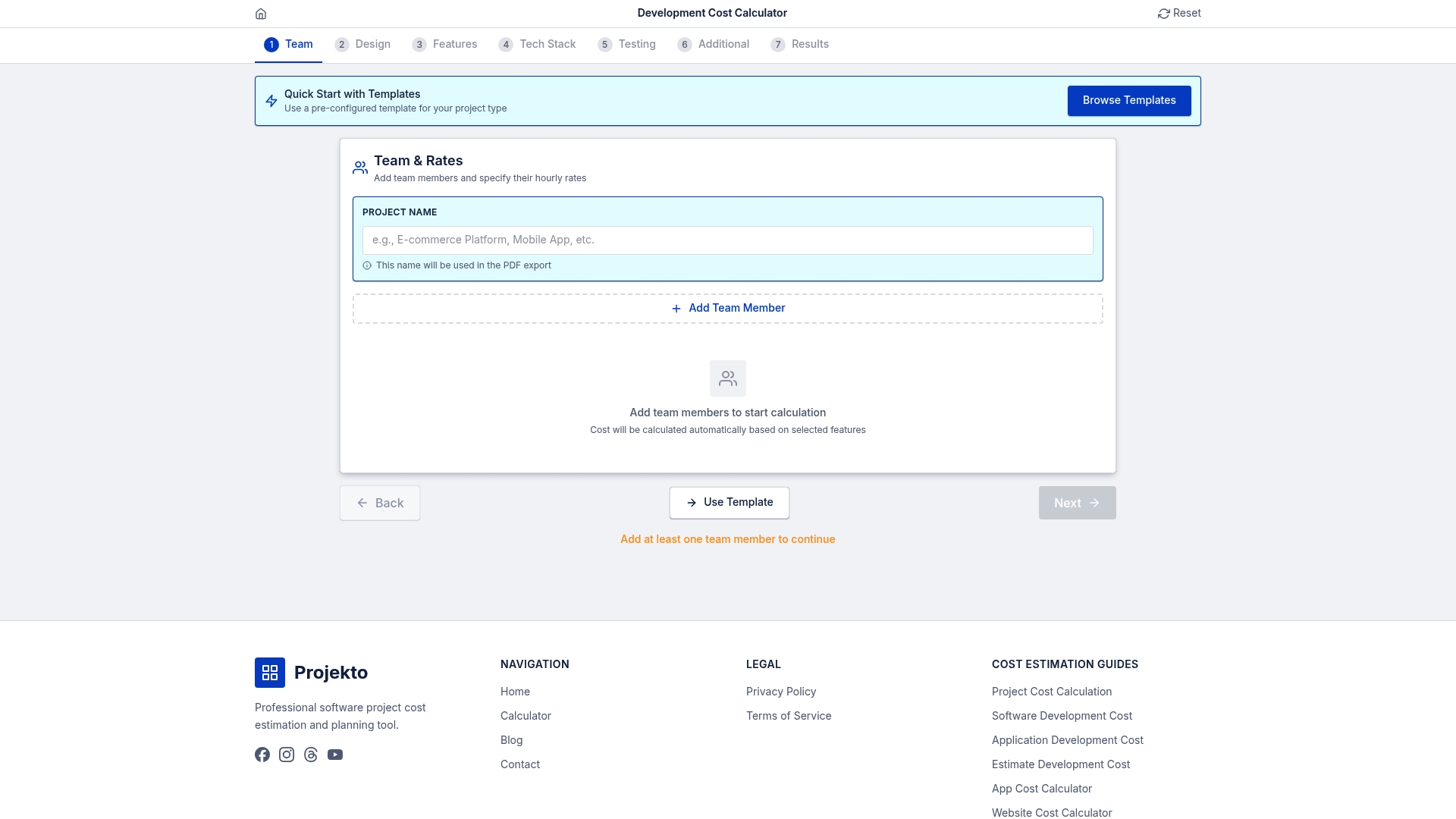
Whether you're building a project management app with tiered pricing or a banking app requiring sophisticated usage metering, understanding development costs upfront prevents underfunding critical features that support your chosen pricing model. Use these tools to make informed investment decisions that balance pricing strategy with technical feasibility and time-to-market objectives.
FAQ
What are the most popular SaaS pricing models and why?
Per-user pricing remains dominant at 57% adoption because it provides predictable revenue forecasting and intuitive value perception for both sellers and buyers. Customers easily understand paying per team member, and finance teams can forecast costs based on headcount growth. This simplicity accelerates sales cycles and reduces customer confusion compared to more complex models. However, usage-based pricing is growing rapidly to 43% as companies seek better alignment between consumption and costs, particularly in AI and infrastructure services.
How do I decide which pricing model fits my startup stage?
Early-stage startups should start with flat-rate or simple per-user models that minimize customer decision friction and accelerate validation cycles. These approaches let you focus on product-market fit rather than pricing optimization. As you reach growth stage with proven value and diverse customer segments, transition to tiered pricing that captures expansion revenue and accommodates different buyer profiles. Scale-stage companies can implement sophisticated hybrid or usage-based models once they've built the operational infrastructure and customer education programs to support complexity.
What are the risks of implementing usage-based pricing?
Usage-based pricing requires sophisticated billing infrastructure and introduces unpredictable revenue streams that complicate financial forecasting and investor communications. You need real-time metering systems, complex billing calculations, and robust customer communication about variable costs. Customers may experience bill shock if consumption spikes unexpectedly, damaging satisfaction and retention. The operational overhead includes engineering resources for metering accuracy, finance systems for variable revenue recognition, and customer success programs to help buyers understand and optimize their usage patterns.
How often should SaaS pricing models be evaluated and adjusted?
Annual pricing reviews help you capture evolving market dynamics, competitive positioning shifts, and changing customer value perception. Your business stage, product capabilities, and target segments evolve continuously, requiring pricing alignment to maximize revenue capture. Schedule comprehensive pricing analysis each year, examining customer acquisition costs, lifetime value trends, expansion rates, and competitive benchmarking data. Between annual reviews, monitor key metrics like conversion rates, upgrade velocity, and churn by pricing tier to identify optimization opportunities. Major product launches or market shifts may warrant interim pricing adjustments outside the annual cycle.