

TL;DR:
- Accurate testing estimates require detailed scope, environment setup, and contingency planning.
- Mobile testing adds 50-80% effort due to device coverage and OS compatibility.
- Using structured methods like WBS and Three-Point Estimation with historical data improves reliability.
Underestimating testing efforts is one of the most common and costly mistakes in software project delivery. When test plans are built on guesswork rather than structured analysis, teams face blown timelines, undetected defects, and budget overruns that erode stakeholder confidence. For project managers, product owners, and business analysts working on web and mobile applications, getting this estimate right is not optional. This guide walks through the foundational components of a testing estimate, proven methodologies, best practices for reliability, and the specific multipliers that apply to mobile and cross-platform projects.
Table of Contents
- What goes into estimating testing efforts?
- Key methodologies for estimating testing efforts
- Best practices and real-world tips for reliable estimates
- Special considerations and multipliers for mobile and cross-platform testing
- A fresh perspective: What most test estimation guides miss
- Estimate software testing efforts with confidence
- Frequently asked questions
Key Takeaways
| Point | Details |
|---|---|
| Breakdown is critical | Decompose testing into clear phases to avoid missing hidden tasks. |
| Mix methods for accuracy | Using multiple estimation methods yields more reliable results. |
| Always buffer for risk | Add a 15-25 percent contingency to manage unknowns and overhead. |
| Mobile multiplies effort | Expect mobile/cross-platform testing to take 50 to 80 percent longer. |
| Review and adapt | Regularly update estimates as project realities shift or new risks emerge. |
What goes into estimating testing efforts?
A testing estimate is not simply a count of test cases multiplied by hours. It reflects the full scope of work required to validate a product, and that scope is shaped by several project-specific factors. Delivery timelines, feature scope, team experience levels, the complexity of the test environment, and non-testing activities all influence the final number. Ignoring any one of these variables introduces risk into your plan.
The major components of a testing effort estimate typically include:
- Test planning and strategy (defining scope, approach, and objectives)
- Test case design and documentation (writing, reviewing, and organizing test cases)
- Test environment setup (configuring servers, databases, and test data)
- Test execution (running manual and automated tests)
- Defect reporting and retesting (logging, tracking, and verifying fixes)
- Meetings, reviews, and sign-offs (sprint ceremonies, stakeholder reviews)
- Contingency and buffer (risk coverage for scope changes and unknowns)
Precise scoping early in the project is essential. Teams that invest time in early documentation and accurate project estimation are far better positioned to catch hidden tasks before they surface mid-sprint. Estimating team size also plays a direct role, since a smaller team will require more calendar time to complete the same volume of test work.
One of the most overlooked areas is what practitioners call "shadow work." These are tasks that exist but rarely appear in initial estimates.
| Effort category | Typical percentage of total effort |
|---|---|
| Test planning and strategy | 10-15% |
| Test case design | 20-25% |
| Environment setup and config | 10-15% |
| Test execution | 30-40% |
| Defect management and retesting | 10-15% |
| Meetings, reviews, and admin | 5-10% |
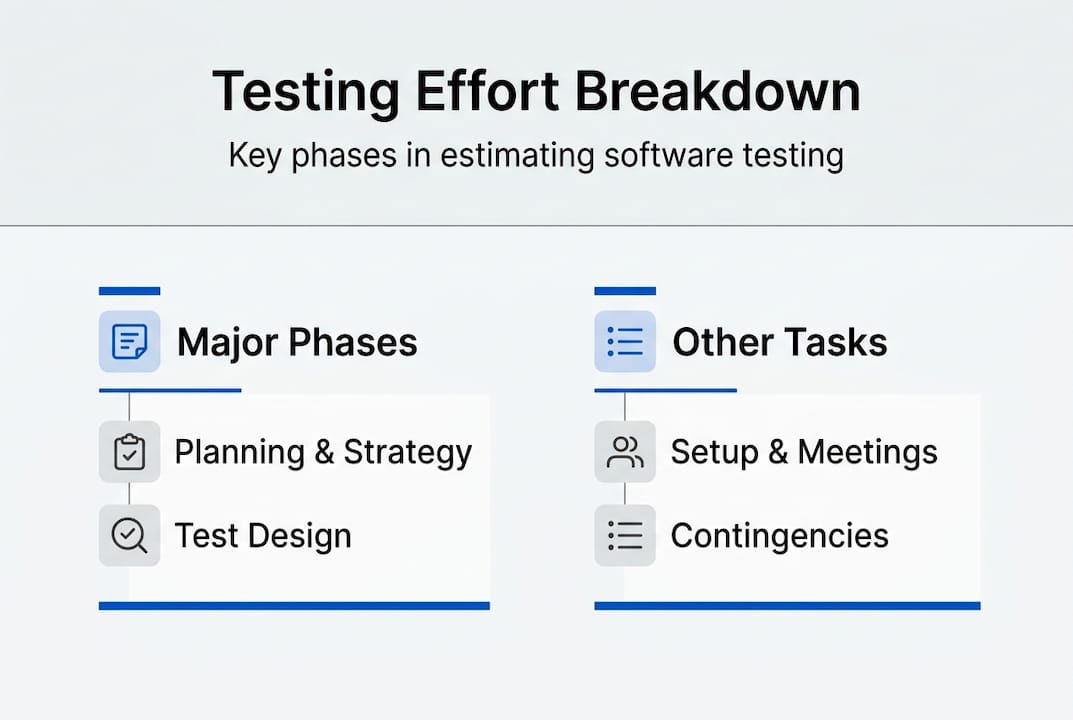
Environment setup, meetings, and contingencies can represent 20-30% of total testing effort, which means skipping these in your estimate almost guarantees you will run short.
Pro Tip: Always audit your estimate for shadow work such as tool onboarding, license procurement, documentation updates, and knowledge transfer sessions. These tasks are real, they consume real hours, and they belong in your plan.
Key methodologies for estimating testing efforts
Understanding what is included in a testing estimate sets the stage for choosing how to estimate. Several industry-proven methodologies exist, and each suits a different project context.
Common methodologies for estimating testing efforts include Work Breakdown Structure (WBS), Three-Point Estimation, Functional Point Analysis (FPA), Wideband Delphi, and percentage of development effort. No single method is universally superior. The right choice depends on your project's maturity, data availability, and team structure.
Here is a quick-start guide using WBS combined with Three-Point Estimation, which is practical for most web and mobile projects:
- Decompose the scope into individual testable features and user stories using WBS.
- Assign three time estimates to each task: optimistic (O), most likely (M), and pessimistic (P).
- Apply the PERT formula: Expected time = (O + 4M + P) / 6.
- Sum the expected times across all tasks to get the base estimate.
- Add contingency based on risk profile (see Section 4 for recommended percentages).
- Validate the result against historical benchmarks or expert input.
| Methodology | Best suited for |
|---|---|
| WBS | Projects with well-defined scope and deliverables |
| Three-Point Estimation | Projects with uncertainty or limited historical data |
| Functional Point Analysis | Large enterprise systems with measurable functional units |
| Wideband Delphi | Complex projects benefiting from group consensus |
| Percentage of dev effort | Early-stage estimates when full scope is not yet defined |
For teams working on estimating software development cost, combining WBS with Three-Point Estimation provides a defensible, data-backed number. Understanding estimation scope before selecting a method also reduces the risk of choosing a technique that does not fit your project's structure.
Avoiding common estimation pitfalls requires discipline in method selection and consistent application.
Pro Tip: Use two or more estimation methods and compare the results. If the outputs are close, you have confidence in your number. If they diverge significantly, that gap signals assumptions worth investigating before you commit to a timeline.
Best practices and real-world tips for reliable estimates
Method knowledge is only useful when paired with disciplined execution. Translating estimation techniques into reliable numbers requires a set of practices that experienced test managers apply consistently.

Historical project data is your most reliable baseline. If your organization has completed similar projects, the actual hours logged for testing phases are far more accurate than any formula applied in isolation. Build a data library of past projects, categorized by application type, team size, and complexity, and reference it every time you start a new estimate.
Involving the full team is equally important, particularly when using Wideband Delphi. Subject matter experts, developers, and testers each see different risks in the same feature. A business analyst may identify an edge case that a developer never considered, and that edge case could represent several additional test cycles.
Key best practices for building reliable estimates include:
- Document all assumptions explicitly so stakeholders understand what the estimate is based on
- Break work down with WBS to the task level before assigning hours
- Add a contingency buffer of 15-25% to cover risks, requirement changes, and unknowns
- Revalidate estimates at the start of each sprint or phase, not just at project kickoff
- Account for automation impacts carefully, since automation scripts require build and maintenance time before they reduce execution effort
- Review estimates with end users to surface scenarios the internal team may have missed
According to test estimation best practices, using historical data, involving experts, breaking down tasks via WBS, and adding 15-25% contingency for risks are the most effective levers for estimation accuracy. Teams that skip the contingency step are the most likely to encounter the costly estimation mistakes that derail delivery.
Regular review cycles also matter. An estimate created at project kickoff becomes less accurate as requirements evolve. Building a cadence of estimate reviews into your project governance keeps the plan aligned with reality.
Pro Tip: Always walk your estimate through at least one review session with end users or business stakeholders. They frequently identify missing test scenarios, especially around business rules and edge cases, that the technical team has overlooked.
Special considerations and multipliers for mobile and cross-platform testing
General best practices build a solid foundation, but mobile and cross-platform projects introduce additional estimation variables that require specific adjustments. Failing to account for these multipliers is a leading cause of underestimated mobile testing budgets.
Mobile-specific factors like device coverage can add 50-80% more time to a base estimate, and novice teams require a 1.6x multiplier to account for ramp-up time and learning curve. These are not conservative padding figures. They reflect real-world data from mobile projects across multiple platforms.
| Mobile testing component | Typical multiplier or addition |
|---|---|
| Device coverage (physical and emulated) | +50-80% to execution time |
| Novice or new-to-mobile team | 1.6x base estimate |
| Requirement changes mid-project | +20-25% to total effort |
| OS version compatibility checks | +15-20% to execution time |
| Cross-platform (iOS + Android) | 1.5-1.8x single-platform estimate |
Beyond the multipliers, mobile projects carry a set of tasks that rarely appear in web-focused estimates:
- Device farm setup and management
- App provisioning and certificate configuration
- Push notification testing across OS versions
- Offline mode and connectivity interruption testing
- App store submission validation and regression
- Battery, memory, and performance profiling
Using project estimators that account for mobile-specific variables helps teams avoid the most common underestimation traps. Teams evaluating mobile testing alternatives or working through mobile app budgeting myths will find that structured multiplier tables provide a more defensible estimate than rule-of-thumb percentages. Referencing an app cost calculator early in planning can also surface budget gaps before they become project risks.
"In mobile testing, the buffer is not a sign of poor planning. It is evidence of accurate planning. Projects that skip device coverage multipliers and OS compatibility buffers consistently deliver late and over budget."
A fresh perspective: What most test estimation guides miss
Most estimation guides focus on the mechanics of calculation and stop there. The harder problem is behavioral, not mathematical. Teams under delivery pressure routinely squeeze estimates to meet stakeholder expectations, and that decision is almost always reversed later at a higher cost.
Relying solely on percentage ratios, such as a fixed dev-to-test ratio of 3:2, can backfire when the project context does not match the data behind that ratio. Some sources advocate metrics-driven ratios while others favor consensus-based methods, and automation ROI typically only materializes after three to five release cycles, not immediately.
Automation is frequently treated as a cost-reduction tool from day one. It is not. Automation is an upfront investment with delayed returns, and estimating as if automation will reduce effort in the first sprint is a structural error that compounds over time.
The most effective teams treat estimation as a living document, not a one-time deliverable. They document every assumption, revisit the estimate at each phase gate, and resist pressure to adjust numbers without supporting evidence. Understanding common estimation pitfalls is as important as mastering the methods themselves.
"The estimate is only as reliable as the assumptions behind it. Document them, own them, and update them when reality changes."
Pro Tip: Before finalizing any estimate, write down every assumption it depends on. If a stakeholder later challenges the number, you can show exactly what changed and why the estimate needs to be revised.
Estimate software testing efforts with confidence
Putting structured estimation into practice is easier when you have the right tools supporting your process. Whether you are planning a healthcare platform, an event management application, or a custom mobile product, having a reliable starting point for time and budget saves hours of back-and-forth in planning sessions.
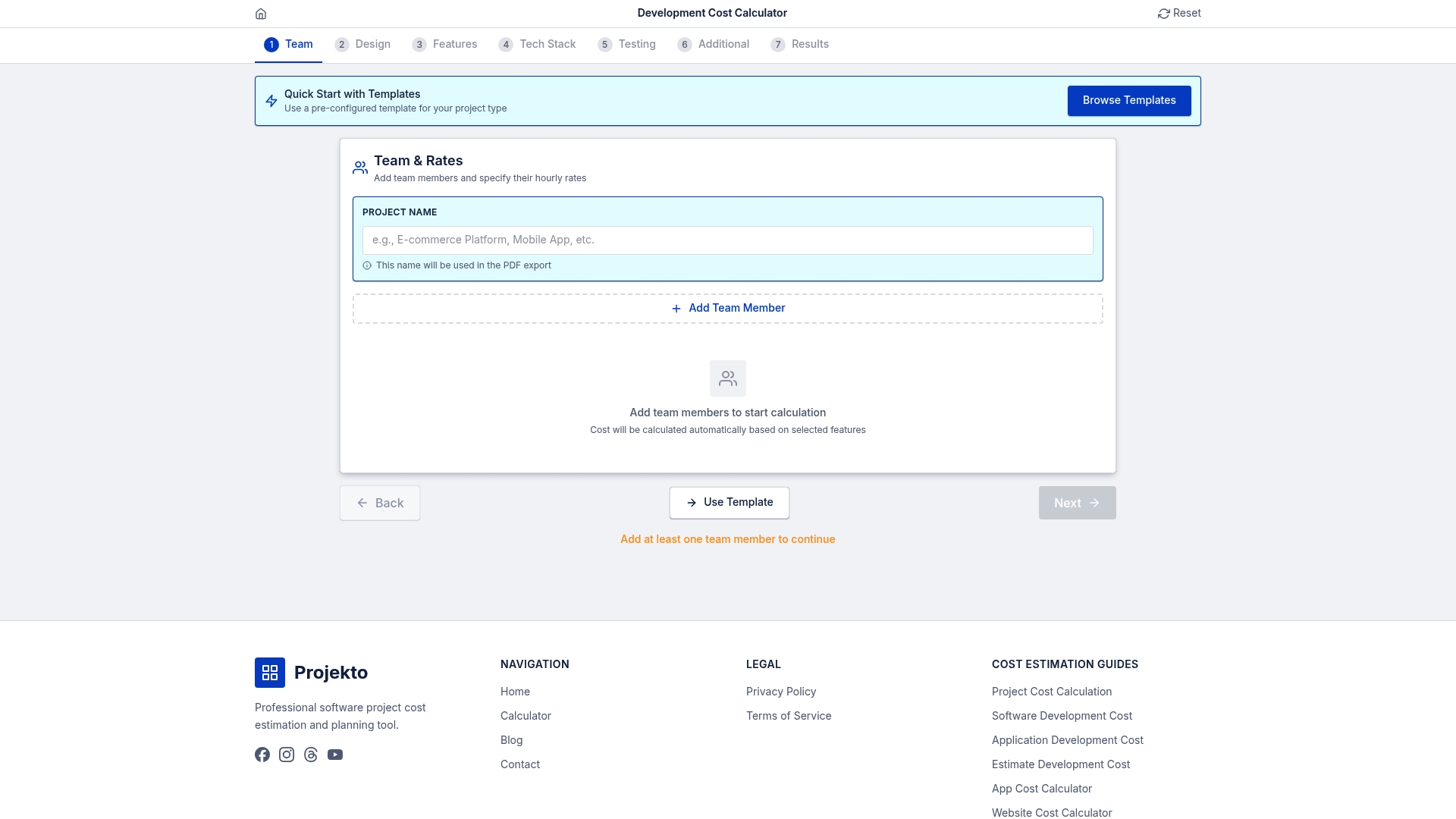
The testing effort calculator at Projecto gives project managers and product owners a structured, transparent way to generate effort estimates grounded in real project variables. You can also explore purpose-built tools like the event management app costs estimator or the healthcare app cost tool to benchmark your testing budget against comparable projects and move forward with confidence.
Frequently asked questions
What is the most accurate way to estimate testing efforts?
Combining Work Breakdown Structure with Three-Point Estimation and validating against historical benchmarks is widely considered the most accurate approach for web and mobile projects.
How much contingency buffer should I add to my testing estimate?
A buffer of 15-25% is recommended to cover risks, uncertainties, and non-testing overhead for most software projects.
Do mobile app tests really take longer to estimate?
Yes, mobile device coverage alone can increase testing effort by 50-80% compared to a web-only baseline, making mobile estimates structurally more complex.
How does test automation affect estimation?
Automation adds significant setup and maintenance costs in early cycles but reduces execution effort meaningfully after three to five repeated test cycles.
Which teams need higher effort multipliers for test estimation?
Teams new to mobile or a specific domain typically require a 1.6x effort multiplier to account for ramp-up time, tool learning, and initial configuration overhead.