

TL;DR:
- Undocumented assumptions often cause project overruns and budget increases.
- Capturing detailed assumptions improves visibility, accountability, and scope control.
- Regularly reviewing and updating assumptions enhances project accuracy and organizational learning.
Midway through a software project, a stakeholder asks why the budget has grown by 40%. The development team points to third-party API integration complexity. The project manager assumed the vendor would provide a fully documented SDK. The client assumed no integration work was needed at all. Nobody wrote any of this down. This scenario plays out across tech companies every week, and the root cause is almost never bad engineering. It is undocumented assumptions driving invisible risk. This guide covers what to capture, when to capture it, and how to validate and maintain assumption documentation so your estimates hold up under real project conditions.
Table of Contents
- Why estimation assumptions matter in tech projects
- What to document: The core elements of estimation assumptions
- How to elicit and validate assumptions with your team
- How to record, trace, and update estimation assumptions for lasting value
- Why documented assumptions are your project's secret weapon
- Level up your estimation process
- Frequently asked questions
Key Takeaways
| Point | Details |
|---|---|
| Document your basis | Clarify how your estimate was created, with data sources, assumptions, and methodologies. |
| Engage your team | Team estimation sessions surface and align everyone’s assumptions for higher accuracy. |
| Capture confidence levels | Explicitly record uncertainty using confidence ranges to expose and manage risks. |
| Keep assumptions current | Regularly update assumption records as new realities and decisions emerge. |
Why estimation assumptions matter in tech projects
Every estimate carries hidden weight. Behind the hours and dollar figures are dozens of silent decisions: which team member handles which module, whether a third-party API requires paid access, how many rounds of stakeholder review are included. When those decisions stay silent, they become traps.
Software estimation mistakes rarely originate from miscalculation. More often, they stem from assumptions that were never stated, never challenged, and never aligned across stakeholders. One team member assumes unit testing is included in the estimate. Another assumes it is handled separately. That gap quietly inflates delivery timelines and erodes trust.
The concept of a basis of estimate addresses this directly. It is a structured record that explains how an estimate was produced, which constraints were applied, and what level of confidence it carries. Basis of estimates documentation allows stakeholders to trace how numbers were produced and what would change them. This transparency converts an estimate from an opinion into a defensible artifact.
The reasons why estimation fails on repeated projects often trace back to the same organizational gaps: teams do not record what shaped their numbers, so they cannot learn from the delta between estimate and actuality. When the project lands over budget, there is no reference point to understand why.
Clear assumption documentation changes that dynamic. It creates an active record that teams can review, challenge, and revise as project realities evolve. The core benefits include:
- Visibility: Stakeholders see what conditions the estimate depends on, reducing surprises.
- Accountability: Responsibilities for assumption validation are assigned and trackable.
- Scope control: When new requirements arrive, documented assumptions reveal what is and is not already included.
- Learning: Post-project reviews become precise when teams can compare original assumptions to what actually occurred.
"The purpose of documenting your basis of estimate is not to be right the first time. It is to understand precisely where and why your estimate evolved."
When assumptions are visible, disagreements become productive conversations. When they are hidden, they become blame.
What to document: The core elements of estimation assumptions
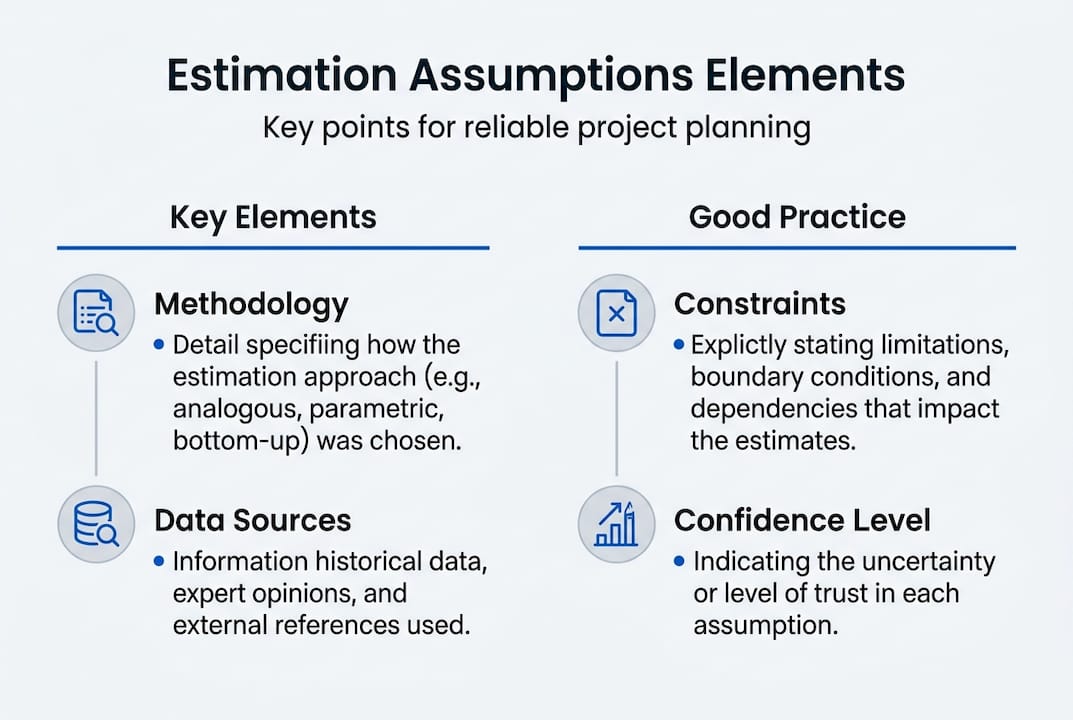
Knowing that assumptions must be captured is one thing. Knowing exactly what to capture is what separates teams that improve from teams that repeat the same overruns. Capturing methodology, data sources, assumptions, constraints, and confidence level is critical for building estimates that stakeholders can actually trust and trace.
Every estimation record should contain these core elements:
- Methodology: How the estimate was built. Was it based on analogous projects, parametric modeling, expert judgment, or a combination?
- Data sources: What numbers were used. Historical velocity data, vendor quotes, industry benchmarks, or team-provided figures.
- Business assumptions: Conditions assumed true on the business side. For example, content is provided by the client, or approvals happen within 48 hours.
- Technical assumptions: Decisions about architecture, integrations, and tooling. For example, the platform uses an existing authentication provider rather than a custom-built solution.
- Delivery assumptions: Team availability, sprint cadence, and testing protocol. This is where non-coding work like code review and documentation gets explicitly included or excluded.
- Constraints: Fixed deadlines, budget ceilings, regulatory requirements, or external dependencies with hard timelines.
- Confidence range: A stated percentage range, such as plus or minus 20%, that communicates the estimate's uncertainty level explicitly.
The table below shows how these elements translate to a practical record structure:
| Element | Example entry |
|---|---|
| Methodology | Story point estimation with team velocity of 32 points per sprint |
| Data source | Historical data from three similar projects completed in 2025 |
| Business assumption | Client delivers all design assets by sprint 2 |
| Technical assumption | AWS infrastructure is pre-configured and accessible |
| Constraint | MVP launch fixed for Q3 2026 |
| Confidence range | Plus or minus 25% given early-stage requirements |
Working with project estimators who understand these elements produces materially stronger estimates. The project sizing process is also more reliable when the team knows which category each input falls into.
Pro Tip: Build a reusable estimation template with fields for each element above. Blank fields act as a prompt, signaling that the section was skipped rather than not applicable.
How to elicit and validate assumptions with your team
Documentation cannot happen if the assumptions never surface in the first place. Many assumptions stay hidden because estimators unconsciously treat their own mental model as shared reality. Structured team sessions break that pattern by forcing assumptions into the open where they can be examined and agreed upon.
Here is a step-by-step approach to running effective assumption elicitation sessions:
- Schedule a dedicated estimation review. Do not treat assumption surfacing as a side activity during sprint planning. Give it a defined agenda and a time block.
- Break the estimate into components. Review each feature or module separately. Granularity forces specificity, which is where hidden assumptions live.
- Use structured estimation techniques. Team estimation methods like Planning Poker require every participant to commit to an estimate independently before discussion. This reveals divergence immediately.
- Investigate all divergence. When one developer estimates four hours and another estimates sixteen, the gap almost always reflects an unstated assumption about scope, complexity, or integration requirements.
- Document disputes and their resolution. Record not just the agreed estimate, but the reasoning that resolved the disagreement.
Team-based estimating methods like Planning Poker surface hidden assumptions and lead to consensus, which is precisely why they outperform solo estimation for complex technical projects. Estimation consensus is not about averaging opinions. It is about aligning mental models so the number everyone agrees on reflects the same underlying reality.
| Approach | Assumption discovery rate | Risk of hidden assumptions |
|---|---|---|
| Solo estimator | Low | High |
| Team session without structure | Medium | Medium |
| Structured team session (e.g., Planning Poker) | High | Low |
Pro Tip: Treat wide estimate ranges as diagnostic signals, not problems to average away. If estimates for a single task span from 2 hours to 12 hours, at least one assumption is still unresolved. Stop and surface it before moving on.
How to record, trace, and update estimation assumptions for lasting value
Documenting assumptions once is valuable. Maintaining them across a project lifecycle is what produces compounding returns, both in risk reduction and organizational learning. Document estimation rationale with traceability across data sources, resource rates, and constraints to reduce risk and improve learning over time.

A common failure mode is treating estimation documentation as a one-time deliverable. The project kicks off, assumptions are captured in a shared document, and nobody opens it again until something goes wrong. Effective traceability requires active maintenance.
Here is a process for keeping assumption documentation current and useful:
- Assign an owner. One person is responsible for updating the assumption record at defined intervals. Shared responsibility usually means no responsibility.
- Link estimates to their assumptions. Every line-item estimate should reference the assumption it depends on. When the assumption changes, the estimate can be adjusted with clear justification.
- Log changes with rationale. Record what assumption changed, when it changed, and why. "Scope increased" is not sufficient. "Client added two-factor authentication requirement after sprint 3 review" is traceable.
- Review at milestone gates. At the end of each sprint or project phase, compare current assumptions against the original record. Flag any that have shifted.
- Conduct a post-project retrospective on assumptions. Which assumptions held? Which were wrong? What would have surfaced them earlier?
Explicitly capturing uncertainty and confidence ranges makes assumption sensitivity easier to manage over project cycles. An estimate with a documented plus or minus 30% range signals that the underlying assumptions are still being validated, which sets appropriate stakeholder expectations from the start.
Knowing how to review project estimations at structured intervals is what prevents documentation from becoming stale. Effort estimation records, in particular, require updating whenever team velocity, scope, or technical approach shifts.
"The real risk is not what you do not know. It is what you think you know that has never been written down or verified."
Pro Tip: Assign a standing agenda item in your sprint retrospective to review whether any estimation assumptions have changed since the last review. Ten minutes of structured reflection prevents hours of rework.
Why documented assumptions are your project's secret weapon
Most project teams treat assumption documentation as administrative overhead, something to satisfy a process checklist rather than a tool that actively shapes project outcomes. That framing is costly.
The teams that consistently deliver on time and on budget do not necessarily estimate more accurately on the first pass. They maintain better visibility into where their estimates are fragile. Documented assumptions create that visibility. When a risk materializes, the team can immediately identify which assumption it violated, which parts of the plan it affects, and what the adjustment should be. That response time is a genuine competitive advantage.
Clear assumption documentation also changes the culture of accountability. When an estimate is wrong, the question shifts from "who made the bad estimate" to "which assumption changed and what do we learn from it." That shift turns project postmortems from blame sessions into structured knowledge-building exercises. Costly estimation mistakes are far less likely to repeat when the team has a clear record of what went wrong and why.
The most effective project organizations treat their documented assumptions as intellectual assets. They codify what they have learned, build it into templates, and carry institutional knowledge forward across projects and team members. That is not compliance. That is a strategic advantage that compounds with every project iteration.
Level up your estimation process
Structured assumption documentation is only as effective as the tools that support it. If your team is still managing estimates in disconnected spreadsheets without built-in fields for methodology, confidence ranges, or constraint logging, critical information will continue to fall through the gaps.
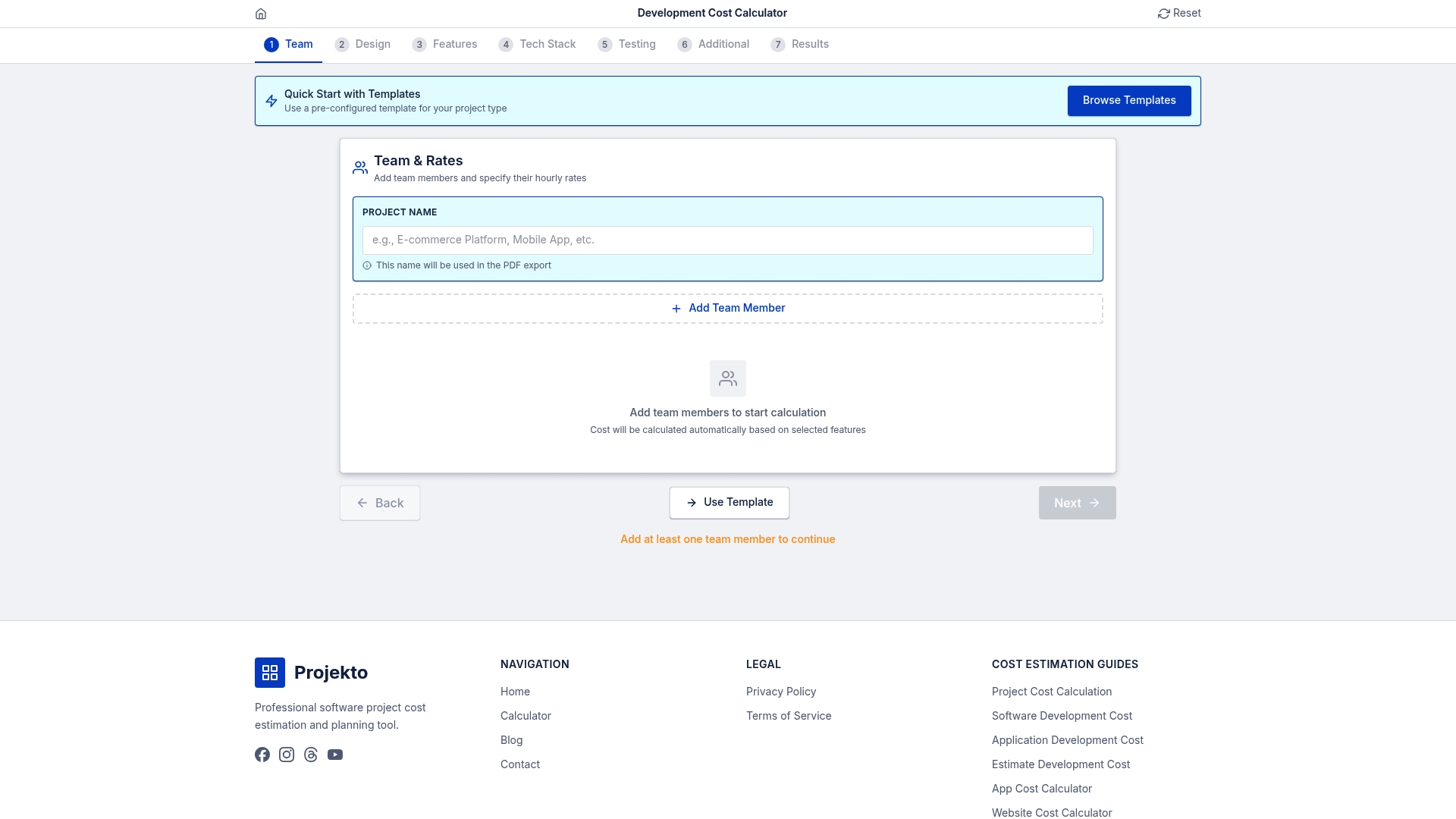
EstimateCalc's development cost calculator is built to embed these best practices directly into your estimation workflow. It structures your inputs around the same core elements covered in this guide: scope, assumptions, constraints, and confidence levels, so your basis of estimate is captured automatically as you build. For project managers and business owners who want reliable, traceable estimates without the manual overhead, it is the logical next step after implementing the strategies above.
Frequently asked questions
What should be included when documenting estimation assumptions?
Always include your methodology, data sources, key assumptions, constraints, and your confidence range. Capturing these elements ensures full traceability for every estimate your team produces.
How do team-based techniques like Planning Poker help with better assumption documentation?
They reveal different perspectives and hidden assumptions through discussion, leading to more accurate and shared documentation. Planning Poker surfaces assumptions that solo estimators rarely identify on their own.
How often should estimation assumptions be updated?
Update them at every major project change, review, or after each sprint to track evolving risks and realities. Documenting rationale and tracking updates improves learning and accuracy across project iterations.
Why is recording a confidence range for estimates recommended?
It explicitly shows uncertainty, making project risks visible and easier to manage. Explicitly capturing uncertainty through confidence ranges clarifies assumption sensitivity across the full project cycle.