

TL;DR:
- A structured budget estimation process helps prevent software project overruns caused by scope creep.
- Using a combination of estimation methodologies and involving technical experts improves accuracy.
- Continuous, transparent re-estimation and market benchmarks ensure realistic and credible project budgets.
Budget overruns are not rare anomalies in software projects. They are the default outcome when estimation is treated as a formality rather than a discipline. 40% of projects exceed their original budgets due to poorly defined scope, and the consequences range from delayed launches to cancelled products. For business owners and project managers building web or mobile applications, a structured budget estimation process is the most reliable defense against these outcomes. This guide covers what the process involves, how to execute it step by step, which methodologies fit which situations, and how to validate your numbers against real-world benchmarks.
Table of Contents
- Understanding the essentials: What is the budget estimation process?
- Step-by-step guide: How to estimate your app development budget
- Choosing the right estimation methodology
- Benchmarks, rates, and cost drivers in app development estimation
- Avoiding common pitfalls and ensuring estimation accuracy
- Our perspective: Why iterative, transparent estimating wins
- Next steps: Streamline your app budget estimation
- Frequently asked questions
Key Takeaways
| Point | Details |
|---|---|
| Break down the process | Divide your project into phases and tasks for clarity and accurate budgeting. |
| Choose your method wisely | Select the estimation approach that best fits your project's needs and available data. |
| Benchmark your estimates | Compare your numbers with market data to ensure realism and avoid underfunding. |
| Plan for surprises | Include a 15-20% contingency to prepare for changes and uncertainties. |
| Review and adjust | Regularly compare actual costs to your estimates to improve future accuracy. |
Understanding the essentials: What is the budget estimation process?
A budget estimation process is the structured sequence of activities used to forecast the total cost of a software project before development begins. It is not a single calculation. It is a workflow that starts with scope definition and ends with a documented, time-phased cost baseline that stakeholders can act on.
For web and mobile app projects, this process typically follows five structured steps. According to mobile app cost data, the process involves: defining scope and core features through MVP prioritization, breaking the project into phases such as discovery, design, development, QA, and deployment, selecting the appropriate estimation technique, aggregating costs and adding reserves, and time-phasing the baseline against the project schedule.
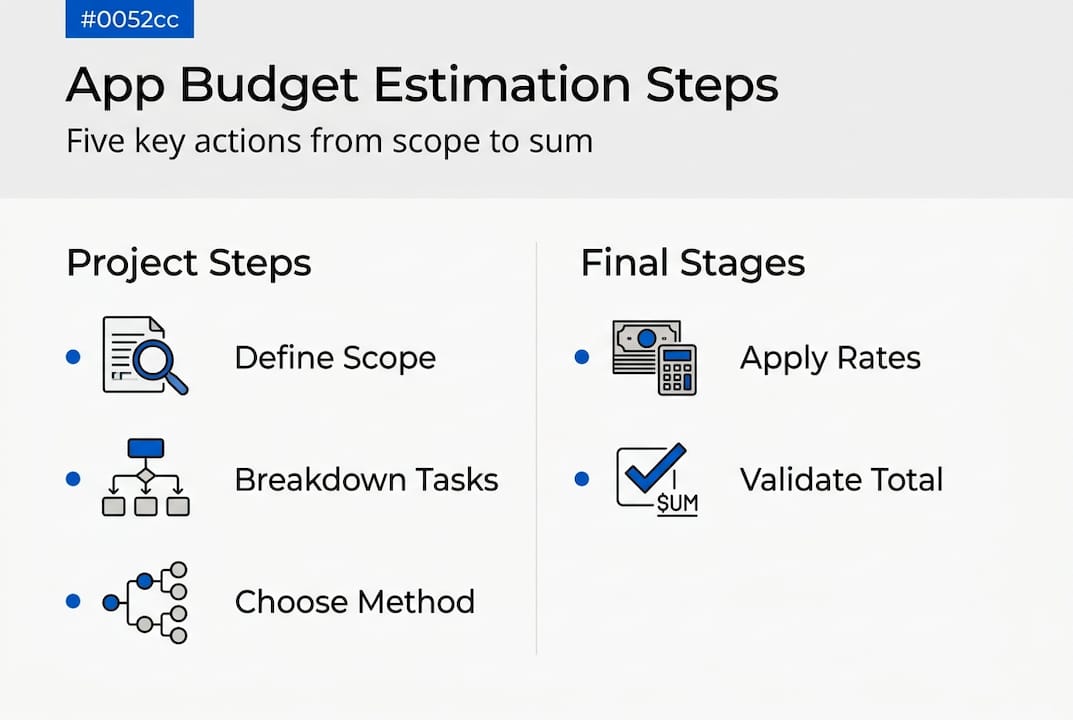
Understanding estimation scope is foundational here. Scope creep is the leading cause of cost overruns, and a clearly bounded MVP definition keeps early estimates grounded in what is actually being built.
Key components every budget estimate should include:
- Feature list prioritized by MVP versus post-launch scope
- Phase-by-phase effort breakdown in hours or story points
- Team composition and applicable hourly rates
- Third-party service costs and licensing fees
- Contingency reserve (typically 15 to 20% of the total)
- Post-launch maintenance and operational cost projections
| Estimation phase | Primary output |
|---|---|
| Scope definition | Feature list, MVP boundary |
| Phase breakdown | Task-level effort estimates |
| Methodology selection | Chosen technique and inputs |
| Cost aggregation | Total estimate with reserves |
| Baseline alignment | Time-phased cost schedule |
Following project cost estimation best practices ensures that each phase produces a usable output, not just a number that gets revised every sprint.
Step-by-step guide: How to estimate your app development budget
With a clear understanding of what the process involves, here is how to execute it in practice.
Step 1: Define scope and establish MVP priorities. Document every feature the application needs, then categorize each as essential for launch or as a post-MVP addition. This boundary prevents the estimate from inflating based on aspirational features rather than committed deliverables.
Step 2: Break the project down by phase and task. Map the work across discovery, UX design, frontend and backend development, third-party integrations, QA testing, and deployment. Refer to a phase-by-phase cost breakdown to benchmark your task list against comparable projects.
Step 3: Select an estimation methodology. Key estimation techniques include analogous estimation (drawing from historical project data), parametric estimation (applying a rate per unit of output), bottom-up estimation (aggregating individual task estimates), three-point and PERT analysis (averaging optimistic, pessimistic, and most likely scenarios), and Agile Planning Poker using story points on a Fibonacci sequence. Each method has different accuracy profiles depending on how much information is available at the time of estimation.
Step 4: Gather cost data and apply team rates. Collect actual hourly rates for your team or vendor, factor in tool and infrastructure costs, and apply them to your effort estimates by phase.

Step 5: Aggregate, validate, and document. Sum all costs, add your contingency reserve, and validate the total against industry benchmarks. Document your assumptions explicitly. Reviewing common estimation pitfalls at this stage helps you catch systematic errors before they reach stakeholders.
Pro Tip: Never submit a budget estimate without a written assumptions log. If a core assumption changes, the estimate must change with it. This protects both the project team and the client.
Choosing the right estimation methodology
Selecting the technique that best fits your project context has a direct impact on estimate reliability. No single method is universally superior.
| Method | Best for | Key limitation |
|---|---|---|
| Analogous | Early-stage, low detail | Accuracy depends on similarity of reference projects |
| Parametric | Repeatable, measurable work | Requires reliable unit cost data |
| Bottom-up | Detailed, well-scoped projects | Time-intensive to produce |
| Top-down | Vision-level feasibility | Too broad for execution planning |
| Three-point (PERT) | Uncertain or novel projects | Requires three credible estimates per task |
| Agile/Planning Poker | Iterative, sprint-based teams | Requires experienced team participation |
| COCOMO | Large-scale software projects | Complexity of COCOMO model inputs limits accessibility |
The COCOMO model, which calculates effort using formulas such as Effort equals a multiplied by KLOC raised to the power of b, adjusted by cost drivers like reliability and complexity, is powerful for enterprise-scale projects but requires precise function point data to be useful.
For most web and mobile app projects in the $50k to $500k range, a hybrid approach yields the best results. Use top-down estimation to validate overall budget feasibility early, then transition to bottom-up estimation for each defined phase as the scope solidifies. Reviewing estimator tool comparisons and project estimator insights can help you select tools that support your chosen methodology.
Pro Tip: Involve senior developers in any bottom-up estimation session. Their task-level intuition consistently outperforms project manager assumptions on effort hours, particularly for complex backend or integration work.
An overview of key methodologies confirms that combining techniques reduces variance and produces estimates that are both defensible and actionable.
Benchmarks, rates, and cost drivers in app development estimation
Grounding your estimate in current market data is essential for credibility. Abstract estimates that lack benchmark validation are routinely challenged by stakeholders and vendors alike.
2026 cost benchmarks for web and mobile apps:
| App type | Estimated cost range | Typical timeline |
|---|---|---|
| Simple MVP (mobile) | $10,000 to $60,000 | 6 to 10 weeks |
| Standard mobile app | $60,000 to $150,000 | 10 to 16 weeks |
| Complex mobile app | $150,000 and above | 6 months or more |
| Basic web application | $20,000 to $50,000 | 6 to 12 weeks |
| Mid-tier web app | $100,000 to $250,000 | 3 to 6 months |
| Enterprise web platform | $300,000 and above | 6 to 12 months |
According to app development cost data, US-based development teams average approximately $100 per hour, while offshore teams in Eastern Europe or Southeast Asia typically range from $25 to $65 per hour. These differentials make team location one of the most significant cost drivers in the entire estimate.
Primary cost drivers to monitor:
- Platform scope: iOS only, Android only, or cross-platform development
- Real-time features such as messaging, live tracking, or push notifications
- Third-party integrations including payment gateways, mapping APIs, and analytics platforms
- Custom UI and animation complexity versus standard component libraries
- Backend architecture requirements such as microservices versus monolithic design
A 15 to 20% contingency reserve should be applied to every total estimate. Refer to software development cost benchmarks and guidance on estimating team size to calibrate your estimates further. Recent app cost research confirms that post-launch maintenance consistently adds 15 to 25% of the original development cost annually.
Avoiding common pitfalls and ensuring estimation accuracy
Even well-structured estimates fail when common errors go unaddressed. The most damaging mistakes are systematic and preventable.
Top estimation mistakes and how to prevent them:
- Scope creep without change control. Every feature added after the baseline is set without a formal change request erodes the budget silently. Implement a change control process from day one.
- Underestimating non-coding work. Project management, stakeholder communication, documentation, and QA typically consume 30 to 40% of total project hours. Excluding them produces structurally flawed estimates.
- Ignoring integration and testing time. API integrations and end-to-end testing routinely take twice as long as initially planned. Budget for them explicitly.
- Failing to track actuals against the baseline. An estimate that is never compared to real spending data cannot be improved. Reviewing project estimations against actuals at every milestone is non-negotiable.
- Treating the initial estimate as final. Projects evolve. Re-estimate at the end of each major phase using real velocity data and adjust the remaining budget accordingly.
"Poor scope definition drives budget overruns in 40% of software projects. Agile methodologies help by enabling iterative correction, but they require discipline and consistent estimation practices to be effective."
Pro Tip: Use estimation consensus methods such as Planning Poker to surface disagreements within the team before they become budget problems. Disagreement during estimation is a signal, not an inconvenience.
For contracts, time-and-materials arrangements are more suitable for projects with evolving scope, while fixed-price contracts work best when requirements are fully locked and stable. Reviewing estimation mistakes to avoid and project budgeting best practices before finalizing any contract structure will reduce downstream disputes.
Our perspective: Why iterative, transparent estimating wins
The most common mistake in project budgeting is not a technical one. It is the belief that a single, thorough estimate produced at the start of a project will remain valid throughout its lifecycle. For dynamic app development projects, this assumption is almost always wrong.
The teams that consistently deliver on budget do not estimate once. They estimate continuously. They use top-down analysis to establish a feasibility boundary early, then shift to bottom-up estimation for each phase as scope details emerge. They involve developers, QA leads, and DevOps engineers in the process from the beginning, not as a courtesy but because task-level accuracy requires task-level expertise.
Transparency matters as much as technique. When project managers share estimate rationale openly with clients and stakeholders, including assumptions, risks, and confidence intervals, trust increases and expectation management becomes far easier. Hidden contingencies and padded line items might feel protective, but they erode credibility the moment a client asks for line-item detail.
The goal is not a perfect estimate. It is an honest, living estimate that reflects current knowledge and gets refined as certainty increases. Teams that avoid estimation mistakes by building review cycles into the project rhythm deliver fewer surprises and recover faster when reality diverges from the plan.
Next steps: Streamline your app budget estimation
Putting this process into practice is significantly faster with purpose-built tools designed around real development cost data.
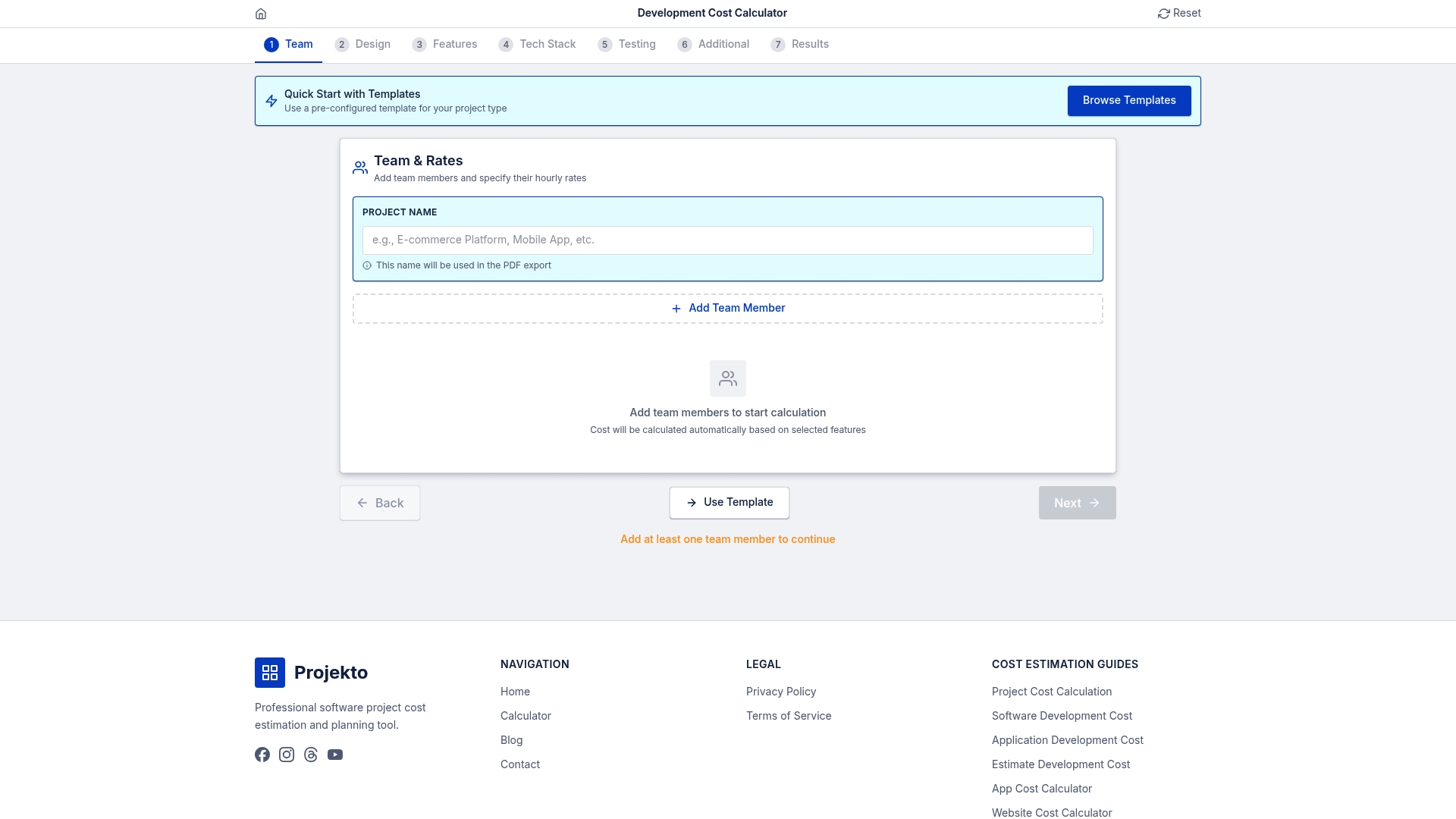
Estimate your project cost using Projecto's professional calculator, which is built specifically for web and mobile app development budgeting. Whether you are planning a navigation app or scoping a project management app, the calculator gives you a structured, transparent estimate grounded in current market rates. It covers all major cost drivers and phases, so you can walk into your next stakeholder meeting with numbers that hold up to scrutiny. Start with your MVP scope and build outward from there.
Frequently asked questions
What is the most accurate budget estimation method for web and mobile apps?
Bottom-up estimation is typically the most accurate because it aggregates task-level effort across the entire project, but hybrid approaches combining top-down feasibility checks with bottom-up detail are often the most practical for complex app projects.
How much contingency should I add to my app budget estimate?
Plan to add 15 to 20% contingency to your total estimate to cover unknown risks, scope adjustments, and technical complexity that surfaces during development.
What are typical cost ranges for developing an MVP app in 2026?
A simple MVP app typically costs between $10,000 and $60,000 and takes six to ten weeks to complete, depending on the platform and core feature set.
How can I avoid major estimation mistakes?
Define and lock scope before estimating, involve technical team members in task-level breakdowns, and track actual costs against your baseline at the end of every sprint or project phase.
What cost drivers should I watch for when estimating app budgets?
The primary app development cost drivers include platform choice, real-time feature requirements, third-party API integrations, and the complexity of custom UI design and backend architecture.