

Integration effort is one of the most consistently underestimated variables in software project planning. Business owners and project managers often treat third-party connections as minor line items, only to discover mid-project that API inconsistencies, error handling requirements, and undocumented edge cases have consumed weeks of additional engineering time. According to industry research, edge cases and API issues can double or triple integration effort, with some practitioners citing a rule of thumb that integrations take three times the worst-case estimate. Understanding why this happens, and how to prevent it, is essential for any team building web or mobile applications.
Table of Contents
- Why integration effort is underestimated
- The real drivers of integration complexity
- Comparing approaches: Custom build vs platform solutions (iPaaS))
- Best practices for accurate integration effort estimation
- Estimate your integration effort before it estimates you
- Frequently asked questions
Key Takeaways
| Point | Details |
|---|---|
| Expect the unexpected | Integration projects almost always require more time and cost than initial estimates suggest. |
| Know your options | Choosing between custom and platform-based integrations affects both your cost and ability to adapt in the future. |
| Budget for change | A contingency of 20-30 percent prepares your project for the inevitable surprises of integration work. |
| Prioritize robust design | Invest upfront in architecture, error handling, and observability to prevent cascading failures and overruns. |
| Make effort visible | Accurate estimation helps you align technical work with business goals and stakeholder expectations. |
Why integration effort is underestimated
The gap between estimated and actual integration effort is not a matter of careless planning. It reflects structural challenges that affect even experienced development teams. The most common root causes include incomplete or outdated API documentation, third-party platform variability, unexpected rate limits, and the compounding cost of error handling and retry logic. Each of these factors adds hours that rarely appear in initial scoping sessions.
Research confirms the scale of this problem. Integration effort is underestimated by 2x on the initial build and by as much as 5x on ongoing maintenance, largely because teams fail to account for the full scope of unknowns at the outset. Similarly, underestimating third-party integrations and ignoring team velocity are consistently ranked among the leading pitfalls in software development effort estimation.
The consequences extend well beyond a single sprint. Budget overruns delay feature releases, strain vendor relationships, and in some cases force teams to cut scope on core functionality to compensate. The following factors are the most frequent contributors to integration underestimation:
- Incomplete API documentation that omits edge cases or deprecated endpoints
- Changing third-party APIs that require rework after initial implementation
- Insufficient error handling and retry logic for failed requests
- Scope creep driven by business stakeholders adding integration requirements mid-project
- Maintenance overhead for monitoring, logging, and version updates
- Mobile-specific complexity including SDK updates and device-level permission handling
"The real cost of integration is not the initial build. It is the ongoing maintenance, monitoring, and rework that accumulates over months and years."
Pro Tip: When scoping any integration, ask your development team to document every known unknown, including rate limits, webhook reliability, and authentication edge cases, before finalizing the estimate. This single step can prevent the most common sources of overrun.
For a broader view of where estimation typically breaks down, the analysis of estimation pitfalls in software projects provides a useful reference for project managers building their estimation process.
The real drivers of integration complexity
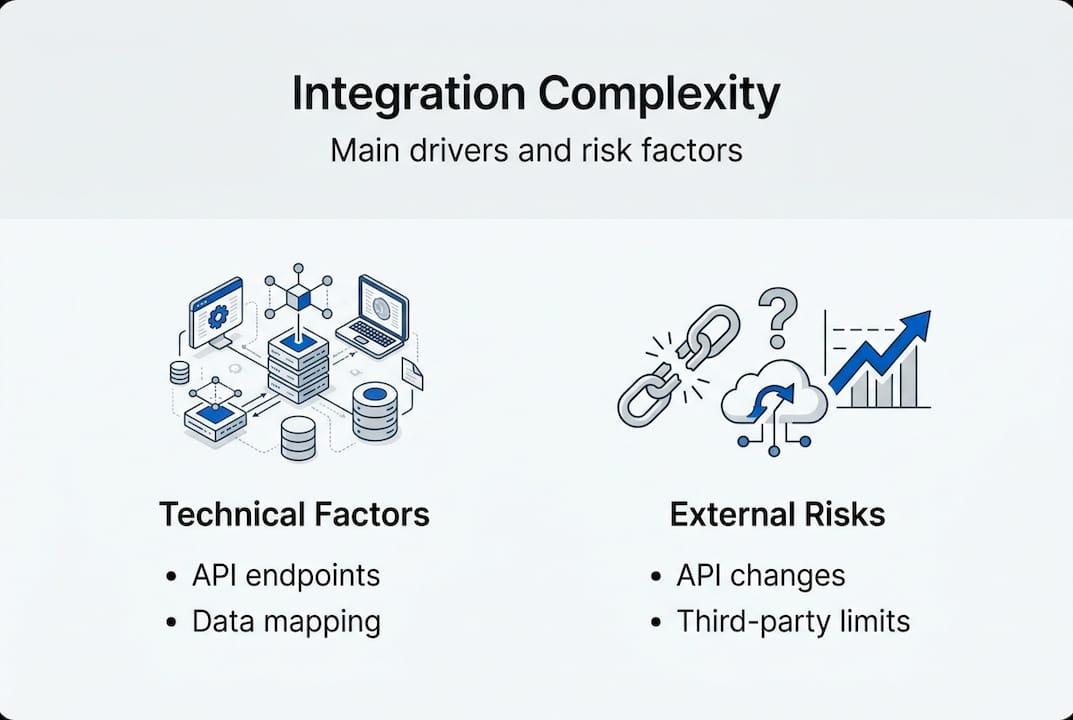
Not all integrations carry the same risk profile. The complexity of any given integration is determined by a combination of technical and business factors, many of which are not visible during initial scoping. Understanding these drivers allows teams to apply appropriate effort multipliers before committing to a timeline.
Empirical benchmarks illustrate the range clearly. Stripe and Salesforce integrations can cost between $50,000 and $75,000 for the initial build, with annual maintenance running $15,000 to $20,000, depending on the number of endpoints, real-time data requirements, and the degree of customization involved. On the timeline side, application integration projects commonly take 9 to 15 months to complete, with significant variance based on approach and complexity.

The table below summarizes the primary complexity drivers and their typical impact on effort:
| Complexity driver | Impact on effort | Notes |
|---|---|---|
| Number of API endpoints | High | Each endpoint requires mapping, testing, and error handling |
| Real-time data requirements | High | Requires persistent connections, webhooks, or polling logic |
| Custom business logic | Medium to high | Increases testing surface and maintenance burden |
| Third-party update frequency | Medium | Frequent API changes require ongoing rework |
| Observability and logging | Medium | Often underscoped but critical for production reliability |
| Mobile SDK dependencies | Medium to high | SDK updates can break functionality across device versions |
| Legacy system connectivity | High | Older systems often lack modern API standards |
Beyond the table, several factors deserve specific attention. External APIs introduce unpredictable risk because their update cycles are outside your control. A payment provider that deprecates an authentication method mid-project can invalidate weeks of completed work. For teams working on software sizing for accurate estimates, factoring in third-party volatility as a formal risk category is a practical step that most estimation frameworks overlook.
For a structured approach to estimating software development cost that accounts for integration complexity, breaking down each integration into discrete work units, including scoping, implementation, testing, and maintenance, produces more reliable figures than treating integration as a single line item.
Comparing approaches: Custom build vs platform solutions (iPaaS)
Once the complexity of an integration is understood, the next decision is how to execute it. Teams generally choose between building custom integration code in-house or using an integration platform as a service (iPaaS) such as MuleSoft, Zapier, or Workato. Each approach carries distinct implications for effort estimation, cost, and long-term maintainability.
Building in-house provides greater control over logic, data handling, and performance, but it also means the team owns all maintenance, monitoring, and upgrade work. iPaaS solutions reduce that burden but introduce dependency on a vendor's roadmap and pricing model. The total cost of ownership for any integration must account for both the initial build effort and the ongoing maintenance commitment, regardless of which approach is chosen.
The comparison table below outlines the key trade-offs:
| Factor | Custom build | iPaaS |
|---|---|---|
| Initial build effort | High | Low to medium |
| Ongoing maintenance | High | Low to medium |
| Flexibility and control | High | Medium |
| Speed to first deployment | Slow | Fast |
| Vendor dependency risk | None | Medium to high |
| Cost predictability | Variable | More predictable |
| Suitable for complex logic | Yes | Limited |
Pro Tip: If your integration involves highly specific business rules or sensitive data flows, a custom build is often the more defensible long-term choice despite the higher upfront effort. For standard use cases like CRM syncing or notification delivery, iPaaS typically delivers faster results at lower total cost.
When evaluating which path to take, consider the following steps:
- Map the integration requirements in detail, including data volume, transformation logic, and error handling needs.
- Assess team capability to build and maintain custom integration code over a 12 to 24 month horizon.
- Request vendor demos from at least two iPaaS providers to evaluate fit against your specific use case.
- Calculate total cost of ownership for both options over a three-year period, including licensing, engineering time, and incident response.
- Factor in scalability requirements, since iPaaS platforms can become cost-prohibitive at high transaction volumes.
For teams evaluating custom development pricing against platform costs, the three-year TCO comparison often reveals that iPaaS is more cost-effective for standard integrations, while custom builds pay off for high-volume or highly specialized workflows. Understanding SaaS pricing model types is also relevant when assessing the long-term cost of iPaaS licensing.
Best practices for accurate integration effort estimation
Accurate estimation is not a single event. It is an iterative process that improves as more information becomes available. The following steps provide a practical framework for business owners and project managers who need reliable integration estimates before committing resources.
- Define scope at the endpoint level. List every API endpoint, webhook, and data transformation required. Vague scope is the primary cause of underestimation.
- Break down each integration into phases. Separate scoping, implementation, testing, error handling, and maintenance into distinct effort buckets with individual estimates.
- Factor in edge cases explicitly. For each integration, identify at least three failure scenarios and estimate the effort to handle them gracefully.
- Apply a contingency bracket. A contingency buffer of 20 to 30% above the base estimate is essential for projects involving legacy systems or third-party APIs with variable reliability.
- Review team velocity against historical data. Past integration projects within your team provide the most reliable calibration data for future estimates.
- Plan for iterative refinement. Treat the initial estimate as a range, not a fixed number, and schedule formal re-estimation checkpoints at the end of each development phase.
Pro Tip: Never finalize an integration estimate without a technical spike, which is a short, time-boxed investigation where a developer actually connects to the target API and documents real-world behavior. This single practice eliminates the most common source of estimation error.
For teams that want to align their estimation process with business outcomes, the guide on scoping for estimation accuracy outlines how to connect technical scope decisions to project success metrics in a structured way.
Estimate your integration effort before it estimates you
Most integration overruns are not caused by poor engineering. They are caused by estimates that were never grounded in the actual complexity of the work. The frameworks and benchmarks covered in this article give you a starting point, but applying them consistently requires a structured tool.
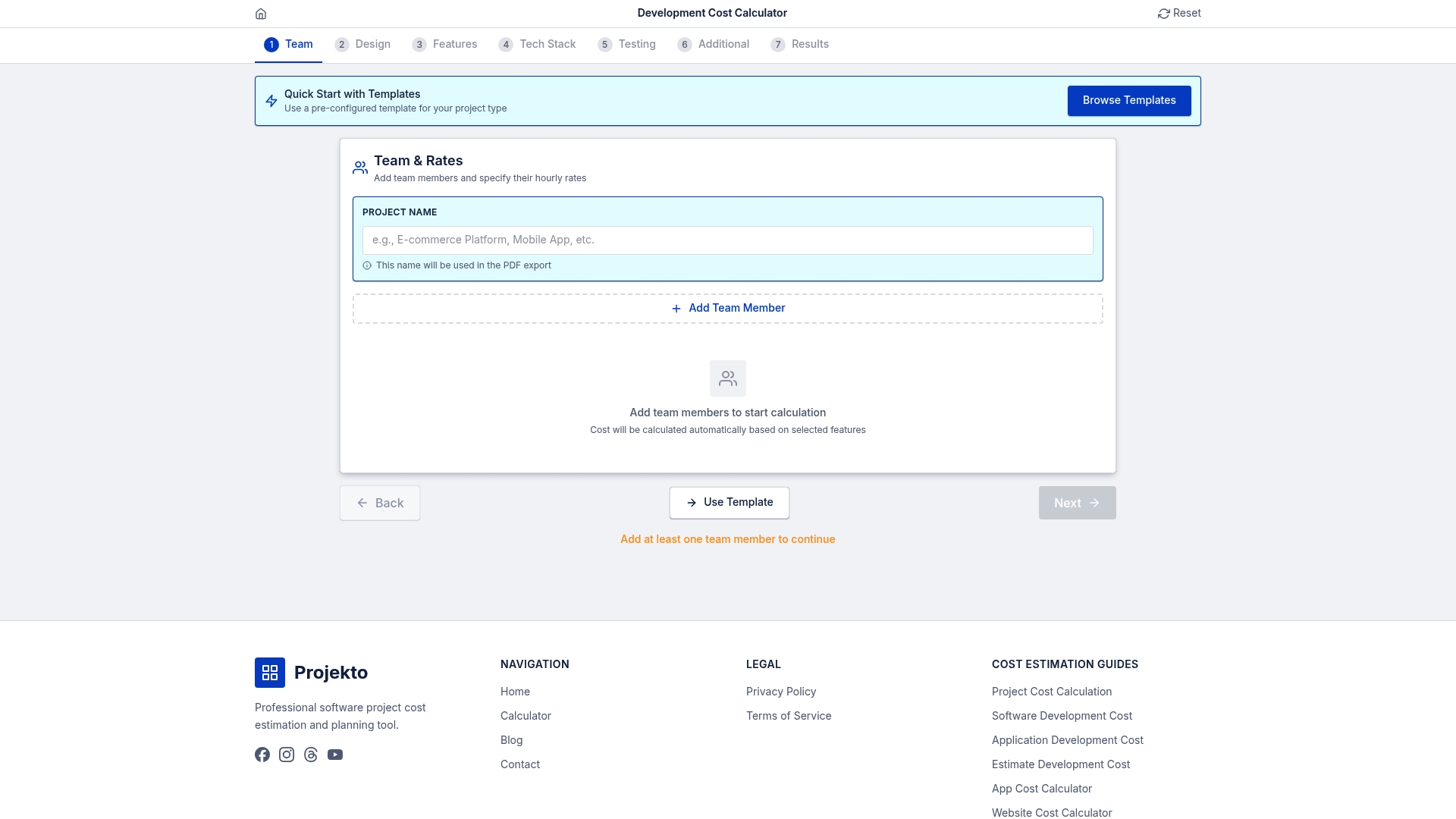
The Projecto Calculator is built specifically for business owners and project managers who need reliable time and budget estimates for web and mobile app development, including integration-heavy projects. Rather than relying on rough guesses or spreadsheet models, you can input your project parameters and receive structured estimates that account for integration complexity, team velocity, and contingency requirements. If you are planning a project that involves third-party APIs, payment systems, or data synchronization, using a purpose-built estimation tool is the most direct way to protect your budget and timeline from the start.
Frequently asked questions
What is integration effort in software projects?
Integration effort is the total work required to connect your applications, covering planning, coding, testing, and ongoing maintenance for each integration point.
Why does integration take longer than expected?
Webhooks, API changes, and undocumented features routinely cause 2x to 3x increases in effort, even for teams with prior integration experience.
How much contingency should I add for integration projects?
Add 20 to 30% above your base estimate to cover third-party risks, legacy system variability, and undocumented edge cases.
What makes integration more complex for mobile apps?
Mobile integrations require additional effort for SDK updates, privacy compliance, and real-time synchronization across device types and operating system versions.
Which approach minimizes integration maintenance effort?
iPaaS solutions usually require less maintenance than custom builds, but they introduce vendor dependency and may limit flexibility for complex or high-volume workflows.