

Over 70% of software projects fail to meet their original goals, and software failures cost billions annually across industries worldwide. For businesses and entrepreneurs planning web or mobile applications, that statistic is not abstract. It represents wasted budgets, missed market windows, and teams that spent months building the wrong thing. Software feasibility analysis is the structured process that separates projects with a realistic path to success from those that are likely to stall or collapse. This guide covers what feasibility means in practice, how to apply the TELOS framework, what the latest benchmark data reveals about project outcomes, and how to use modern tools to make faster, better-informed investment decisions.
Table of Contents
- Defining software feasibility: Core principles and why it matters
- TELOS framework: The five pillars of software feasibility
- Benchmarking feasibility: Project outcomes and risk reduction
- Applying feasibility insights: Practical steps for businesses and entrepreneurs
- Our perspective: What most guides miss about feasibility for tech projects
- Quickly estimate your software project feasibility
- Frequently asked questions
Key Takeaways
| Point | Details |
|---|---|
| High failure risk | Most software projects fail or are challenged, making feasibility studies essential for risk reduction. |
| TELOS framework | Assess technical, economic, legal, operational, and schedule feasibility before investing in any project. |
| Benchmark for success | Use real-world statistics to set expectations and prioritize projects that have higher odds of success. |
| Practical action steps | Small, MVP-led projects and modern tools like AI estimators deliver faster, smarter feasibility insights. |
Defining software feasibility: Core principles and why it matters
Software feasibility is a structured evaluation of whether a proposed software project can be successfully built, deployed, and sustained within the constraints of a specific business context. It is not a single question but a multi-dimensional assessment that examines technology, budget, legal compliance, organizational capacity, and time. The goal is to surface critical risks before a single line of code is written, when changes are still inexpensive.
Understanding software sizing basics is a foundational step in this process, because accurate scoping directly determines whether a feasibility study produces reliable cost and timeline estimates. Without a clear scope, even the most thorough feasibility report becomes speculative.
Why does this matter so much? Because software failure rates remain stubbornly high despite decades of improved tooling and methodology. Research consistently shows that only 30 to 35% of projects are fully delivered on time, on budget, and with the originally specified features. The rest are canceled, significantly scaled back, or delivered so late that the market opportunity has shifted.
The most common risk factors that feasibility studies are designed to catch include:
- Unclear or unstable requirements that expand scope without expanding budget
- Underestimated technical complexity, particularly around integrations and third-party APIs
- Regulatory and compliance gaps, especially in sectors like healthcare, finance, or data privacy
- Insufficient organizational capacity to support development, testing, and post-launch operations
- Unrealistic timelines driven by market pressure rather than engineering reality
A structured feasibility evaluation acts as a first line of defense against all of these failure modes. It forces stakeholders to confront hard questions early, align expectations across teams, and establish a documented baseline for decision-making.
"A feasibility study is not about proving a project is viable. It is about determining whether it is viable under your specific constraints, with your specific resources, and in your specific market context."
For entrepreneurs, this distinction matters. A feasibility study is not a formality to check off before funding. It is an active risk management tool that directly shapes whether your investment is sound.
TELOS framework: The five pillars of software feasibility
The TELOS framework is the industry-standard model for organizing a software feasibility study. TELOS stands for Technical, Economic, Legal, Operational, and Schedule. Each dimension addresses a distinct category of project risk, and together they provide a complete picture of whether a project should proceed.
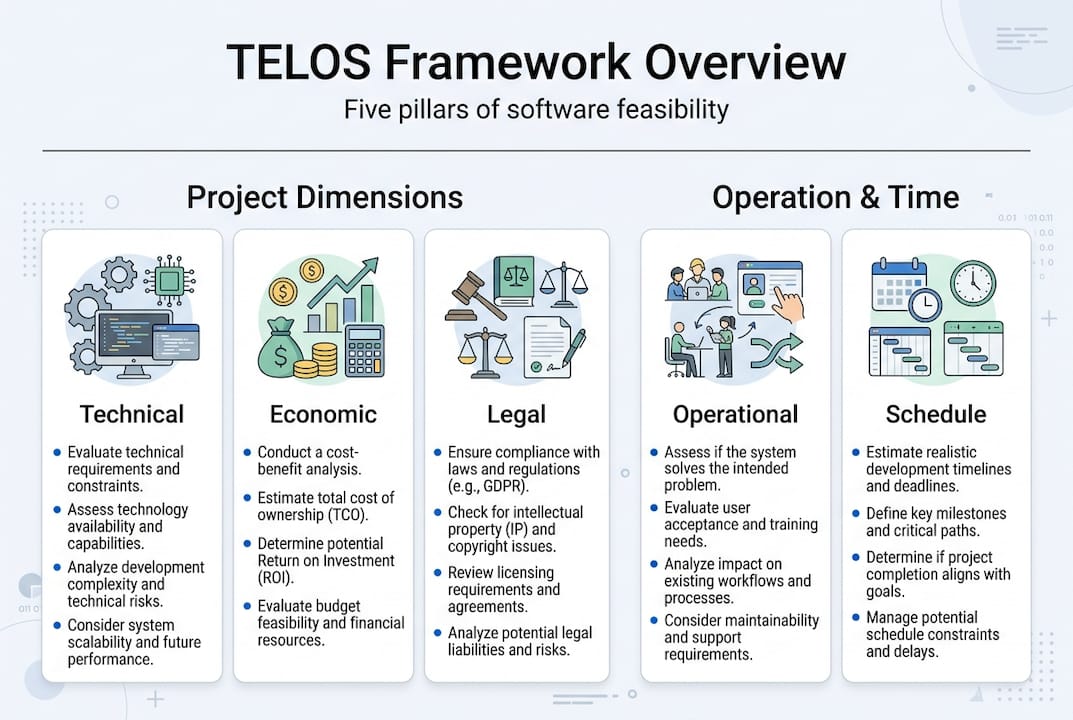
| TELOS dimension | Core question | Practical example |
|---|---|---|
| Technical | Can the technology support the requirements? | Evaluating whether your stack can handle real-time geospatial filtering at scale |
| Economic | Is the ROI justified given total cost? | Modeling development cost against projected revenue over 24 months |
| Legal | Are compliance requirements met? | Reviewing GDPR, HIPAA, or PCI-DSS obligations before architecture decisions |
| Operational | Does the organization have capacity to run it? | Assessing whether internal teams can support post-launch maintenance |
| Schedule | Can the timeline be realistically achieved? | Validating sprint velocity against a hard launch deadline |
For a detailed breakdown of feasibility costs across each dimension, it helps to model estimates early so that economic feasibility is grounded in real numbers rather than rough approximations.
Here is how to approach each TELOS pillar in sequence:
- Technical feasibility: Audit your proposed tech stack, identify integration points, and flag any unproven or high-risk components.
- Economic feasibility: Build a cost-benefit model that includes development, infrastructure, licensing, and ongoing support costs.
- Legal feasibility: Engage legal counsel to identify applicable regulations, especially for healthcare software feasibility or fintech applications where compliance costs are significant.
- Operational feasibility: Map the project against your team's current capacity, skill gaps, and support infrastructure.
- Schedule feasibility: Validate your timeline against historical velocity data or industry benchmarks, not optimistic projections.
Hybrid approaches are common for enterprise projects, combining formal TELOS analysis with agile discovery sprints to validate assumptions in parallel rather than sequentially.
Pro Tip: Most entrepreneurs skip the legal and operational dimensions because they feel less urgent than technical and economic questions. These two pillars are where projects most often encounter late-stage surprises. Conduct your TELOS feasibility in full, not selectively.
Benchmarking feasibility: Project outcomes and risk reduction
Feasibility studies are not just theoretical exercises. The data on project outcomes makes a strong empirical case for investing in them before committing to full development.

According to the Standish CHAOS 2023 report, only 30 to 37% of software projects are fully successful. The numbers get significantly worse as project size increases. Large enterprise projects fail or are significantly impaired at rates exceeding 60%.
| Project size | Full success rate | Partial success or failure |
|---|---|---|
| Small projects | ~55-60% | ~40-45% |
| Medium projects | ~35-40% | ~60-65% |
| Large projects | ~15-20% | ~80-85% |
Methodology also plays a major role. Agile projects outperform Waterfall in success rates across nearly every project size category, largely because iterative delivery creates natural checkpoints for reassessing feasibility assumptions as conditions change.
The cost of getting this wrong is substantial. Software project failures cost the global economy over $450 billion annually, a figure that includes direct development waste, lost revenue, and the opportunity cost of delayed market entry.
Feasibility studies reduce risk across specific failure categories:
- Cost overruns: Economic feasibility modeling surfaces budget gaps before they become crises
- Timeline slippage: Schedule feasibility benchmarking catches unrealistic deadlines early
- Legal exposure: Legal feasibility review prevents costly post-launch compliance retrofits
- Integration failures: Technical feasibility audits identify high-risk third-party dependencies
- Adoption failures: Operational feasibility checks ensure the organization can actually use what gets built
Understanding estimation pitfalls is directly relevant here, because many feasibility studies are undermined by the same cognitive biases that cause poor estimates: optimism bias, scope creep, and anchoring to initial assumptions.
The practical implication is clear. Businesses that invest in structured feasibility analysis before committing to full development are statistically more likely to deliver projects that meet their original objectives, within budget and on schedule.
Applying feasibility insights: Practical steps for businesses and entrepreneurs
Translating feasibility theory into action requires a structured process that fits the realities of how software businesses actually operate. Here is a practical sequence for conducting or commissioning a feasibility study for a web or mobile application.
- Define requirements and scope: Document functional requirements, user personas, and integration dependencies before any cost or timeline estimates are generated. Vague scope produces unreliable feasibility outputs.
- Map against TELOS dimensions: Systematically evaluate each pillar using the framework above. Assign owners for technical, legal, and operational assessments so that each dimension gets genuine expert attention.
- Build a cost-benefit model: Use real market data and estimation scope tips to construct a model that includes total cost of ownership, not just initial development spend.
- Run technical and legal checks in parallel: These two dimensions often have the longest lead times. Starting them simultaneously with economic modeling saves weeks in the overall feasibility timeline.
- Validate with estimator tools: Project estimators and AI estimator tools are increasingly capable of producing rapid cost and timeline benchmarks that support the economic and schedule dimensions of TELOS.
- Document findings and decision criteria: A feasibility study should produce a clear go, no-go, or conditional recommendation with documented assumptions so that the decision can be revisited as conditions change.
Small projects have higher success rates, and AI tools are emerging as practical aids for early-stage risk prediction, particularly for scope and cost estimation.
For startups specifically, pricing custom projects is one of the most common areas where feasibility studies add immediate, tangible value by preventing underbudgeted commitments.
Pro Tip: If a full feasibility study feels too resource-intensive for an early-stage idea, start with a constrained MVP scope. Smaller, well-defined projects not only have higher success rates but also generate real market feedback that makes subsequent feasibility assessments far more accurate.
Our perspective: What most guides miss about feasibility for tech projects
Most feasibility guides treat the process as a one-time gate before development begins. That framing misses something important about how software projects actually succeed or fail in practice.
For startups and early-stage ventures, a formal TELOS study completed before any market validation can produce a false sense of certainty. The market conditions, regulatory environment, and technical landscape that existed when the study was written may shift significantly within six months. Feasibility precedes business plans, but for startups, MVP-based market testing often surfaces risks that no desk research can anticipate.
The more durable approach combines a focused feasibility assessment with iterative validation loops. Run your TELOS analysis, but treat it as a living document rather than a final verdict. As estimation failures reveal, the assumptions that undermine projects most often are the ones that seemed most stable at the outset.
Legal feasibility is particularly underweighted in most startup contexts. Regulatory changes in data privacy, AI governance, and sector-specific compliance are accelerating. A project that passes legal feasibility in early 2026 may face materially different requirements by launch. Build ongoing legal review into your development process, not just your pre-development checklist.
Quickly estimate your software project feasibility
Understanding feasibility theory is valuable. Applying it to your specific project with real cost and timeline data is where decisions actually get made.
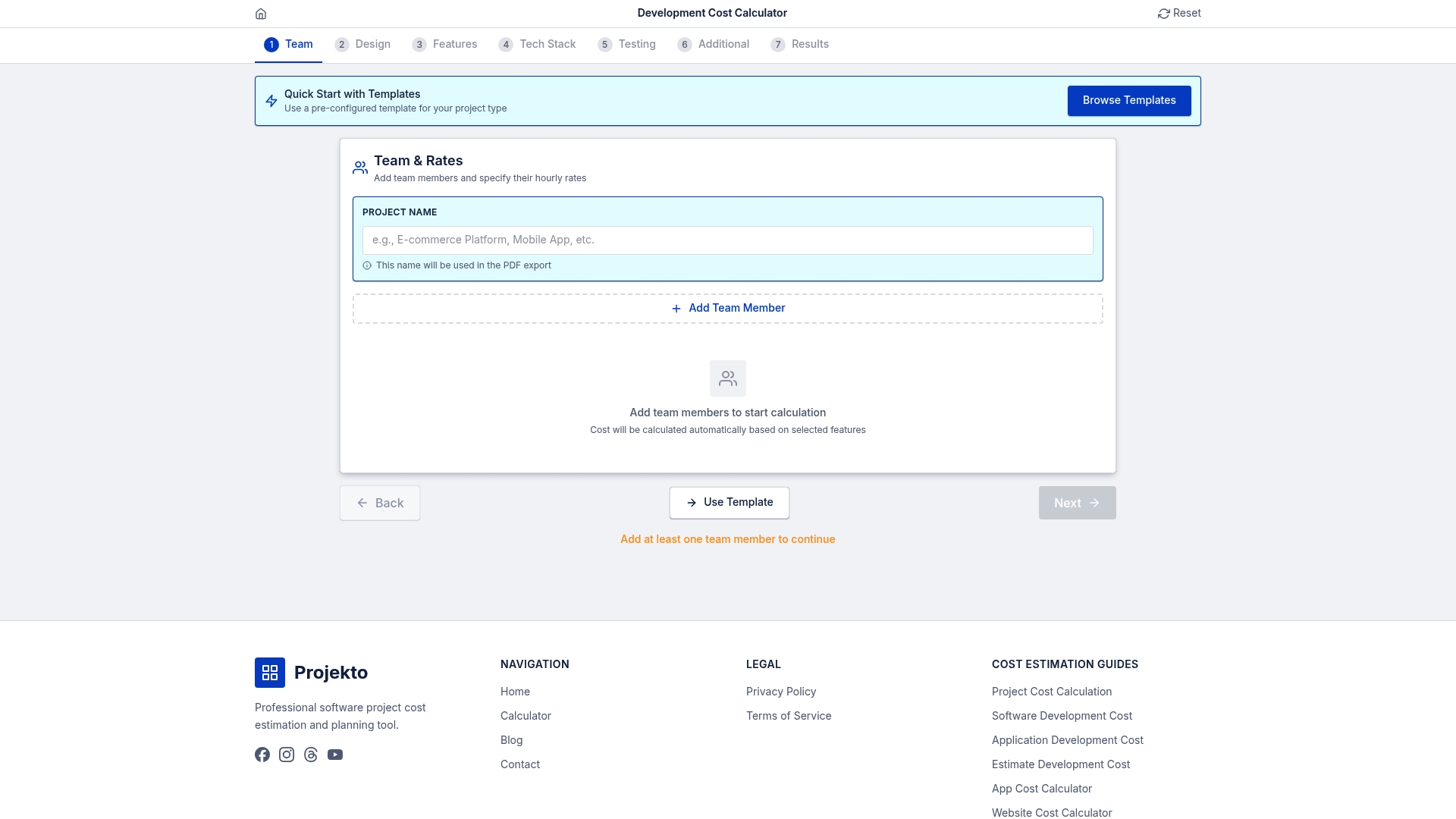
The development cost calculator at Projecto gives businesses and entrepreneurs an immediate, structured starting point for economic and schedule feasibility analysis. You can input your project parameters and receive detailed time and budget estimates that directly support the TELOS framework's economic and schedule dimensions. Whether you are evaluating a new web platform, a mobile application, or a complex integration project, the calculator provides the quantitative baseline your feasibility study needs to produce a reliable go or no-go recommendation.
Frequently asked questions
What are the main types of software feasibility?
The main types are technical, economic, legal, operational, and schedule feasibility, organized under the TELOS framework as the industry-standard model for structured project evaluation.
How does a feasibility study reduce project risk?
A feasibility study identifies risks and screens for issues before resources are committed, with early assessment consistently shown to prevent the costly failures that account for billions in annual losses.
Are feasibility studies necessary for small businesses and startups?
Yes, though startups may benefit from combining formal studies with rapid MVP validation; small projects succeed at significantly higher rates, making a focused feasibility check a high-return investment even for lean teams.
What is the average success rate for software projects?
Only 30 to 37% of projects are fully successful by standard measures, with large enterprise projects facing failure or significant impairment at rates exceeding 60%.
Which tools can help with software feasibility analysis?
AI tools for risk prediction and online cost calculators are the most practical options for supporting economic and schedule feasibility analysis for web and mobile applications.