

TL;DR:
- The software development lifecycle offers a structured, phase-based approach to improve project success.
- Choosing the right SDLC model depends on project stability, team experience, and risk tolerance.
- Early security integration and disciplined process application significantly reduce costs and failure rates.
Most businesses assume software development is a straight line from idea to launch. In practice, only 35% of software projects are considered fully successful by empirical benchmarks. The rest run over budget, miss deadlines, or fail to deliver what stakeholders actually needed. The software project lifecycle, formally known as the Software Development Life Cycle (SDLC), exists precisely to prevent those outcomes. It gives teams a structured, repeatable path from initial requirements through deployment and ongoing maintenance. This article breaks down each phase, compares the most widely used SDLC models, and offers practical guidance for project managers and businesses ready to build software that actually ships on time.
Table of Contents
- What is the software project lifecycle?
- Comparing popular SDLC models
- Standards, benchmarks, and security best practices
- Applying the lifecycle for project success
- A fresh perspective: What most guides miss about SDLC
- Estimate your project with confidence
- Frequently asked questions
Key Takeaways
| Point | Details |
|---|---|
| Phases structure projects | Following defined lifecycle phases helps teams plan, build, and deliver successful software. |
| Model selection matters | Choosing the right SDLC model (Waterfall, Agile, DevOps) impacts flexibility, speed, and outcome. |
| Integrate security early | Adding security at every stage significantly reduces software vulnerabilities. |
| Use benchmarks and standards | Adopting industry standards and learning from benchmarks drives higher project quality. |
| Adapt the process over time | Evolving your SDLC process with project realities leads to continuous improvement and success. |
What is the software project lifecycle?
The SDLC is, at its core, a structured framework for planning, creating, testing, deploying, and maintaining software applications. It replaces ad hoc development with a defined sequence of phases, each with clear objectives, deliverables, and quality gates. Without it, teams operate reactively, fixing problems that proper planning would have prevented.
The lifecycle typically moves through six phases:
| Phase | Main objective | Typical deliverables |
|---|---|---|
| Requirements gathering | Capture stakeholder needs | Business requirements document, user stories |
| Design | Architect the solution | System architecture, UI wireframes, data models |
| Implementation | Write and integrate code | Working software modules, version-controlled codebase |
| Testing | Validate quality and functionality | Test reports, defect logs, QA sign-off |
| Deployment | Release to production | Live application, deployment runbook |
| Maintenance | Monitor and improve post-launch | Patch releases, performance reports, update logs |
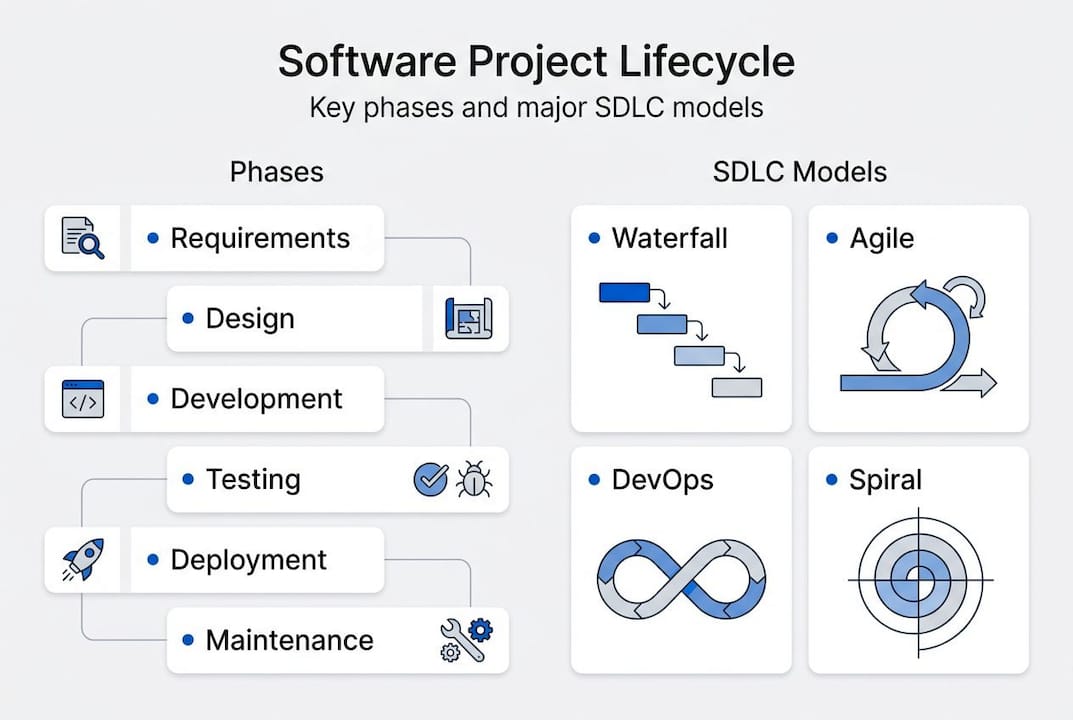
Each phase feeds directly into the next. Skipping or compressing any one of them is where projects begin to unravel. Poorly defined requirements, for instance, cascade into design flaws that multiply testing costs downstream.
Teams that commit to a defined lifecycle gain several concrete advantages:
- Stakeholder alignment: Everyone from the product owner to the QA lead understands what is being built and when.
- Predictable development cost estimation: Defined phases make it far easier to scope work and assign realistic budgets.
- Risk visibility: Issues surface at the phase level rather than at launch, when they are most expensive to fix.
- Audit readiness: Documented deliverables at each phase satisfy regulatory and compliance requirements.
- Team accountability: Clear phase ownership reduces ambiguity about who is responsible for what.
The 35% project success rate is not a failure of talent. It is largely a failure of process. When teams skip requirements validation or rush design to hit an arbitrary deadline, they create technical debt that compounds through every subsequent phase. The SDLC is the mechanism that keeps that debt manageable.
Comparing popular SDLC models
Understanding the phases is just the start. How you sequence and manage them depends entirely on the SDLC model you adopt. SDLC models include Waterfall, Agile, DevOps, Spiral, and V-Model, each built for different project conditions and risk profiles.

| Model | Best for | Key advantage | Main limitation | |---|---|---| | Waterfall | Stable, well-defined requirements | Simple to manage and document | Inflexible to change mid-project | | Agile | Evolving requirements, fast feedback | Rapid iteration, high adaptability | Requires strong team discipline | | DevOps | Continuous delivery environments | Faster release cycles, tight feedback loops | High tooling and culture investment | | Spiral | High-risk, large-scale projects | Risk-driven planning at each loop | Complex to manage and costly | | V-Model | Safety-critical systems | Parallel testing reduces defect escape | Rigid like Waterfall, limited flexibility |
Selecting the wrong model is one of the most common and costly mistakes in software project management. A startup building a consumer app under shifting market conditions will suffer under Waterfall. A government agency building regulated infrastructure will struggle with pure Agile. Choosing the right SDLC requires honest assessment of your project's variables before a single line of code is written.
Here is a practical process for making that decision:
- Assess requirements stability. If your requirements are fixed and well-documented, Waterfall or V-Model may be appropriate. If they are likely to shift, Agile or DevOps is the safer choice.
- Evaluate your team's experience. Agile requires self-organizing teams and experienced scrum masters. If your team is newer, a more structured model reduces coordination overhead.
- Define your release cadence. Projects requiring monthly or continuous releases need DevOps pipelines. Projects with a single major release can work within Waterfall's sequential structure.
- Quantify your risk tolerance. High-stakes projects with significant unknowns benefit from Spiral's iterative risk analysis at each phase loop.
- Consider regulatory requirements. Compliance-heavy domains often mandate documentation standards that align better with Waterfall or V-Model deliverables.
Pro Tip: Do not treat model selection as a one-time decision. Many successful teams run Agile sprints within a broader Waterfall program structure, combining the flexibility of iteration with the predictability of milestone-based delivery.
Standards, benchmarks, and security best practices
Proven standards and real-world benchmarks give your SDLC decisions an empirical foundation rather than relying on intuition alone. ISO/IEC 12207, IEEE 15288, and NIST SP 800-64 are the three most widely referenced frameworks for structuring software lifecycle processes and embedding security from the start.
These standards matter because they define what "good" looks like across each phase, giving teams a reference point for process audits and continuous improvement. ISO/IEC 12207 covers the full software lifecycle from acquisition through retirement. IEEE 15288 addresses system-level engineering processes. NIST SP 800-64 specifically targets security integration throughout the SDLC.
On the benchmarking side, the Standish CHAOS Report remains the most cited source for project outcome data. About 35% of projects succeed, with Agile projects consistently outperforming Waterfall in on-time and on-budget delivery. That gap is not coincidental. Agile's short feedback cycles catch misalignment early, before it becomes a budget crisis.
Key security and quality practices to integrate across your lifecycle:
- Threat modeling in the design phase: Identify attack surfaces before architecture is finalized.
- Static code analysis during implementation: Automated tools catch vulnerabilities at commit time, not at audit time.
- Penetration testing before deployment: Simulate real-world attacks on a staging environment.
- Security regression testing in maintenance: Ensure patches do not introduce new vulnerabilities.
Integrating security early rather than treating it as a final-phase checklist can reduce vulnerabilities by up to 40%. Teams that wait until testing to address security issues face exponentially higher remediation costs. Understanding why estimation fails often comes back to this exact problem: security and compliance work is underestimated because it was not scoped during requirements.
Pro Tip: Use CHAOS Report benchmarks to make the business case for process investment. When stakeholders push back on SDLC rigor, showing that structured projects succeed at nearly three times the rate of unstructured ones is a compelling data point.
The value of incorporating security early extends beyond vulnerability reduction. It also reduces the cost of compliance audits, shortens time-to-certification for regulated products, and builds customer trust in a market where data breaches are increasingly visible.
Applying the lifecycle for project success
Standards and benchmarks set the bar, but the real impact comes from applying the lifecycle end-to-end with discipline and adaptability. Project managers should select models by requirements stability, integrate security early, and review estimation scope at regular intervals throughout delivery.
Here is a practical sequence for applying SDLC principles from kickoff to post-launch:
- Define scope before selecting a model. Use a structured estimation scope guide to document functional and non-functional requirements before committing to a delivery approach.
- Choose your model based on the assessment criteria above. Document the rationale so stakeholders understand the tradeoffs being made.
- Establish phase gates. Each phase should have defined entry and exit criteria. A design phase does not close until architecture is reviewed and approved.
- Integrate security and quality from day one. Assign a security champion to the team and include security acceptance criteria in every user story or design document.
- Run structured project sizing steps at the start of each sprint or phase. Resizing scope mid-project is normal. Doing it without a process is how budgets collapse.
- Conduct retrospectives at phase boundaries. Not just at sprint ends. Ask what the phase revealed about requirements, risk, and team capacity.
- Document maintenance requirements before deployment. Support contracts, SLA commitments, and update cadences should be agreed upon before go-live, not after the first production incident.
The most common pitfalls are requirements ambiguity, scope creep without corresponding budget adjustment, and skipping retrospectives under deadline pressure. Each of these is avoidable with process discipline.
Pro Tip: Periodically review whether your chosen SDLC model is still the right fit. A project that started with stable requirements may encounter significant market changes mid-delivery. Switching from Waterfall to a hybrid Agile approach at a phase boundary is a legitimate and often necessary decision.
A fresh perspective: What most guides miss about SDLC
Most SDLC guides focus on phases, diagrams, and model comparisons. What they consistently underemphasize is the human and organizational friction that determines whether any model actually works in practice.
Requirements ambiguity is not a documentation problem. It is a communication problem. Stakeholders often cannot articulate what they need until they see what they do not want. No SDLC model eliminates that reality. The teams that succeed are those that build frequent validation checkpoints into their process, regardless of which model they have chosen.
Rigid adherence to a single model is also counterproductive. The most effective delivery teams we observe use hybrid approaches: Agile sprints within a Waterfall program structure, or Spiral risk loops feeding into a DevOps pipeline. The model is a tool, not a doctrine.
The overlooked estimation pitfalls almost always trace back to organizational dynamics: a product owner who cannot prioritize, a development team that does not push back on unrealistic timelines, or a project manager who treats the SDLC as a reporting framework rather than a delivery mechanism. The best SDLC is one that evolves with your team's actual capabilities and your project's real constraints, not the idealized version documented in a kickoff presentation.
Estimate your project with confidence
Understanding the software project lifecycle is only valuable if you can translate that knowledge into accurate planning. The Development Cost Calculator gives you a structured starting point for scoping your project across all SDLC phases, from initial requirements through deployment, with time and budget outputs grounded in real development benchmarks.
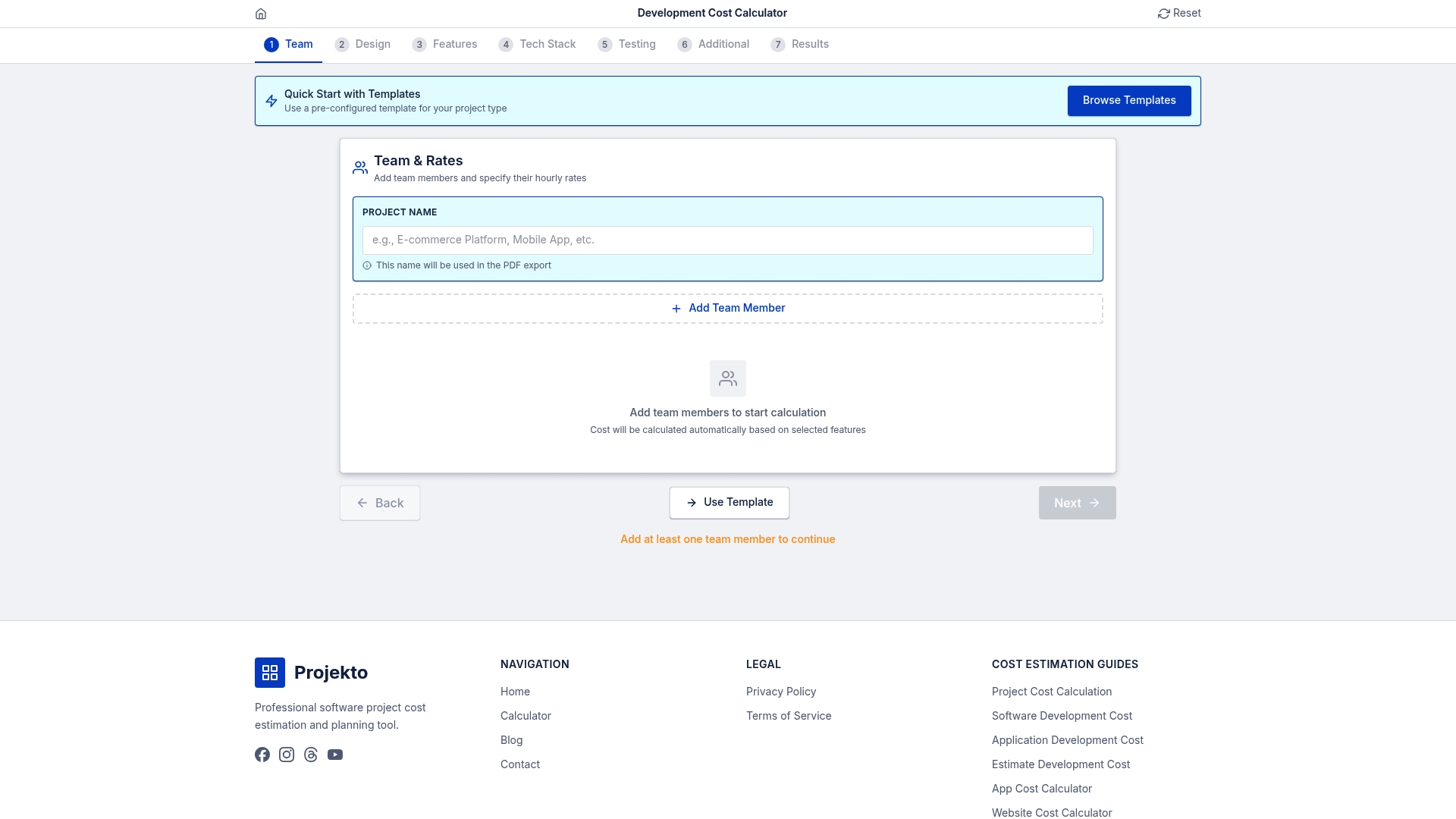
Poor estimation is one of the leading causes of project failure, and it almost always starts with an incomplete picture of scope. Use the calculator alongside our guide on how to estimate software development cost to build a defensible project plan before your first sprint begins. Accurate estimates do not just protect your budget. They build stakeholder confidence and create the conditions for a successful delivery.
Frequently asked questions
How many phases are in the software project lifecycle?
Most frameworks define six key phases: requirements gathering, design, development, testing, deployment, and maintenance. The SDLC phases cover planning through maintenance, though some models consolidate or rename individual stages.
Which SDLC model should I use for my project?
Choose Waterfall for stable, well-documented requirements, or Agile and DevOps for projects that need adaptability and frequent stakeholder feedback. The right model depends on project needs including risk tolerance, team experience, and release cadence.
How do standards like ISO/IEC 12207 affect SDLC?
They define best practices for structuring lifecycle processes, improving quality consistency and audit readiness across teams. Standards such as ISO/IEC 12207 provide a reference framework that teams can adapt to their specific delivery context.
How does early security integration benefit the lifecycle?
Integrating security from the design phase forward can cut vulnerabilities by up to 40% compared to addressing them late in the cycle. Early security integration also reduces compliance costs and shortens certification timelines for regulated products.